The Night That Left Him Limping
This sermon was preached at Sherwood Community Friends Church on Sunday, May 24. You can watch the video in full by clicking below.
In 1964, a twenty-two-year-old heavyweight boxer from Louisville, Kentucky stood in front of reporters and announced that he was done with a name.
"Cassius Clay is a slave name," he said. "I didn't choose it and I don't want it."
His new name — Muhammad Ali — meant something entirely different.
He was one of the greatest fighters who ever lived. But outside the ring, he had been wrestling with something far heavier than any opponent— the question of who he really was.

I think the question Ali was wrestling with is one of the most pressing questions every human being carries whether we name it or not.
Who are you? Not who your family says you are. Not who your worst moment says you are. Not who the label society presses onto you is. Who are you actually supposed to be? Most importantly, who does God say you are?
Today, we enter back into the Biblical story where Jacob has been living under a name his entire life. His given name in Hebrew — Ya'akov — means heel-grabber, deceiver, supplanter. He received it before he was even born, grabbing his twin brother Esau's heel coming out of the womb. It followed him through every scheme, every masquerade, every laborious year at his Uncle Laban's house, all the way to one particular moment on the bank of the Jabbok River where his name finally changes.
WHERE WE ARE IN THE STORY
If you're new today or have missed any weeks in our series, welcome and we're so glad you're here!
We're in a series called GENESIS: The Promise walking through the first book of the Bible, Genesis, and specifically looking at chapters 12 to 50.
The story opens as God calls one man out of obscurity — Abraham — to leave all that was familiar and comfortable, and makes a three-part covenant promise with him: I'll give you land, family, and blessing. God promised that through Abraham's offspring, all the nations of the earth will be blessed.
God gives Abraham a child he thought he would never be able to have and then his loyalty is put to the test.
God carries the covenant through Abraham's son Isaac and then to Isaac's son Jacob.
Last week we followed Jacob as he schemed to steal his father’s patriarchal blessing which gave him full authority over Isaac’s entire family and estate. He ran for his life from his brother Esau (whom he stole that blessing from), spent twenty years working at his Uncle Laban's house where he married two women, Leah and Rachel who bore him 12 sons (who later became the 12 tribes of Israel), and Jacob watched God bless him through all of his schemes and struggles. The covenant kept going — not because Jacob carried it well, but because God refused to let it go.
What we’ll discover as we look at Genesis chapters 32-36, this is when everything changes for Jacob. This is the night he stops running.
GENESIS 32: JACOB'S LAST NIGHT AS HIMSELF
As chapter 32 opens, we find Jacob heading home — finally, after twenty years — and he’s terrified because he got word the brother he cheated out of a blessing and a birthright is on his way to meet him with four hundred men.
God was bringing Jacob back to the covenant land, back to his covenant family of origin, to bring the covenant’s promise through him. But Jacob had fear of going back because of his prior behavior.
The past has a way of waiting for us on the road home doesn’t it?
And Jacob's past had sharp teeth.
The first thing that happens is extraordinary.
Genesis 32:1–2 CSB"Jacob went on his way [this was after he and Laban made their vow together to respectfully go their own way], and God's angels met him. When he saw them, Jacob said, 'This is God's camp.' So he named that place Mahanaim [meaning two camps]."
Do you remember Bethel from last week’s talk? That was the place where Jacob slept on a rock, had his stairway to heaven dream with angels going up and down, and God spoke the covenant over him.
Right after that, Jacob went to live with his Uncle Laban, and now twenty years have gone by. He’s returning to the land of his father Isaac and angels appear to him, again. This is intentional. This is a bookend in Jacob’s story. God is saying: I was there when you left. I am here as you return. I have not moved.
But old Jacob is still very much present. His response to the angels is not to worship God or surrender— it’s strategy.
He was like— yeah, yeah that was nice, but then he immediately sent messengers ahead to Esau with elaborate language calling himself Esau's servant. He counts out hundreds of animals and sends them as a buffer: goats, ewes, rams, camels, cows, bulls, donkeys.
Lions, tigers, and bears— oh my!!
Jacob knows what he’s doing. He sends all these animals with their herdsmen because it was a test to see if Esau would kill them. The man is playing chess while most people are playing checkers.
And then something shifts. Jacob prays sincerely.
Genesis 32:9-12 CSB“Then Jacob said, “God of my father Abraham and God of my father Isaac, the Lord who said to me, ‘Go back to your land and to your family, and I will cause you to prosper,’ I am unworthy of all the kindness and faithfulness you have shown your servant. Indeed, I crossed over the Jordan with my staff, and now I have become two camps. Please rescue me from my brother Esau, for I am afraid of him; otherwise, he may come and attack me, the mothers, and their children. You have said, ‘I will cause you to prosper, and I will make your offspring like the sand of the sea, too numerous to be counted.’”
This is the first genuine prayer we see Jacob make. It wasn’t a bargain or a transaction. He calls God by Name. He acknowledges his own unworthiness. He admits he’s afraid. It’s the first crack in the armor of self-sufficiency. It’s not a wide crack, but a crack with a little humility peaking out.
He sends everyone across the Jabbok River. And for the first time since Bethel twenty years prior, Jacob is completely alone.
THE NIGHT THAT LEFT HIM LIMPING
Genesis 32:24–26 CSB "Jacob was left alone, and a man wrestled with him until daybreak. When the man saw that he had not prevailed against Jacob, he struck his hip socket as they wrestled and dislocated his hip. Then he said to Jacob, 'Let me go, for it is daybreak.' But Jacob said, 'I will not let you go unless you bless me.'"
Now… We need to understand what’s actually happening here, because this passage is one of the most misread in all of Genesis. And the rest of my talk today is primarily focused on this, right here.
The mysterious figure is not trying to win this wrestling match. Think of him like a bouncer. He’s holding Jacob off from getting into the divine camp or moving forward again on his own— since that’s all he knew.
Jacob’s with this spiritual being and he desperately wants into the presence of God like he experienced before. He’s been pushing at that door his entire life— through schemes, through bargains, through self-reliance. And this figure's role is simply to hold him at the threshold until Jacob is ready to yield.
The spiritual figure’s inability to overcome Jacob is not physical inability. The narrator wants us to see that there’s something spiritual going on here and it’s intentional. The truth is, Jacob is not yet willing to yield his grip.
This is a conflict of his inner will, not his strength. It has always been a conflict of wills. The question to wrestle with here is not whether God is stronger than Jacob— of course he is, but rather when will Jacob finally stop fighting on his own terms?
Here’s when it happens… It’s only when the figure threatens to leave— only when Jacob is about to lose control of the encounter entirely— does Jacob finally release his agenda. The man who spent his entire life grabbing and grasping for blessings now grabs hold of the very presence of God and refuses to let go.
Can you imagine the desperation in him at this very moment? Tears welling in his eyes. Strength waning. He's exhausted. He's been running for so long. He's lost. He doesn't know who he is. He doesn't have a family who wants him and he's an expat with no land. He's at his end. He's no longer reaching to grab control. He's reaching out of desperation for God to stay and do something about his situation. He's grabbing— to let go.
Let’s sit with that for a moment.
But Jacob isn't giving up in despondence. He’s been wrestling in the dirt all night, hip dislocated, the sun is rising, and he’s refusing to let go because he knows something and he’s fiercely determined.
Jacob said, "I will not let you go unless you bless me (Genesis 32:26b)."
And precisely in that position—broken, staggering, clinging—he finally receives what he was always chasing.
Genesis 32:27–28 CSB The figure asks the question: "'What is your name?' he asked. 'Jacob,' he replied. 'Your name will no longer be Jacob,' he said. 'It will be Israel, because you have struggled with God and with men and have prevailed.'"
___ ___ ___
BIBLE STUDY SIDEBAR: In our previous teaching series, GENESIS: The Preface, we spent significant time on one of the most important truths in all of ancient literature: in the Biblical world, names are not just labels. Names are function and purpose. They give someone their identified role and purpose in God’s ordered system.
Names tell you what someone is for and what they do. When God names something, he is not simply putting a tag on it—he’s defining function, identity and calling. Jacob, by his parents, was named “heel-grabber, deceiver, supplanter” and this is who he has been. Israel is the one who has wrestled with God and this is who he would become.
___ ___ ___
God gave him a complete identity reconstruction. The same God who ordered and named light, who named the seas, who named humanity as his image-bearers had now renamed Jacob. And what he names, he defines. What he defines, he redeems. Amen?!
The chapter closes with this: Jacob limped from the Jabbok River because of his hip. For the rest of his life, every step Israel would take carried a reminder as proof he met God, God broke him, and he would never again be the same man who walked alone into that night. His limp meant identity and transformation. His limp was proof.
MY STORY
I want to shift for a moment from Jacob’s story to tell you something from within my own story because I think what we learn from Jacob’s Jabbok moment is a reality we could experience too.
I grew up in the Chicago suburbs in a household that looked Christian from the outside. We were at church every Sunday morning, Sunday night, and mid-week. Anytime there was church, we were there. We prayed before dinner. My mom played Christian music in the kitchen around the clock. My family looked the part. But I think for much of my childhood, we were merely Christian pew-sitters rather than people modeling Christ outside the building.
I experienced physical and emotional abuse. The church we attended told families that when their children were defiant, they should "beat the devil out of them." Let’s just say, I must have had a lot of “devil” in me.
Because of that, I grew up without a proper understanding of what a Christian really is or what a healthy family looked like. I craved attention and expressed it through anger and outbursts. I maintained a spiritually weak belief in Jesus, but I never surrendered my heart to him. I lived for myself.
Everything in my life, and every decision I made, had one purpose — self-interest. And that resulted in a lot of burnt bridges.
In my teens and twenties I searched for who I was, but looked in all the wrong places. I partied, was promiscuous, dabbled in recreational substances, and was addicted to pornography.
I was in this condition when I met Lisa in 2003. We married after just seven weeks of meeting each other. [I know, I know.] We thought it was going to be a love story of sunshine and rainbows. Joke was on us!
I barely knew her. I didn’t know myself. And I carried into our marriage every unresolved thing I had been running from— pride, selfishness, manipulation, anger, pornography, and other sexual sin.
I was always angry, verbally abusive, and emotionally withdrawn. I practiced what I knew. We nearly didn't make it.
Around 2013—about ten years into our marriage—God positioned a couple of Godly men in my life at exactly the right moment. These were men who had permission to get in my face and shake me in the right way.
Do you have someone in your life who you’ve given permission to do just that when you need it? I highly recommend it.
Through those men, God finally got my attention and I made the choice to stop running from him. For the first time in my life, I fully surrendered my heart and my will to God.
Now of course, he gives us the free will to resist him as long as we want. But when we choose to surrender our heart and our will to him, that’s when the transformation happens.
The anchor scripture he gave me was Romans 12:1–2 CSB"Therefore, brothers and sisters, in view of the mercies of God, I urge you to present your bodies as a living sacrifice, holy and pleasing to God; this is your true worship. Do not be conformed to this age, but be transformed by the renewing of your mind, so that you may discern what is the good, pleasing, and perfect will of God."
People say all the time, I wish I knew what God wants for me. This is how!
I meditated on that every day, and still do when I need it.
There’s no question in my mind that God truly worked a miracle in me and God definitely worked a miracle in our marriage. Because of Jesus, I am nothing like I once was. He’s still working in me every day because I continue to surrender and God continues to be faithful.
Mine is not a story of self-improvement or bragging that I’ve arrived. No! I had my Jabbok moment. That was the night I stopped running and wrestling and let God break me into something useful and better than I ever was. That’s when I got my “limp” and some years later God gave me my new name. It’s why I no longer go by “Bob”, but by Robert instead. It’s a daily reminder that my name is attached to my Jabbok moment.
And, by nothing except God’s grace, I am standing here in front of you today because of it.
Maybe you know exactly what I'm talking about.
Maybe you’ve had your own Jabbok moment.
Maybe you’re in the middle of it right now and you cannot see the other side.
What Genesis 32 is telling us is you don’t have to have it resolved before God shows up. He was already there before Jacob stopped fighting. He was already there before I did. And he’s already there before you do too.
This is about surrender to God and transformation by God. The limp is the proof.
To see what that looks like, let’s return to the Biblical text for a glimpse back into Jacob’s life from the perspective of his new name and identity.
GENESIS 33: THE LIMP PROVED IT
Genesis chapter 33 is what transformation looks like from the outside.
Jacob limps toward his brother with four hundred men approaching. He bows seven times to the ground. He calls Esau "my lord" and himself "your servant."
Talk about humility right?! That wasn’t Jacob’s reputation at all.
The man who once stole a blessing from this guy through deception is now voluntarily taking the lowest position available.
Esau runs to him not with violence, but with tears. He throws his arms around his brother's neck and weeps. The anticipated catastrophe becomes unexpected grace because that’s just how God works.
Genesis 33:10 CSB Jacob said to Esau, “No, please! If I have found favor with you, take this gift from me. For indeed, I have seen your face, and it is like seeing God’s face, since you have accepted me."
Jacob, who just spent a night seeing God face to face, now sees the face of God in his brother's forgiveness. The reconciliation was not Jacob's strategy.
Remember, he tried to bribe his way into his brother’s favor by sending out waves of animals before him. Jacob didn’t maneuver his way out of this one.
He came forward limping, humble, bowing, and surrendering. God had already gone ahead and turned Esau's heart.
The reversal is now complete. Jacob, who grabbed his brother's blessing through deception, is now pressing gifts back into his hands. What he once schemed and took, he now returns. Talk about total transformation!
It’s not just a changed interior, but an outward change in the way of relating to the people you have wronged. That’s what Jacob did because of what God did within him.
GENESIS 34–36: THE COST OF DYSFUNCTION AND THE RETURN HOME
Now there’s one final part we need to talk about because it’s in the Bible and I’m not one who ever blazes past the strange, weird, or difficult passages.
And as a sidenote, if there are any parts of scripture that you’re wrestling with or that you think are strange, weird, or difficult, I would love to hear what those are. Please share that as a response on our Unfiltered poll. We’ll be considering all responses for our teaching series this summer.
This next one, however, is dark and the Biblical text does not look away.
We don’t have time to read it, so I’ll give you the synopsis, but I do encourage you to read it when you get home.
In chapter 34, Jacob's daughter Dinah is sexually assaulted. His sons Simeon and Levi respond with a brutal act of deception and revenge that resulted in them slaughtering an entire city of men. Jacob is horrified. His response, though, is revealing as he is deeply grieved, but his first concern is his own reputation and the danger this puts his family in. Even here, underneath the limp, the old Jacob is still visible.
You see, the sin stain of a lifetime of scheming doesn't stay contained. It bleeds into the next generation. And the Bible doesn’t soften it because the lesson here is the way we live always shapes the people coming after us.
But then Genesis 35 happens and we get to see God’s grace at work right after something heinous. The truth is, it’s never too late for God to do his work in our families. Amen?!
Genesis 35:1-3 CSB “God said to Jacob, “Get up! Go to Bethel and settle there. Build an altar there to the God who appeared to you when you fled from your brother Esau.”
So Jacob said to his family and all who were with him, “Get rid of the foreign gods that are among you. Purify yourselves and change your clothes. We must get up and go to Bethel. I will build an altar there to the God who answered me in my day of distress. He has been with me everywhere I have gone.”
Piercing through his pain, God calls Jacob back to the place where the stairway to heaven touched down. The place where the promise was first spoken over a scheming, sleeping, running man. And there, God renews the covenant, reaffirms his name as Israel, and speaks the promise one more time. The covenant is holding.
But then—and I realize we’re blitzing through Jacob’s highlight reel at a whirlwind pace—his cherished wife Rachel dies giving birth to his twelfth and youngest son Benjamin. She’s buried on the road to Bethlehem and a pillar was built to mark her tomb. This is an anchor in the land promised by God in his covenant to Abraham, Isaac, and Jacob. God's plan is still moving forward.
Real quickly. Genesis 36 traces Esau's family line and their departure. Two brothers going two directions. God’s covenant moves through Jacob—through Israel—and forward.
THE COMMAND TO PRAY
For several weeks now we have been weaving in one of the seven basic commands of Jesus as our tether between the Biblical text and how we actually live. The seven commands are: repent, be baptized, break bread, love, pray, give, and go.
This week, the command I chose is pray because I think we often misunderstand what prayer could be.
Jacob lived most of his life and his first genuine prayer (Genesis 32:9–12) is not impressive by any metric. It’s fragmented. He’s afraid. He’s a desperate man openly admitting he doesn’t have what it takes while still clutching for what he can.
But it’s also the first time in Jacob's entire story that he actually talks to God instead of bargaining with him or running ahead of him. He still wrestled with God, but it was the crack in the armor that opened the door to his Jabbok moment of surrender.
Jacob’s is an amazing story about God doing lots of cool things in his life journey. But that image of wrestling with God— being injured and then getting the blessing— it's such a potent image isn’t it?
Jacob literally wrestled with God. Who does that?!
All of us.
We wrestle with God when our grandparent dies before we think they’re supposed to.
When we watch children being exploited and wonder how God can allow it.
When we get passed over for the promotion we worked hard for and someone less qualified gets it.
When our spouse doesn't love us the way we long to be loved.
When you lose the baby you’ve tried so hard to have.
When the diagnosis comes back the wrong way.
When the job we wanted doesn’t want us.
When the relationship we poured everything into falls apart.
When your finances aren’t covering your monthly expenses and you don’t know how you’ll make it.
We all have a Jabbok. We’re all in that river at some point.
The difference between Jacob before and Jacob after is not that his flaws or obstacles disappeared. It's that Jacob stopped trying to outmaneuver them on his own. He prayed. He held on to God. He let himself be broken. And on the other side of the breaking, God gave him a new name.
Here’s the invitation for this week. Whatever you’re wrestling with— whatever river you’re standing in right now— name it and pray it.
In your prayer, name what is actually happening and pray for God to help you release the outcome.
Say something as simple as this: “God, I cannot carry this on my own. I am afraid. I need you. I don’t understand. Do what you said you would do. Take what I’m holding, what I’m reluctant to release, and help me surrender it to you.”
Jacob's prayer was not impressive. It was just honest. And God’s power in that was enough to change everything. It’s always enough to change everything.
You might be in a season right now that feels like you’re losing the wrestling match. You’re down on the ground. You cannot stand on your own strength.
What the Biblical text is telling us this morning is this: that might be exactly where God needs you to be. Not because he wants you broken for the sake of brokenness, but because on the other side of the breaking is a new name—a purpose, an identity, a calling—that you could not have received while you were still wrestling on your own terms.
BIG IDEA: God uses broken people when they surrender to him.
The limp is proof.
Let’s conclude with a short prayer from the early Church. It’s from Augustine, writing in the 4th century in his work called Confessions, a book about a man who spent years running from God before finally surrendering. He opens it with these words:
"You have made us for yourself, O Lord,
and our heart is restless,
until it rests in you."
Jacob's heart was restless for twenty years. It rested at Jabbok.
My heart was restless for almost 30 years. I had my Jabbok moment.
Where is your heart restless today?
Name it and Pray it.
Jesus said, “Come to me, all of you who are weary and burdened, and I will give you rest.” Matthew 11:28 CSB
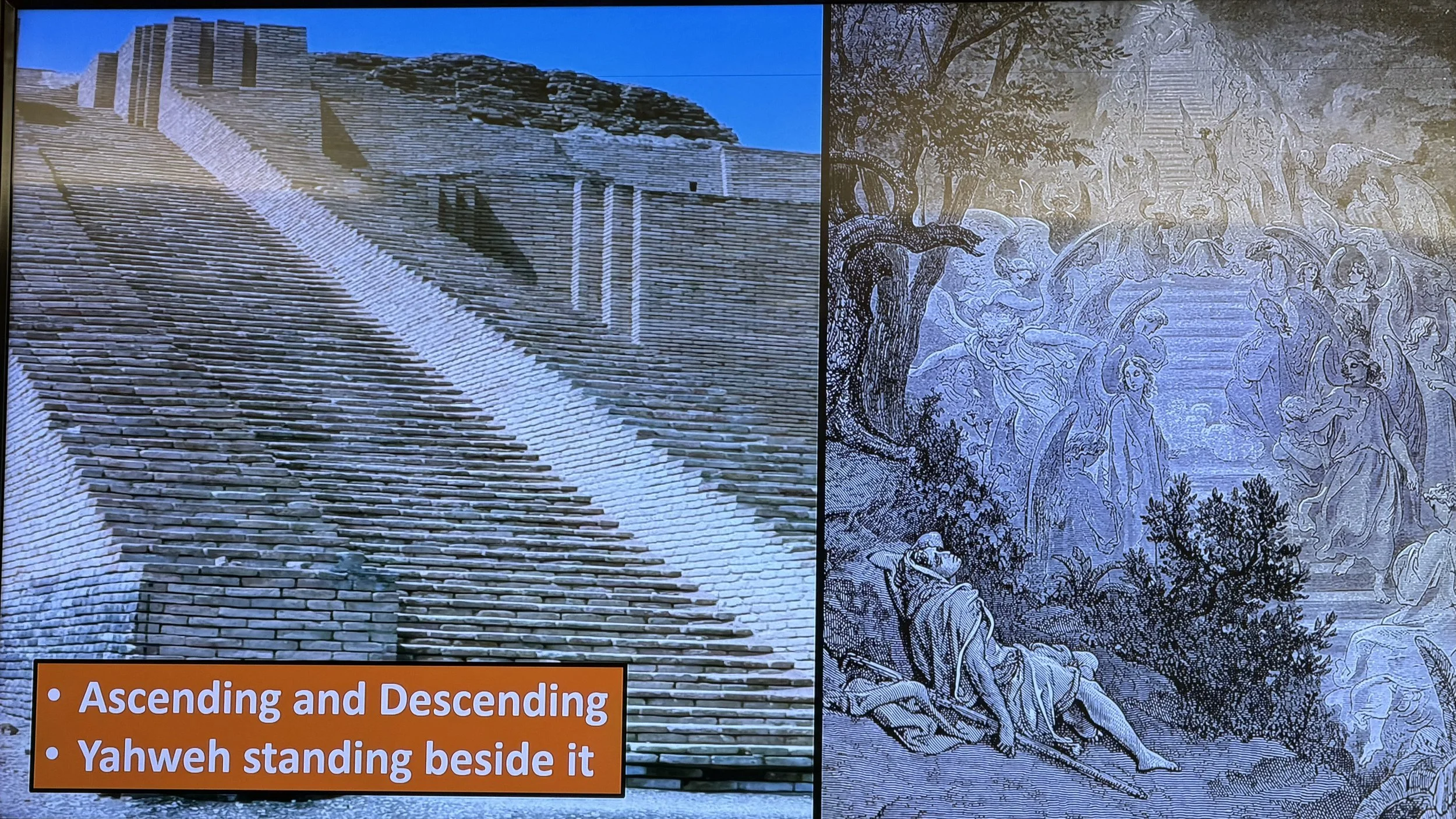
If I say the words "stairway to heaven," some of you already have a Jimmy Page guitar riff in your head. Led Zeppelin wrote one of the most iconic rock songs of the 20th century with that title, but they didn’t invent that image. They borrowed it, whether consciously or not, from Genesis 28. The ancient stairway between heaven and earth was in the Bible nearly two thousand years before Robert Plant belted out the lyrics to the song: "And she's buuuuyyyyyy-ing a staaaaiiiirway to heaven".
But Jacob didn’t have to buy it. God built it and set it right next to where he was sleeping.
Have you seen the Doctor Strange movies or read the comics? You know the scene where he opens a portal between worlds — those spinning rings of orange sparks that tear a doorway in the air between here and somewhere else? That’s probably more similar to what Jacob was seeing. A threshold. A tear in the veil of the physical realm opening into the spiritual. This was a place where two realms connected and movement between them became possible.
Jacob names the place Bet-El (Bethel) meaning the House of God.
Bethel. [Say it with me — Bethel.]
Bethel is the junction between the realm of heaven and the realm of earth. Sacred space. Not because the location was special. Because God showed up there and made it so.
While he was there, in that space, what did God say to Jacob?
“I am with you. I will not leave you.”
This is the same promise he gave Abraham. The same promise echoed to Isaac. Now God spoke it over a man who just narrowly pulled off the scheme of a lifetime and ran from his red, hairy brother after deceiving his blind father.
There is a palpable gravitas to God’s grace here; you can just feel it in your very soul.
Jacob hadn’t cleaned up his act, but God didn’t wait for a better version of Jacob before showing up. He came to him on the road. While he was running. Sunk so low, he slept on a rock.
Now watch what Jacob does next.
Genesis 28:20–22 CSB "Then Jacob made a vow: 'If God will be with me and watch over me during this journey I'm making, if he provides me with food to eat and clothing to wear, and if I return safely to my father's family, then the Lord will be my God. This stone that I have set up as a marker will be a house of God, and I will give to you a tenth of all that you give me.'"
Ummm… Are we reading this correctly?! Jacob presents an “if/then” scenario— to God?
God just made an unconditional promise. And Jacob responds by negotiating the terms.
And ten percent, Jacob?! Are you kidding me?!! You’re offering God ten percent on earnings that God is the source of. Bro! That’s not what we would call a strong opening bid.
And yet, God doesn’t walk. He didn’t retract his stairway as he ascended back up and closed the portal. He doesn’t pull the promise off the table because Jacob tried to scheme Yahweh by turning a grace encounter into a transaction.
Continuing his pattern of faithfulness, God is not distracted by the bargaining Jacob does — and yet still carries his grace through him. God’s grace keeps going. The promise keeps moving. The covenant carries through. Not because Jacob responded well. He obviously didn’t. It’s because God never breaks his word.
GENESIS 29-31: A DOSE OF HIS OWN MEDICINE
After Jacob's Bethel encounter with God, in the next scene, we see him arrive at his uncle Laban's house, immediately fall head over heels in love with Laban’s youngest daughter Rachel, and agrees to work seven years for her.
Remember, Jacob didn't have anything with him besides the clothes on his back because he ran away as fast as he could so Esau wouldn’t kill him. He didn't have a dowry to give as a betrothal gift to Laban for Rachel. Instead, he enslaved himself to Laban for seven years so he could marry her.
The text says those seven years felt like only moments because of his love for her. I think that’s one of the most tender lines in all of Scripture tucked neatly inside a story about a narcissistic schemer.
Seven years pass. The wedding night arrives. And in the morning, Jacob wakes up next to Leah, Laban’s older daughter.
The schemer got schemed!! Must run in the family huh?
Laban switched daughters in the dark of the wedding night. And his explanation was:
Genesis 29:26-27 CSB “It is not the custom in our country to give the younger daughter in marriage before the firstborn. Complete this week of wedding celebration, and we will also give you this younger one in return for working yet another seven years for me.”
Seems that Jacob is getting a dose of his own medicine.
The older before the younger.
Jacob had spent his entire life engineering that exact reversal in his favor within his own family. And now this same strategy and logic has been used against him. He who lived by deception now lived inside it.
The reversal in these chapters is precise to the point of being almost darkly funny. Jacob put on a masquerade to deceive his blind father in the dark; Laban ran a masquerade on Jacob in the dark. Jacob pilfered Esau's double-portion inheritance; Laban kept pilfering Jacob's labor and wages. Jacob sold Esau a bowl of stew; the text tells us Jacob’s own wives use food to negotiate access to his time in their beds. These chapters of Genesis are a long-running dark family soap opera comedy.
Twenty years later. You heard right. Jacob worked twenty years in Laban's house. He finally met someone craftier than himself, and God allowed every bit of it. Not as punishment, but as a life lesson for Jacob’s own development. God was teaching him about character, and it took twenty years of living in the mess he created to begin learning it.
And yet — through all twenty years of this — the Biblical text keeps quietly noting that God was blessing Jacob. His flocks multiplied. His family grew. Twelve sons were born in Laban's house to Jacob— who would become the future twelve tribes of Israel. God was doing something brilliant in the background while Jacob was trying to run every angle in the foreground.
After those twenty years…
Genesis 31:3 CSB "The Lord said to Jacob, 'Return to the land of your fathers and to your family, and I will be with you.'"
Same promise. Same God. Still holding.
In chapter 31 Jacob has yet to learn his lesson because we see him still scheming. He flees from Laban without telling him— taking his whole family and everything he owns. Rachel steals her father's household idols on the way out— which would be a direct jab at Laban’s identity and family culture. She lies about it. Nobody in this family has yet to fully learn to trust God to give what he has already promised. They’re all still gripping for control. Still running.
And God is still there.
Laban makes a covenant with Jacob and said:
Genesis 31:49b-50 CSB “May the Lord watch between you and me when we are out of each other’s sight. If you mistreat my daughters or take other wives, though no one is with us, understand that God will be a witness between you and me.”
This was about each of them not trusting one another, because they were both deceivers and manipulators, and couldn’t do anything to control each other while not being together so an agreement was made to protect one another’s interests.
Even with the obstacles to God’s covenant promise being favoritism, conflict, and character flaws, we see God is not in the short game. He’s in the long game.
Even though the resolution to these obstacles would be coming much later in the story, God provided for his chosen covenant family and preserved them.
Even though he was still scheming and still running, Jacob started moving in the right direction. He headed home.
THE GOD WHO MEETS YOU IN THE RUNNING
The purpose of Genesis chapters 27-31 is not to tell us Jacob’s story. It’s to continue telling us God's story. The narrator isn’t holding these characters up as models to emulate and we ought not refer to the characters as Bible heroes, because that’s not the intended purpose. The narrator is using them as vehicles to show us what God is like. The thread he wants our attention on is not their character. It’s God's.
And what does God's character look like in these chapters?
BIG IDEA: We see God is an obstacle-overcoming God.
He is not impeded by favoritism, conflict, character flaws, lies, bad decisions, broken families, decades of delay, swindlers, or runaway sons and daughters. God doesn’t need perfect people to carry his covenant. He needs people willing to be carried.
Now I want to make one final sweeping Bible connection with you, because the stairway to heaven imagery in Genesis 28 doesn’t end in the Old Testament. It bridges into the New Testament.
John 1:51 CSB Jesus said to his disciple Nathanael, "Truly I tell you, you will see heaven opened and the angels of God ascending and descending on the Son of Man."
Jesus is not pointing to a place. He is pointing to himself. He’s saying: I am Bethel. I am the sullam. I am the place where heaven and earth connect.
The junction between God and humanity is not a location you travel to or have to dream about. It is a person you surrender to and have a real relationship with, today.
Jacob slept on a rock and woke up to find God was already there. All of us in this room are somewhere on a road in the constant cycle of running from something, running toward something, working an angle, carrying something heavy. And the good news of the Gospel is that the God who came down the stairway to meet a scheming man in the wilderness is the same God in this room right now. We don’t have to arrive anywhere or have it resolved. The stairway has already come down.
And the stairway has a name. His name is Jesus.
APPLICATION:
For several weeks now we’ve been weaving in one of the seven basic commands of Jesus, extracted right out of the four Gospels, as our tether between the Biblical text and how we actually live. The seven commands are: repent, be baptized, break bread, love, pray, give, and go. I think the best one for us this week is the first one.
Repent.
The Greek word is metanoia — a change of mind, a turning, a complete reorientation of direction. [Meta-noia. Say it with me.]
It isn’t just feeling guilty. It’s recognizing the way you’re going isn’t the right way, so you turn around, face a different way and walk toward it.
Here’s what I want to say before we practice this together. Often we look at Bible characters like Jacob and try to find ourselves in them, as if the point is to see our reflection and get inspired, but that’s not what the Biblical author is trying to do. He’s not holding Jacob up as a model. He’s showing us what God does with a “Jacob”.
The thread he wants our attention on is this: what is God doing here despite who Jacob is?
God is using these characters to express his covenant plan working through them and into the world.
When we’re honest though — and I want us to be real honest this morning — we do find ourselves in Jacob whether we mean to or not.
Admittedly, I am Jacob. I am that man — a man with deep flaws who has the tendency to live in them more than I should, and who tries to bargain with God.
Does that resonate with you too?
God calls us to repent of that. By faith, let's repent of trying to do this without God and making it all about us. We don't need to bargain with God or compensate for our flaws. God’s grace is greater than all of that.
Here’s what I want you to hear clearly today. God won't come down on you because you’re not perfect or polished and still a mess. We’re all a mess to some degree. We all bargain with God from time to time and he’s not smiting us because of it, is he? God still moves forward with his plans— in my life, in your life, and in the world— because God is a God of grace. Our mess doesn’t scare him away. It’s most definitely not a deal breaker for him.
God uses the human losers. And he’s the winner in the process. That’s the point of all this.
What God actually does— and this is what makes the Gospel of God’s Kingdom so different from every other religion— is that he doesn't accomplish his plans and purposes despite us. He sure could. But he does it in partnership with us. We are the conduits of his covenant. We are his torchbearers.
You don't have to be ready. Jacob wasn't.
You don't have to be clean. Jacob wasn't.
You don't have to be finished. Jacob wasn't — not yet.
You just have to stop running.
We only need to repent and trust God to clean up the mess in us by the grace of the cross and his resurrecting power of his Holy Spirit.
Now I want to create some sacred space for us to practice repentance together. This is not a moment to rush through. This is a moment to actually do something.
I want to invite all of us into a few minutes of silent prayer. Bring before God the place where your grip is tighter than your trust. The bargain you are still holding. The thing you are running from. The version of yourself you are afraid of or ashamed of. Just name it. Silently. Honestly. Release it to God. Time to repent.
Just say this simple prayer to begin: “Lord Jesus Christ, Son of God, have mercy on me, a sinner.”
[SILENT PRAYER — allow 2-3 minutes]
And now I want us to do something that the Church has been doing together for a very long time. This prayer is from the Book of Common Prayer which is one of the oldest and most widely used collections of corporate liturgy in Christian history. Churches across denominations and centuries have stood together and said these words. We now have the opportunity to do the same.
Let’s read and pray it together:
Prayer of Confession
Most merciful God,
we confess that we have sinned against you
in thought, word, and deed,
by what we have done,
and by what we have left undone.
We have not loved you with our whole heart;
we have not loved our neighbors as ourselves.
We are truly sorry and we humbly repent.
For the sake of your Son Jesus Christ,
have mercy on us and forgive us;
that we may delight in your will,
and walk in your ways,
to the glory of your name. Amen.
If you found value in this, here are some additional articles for you.