Running From The Wrong Thing
This sermon was preached at Sherwood Community Friends Church on Sunday, May 17. You can watch the video in full by clicking below.
The 2008 Beijing Olympic torch relay stretched over 85,000 miles and 5 continents with 21,000 torchbearers over nearly four months. The mission was to move one sun ignited flame from its origin in Olympia, Greece, to the opening ceremony cauldron in Beijing, China. Simple in concept. Not in execution.

It hit Paris like a wall. Thousands of protesters flooded the route, objecting to China's treatment of Tibet. They breached security cordons, rushed the torchbearers, and made multiple attempts to extinguish the flame.

That's when Jin Jing, a young Chinese Paralympic athlete, came into the picture. She was an official torchbearer moving her wheelchair forward one rotation at a time when protesters swarmed her position and tried to rip the torch from her hands. She didn't break. She wrapped herself around the flame and held. The photographs went worldwide.

The flame moved through London and San Francisco experiencing the same opposition. Security tightened. Routes were cut short. At several points the entire relay came within reach of being scrubbed.

Did you know, every Olympic torch relay runs with a contingency built in from the start? A safety lantern is carried by the support team. Always present. Always burning the original flame from Olympia. No matter how many times the torch in front goes dark — by weather, mechanical failure, or the hands of opposition — the backup is always there and the mission always has a path forward.

The flame reached Beijing.
The cauldron was lit.
And the Games began.
The covenant God made with Abraham— repeated to his son Isaac, and, as we’ll see today, passed to Isaac’s son Jacob— is the most indestructible promise in the history of the world. Not because of the people who carried it. Not because of their discipline, their character, or how hard they shielded it with their bodies. It’s because of God who keeps it moving forward. He's the One who makes sure the fire reaches where he said it would go no matter how many times the torchbearers drop it, extinguish it, or run the wrong direction with it.
That's what Genesis chapters 27 through 31 is about. It’s also about a stairway to heaven, but not quite yet… we’ll get there.
Pray with me, and then let's open the Biblical text together.
WHERE WE ARE IN THE STORY
If you’re new today or have missed any weeks in our series, welcome and we’re glad you’re here!
We’re in a series called GENESIS: The Promise walking through Genesis chapters 12 to 50.
The story opens as God created and established order. Humanity disrupts it by choosing allegiance other than God to make a name for themselves rather than partner with him to steward his created world.
So God responds by scattering the nations, not in judgment, but in the movement of a covenant. God calls one man out of obscurity— Abraham— to leave all that was familiar and comfortable and makes a covenant with a three-part promise: I’ll give you land, family, and blessing. God promised that through Abraham’s offspring, all the nations of the earth— the same ones who turned their backs on him— will be blessed.
God gives Abraham a child he thought he would never be able to have and then his loyalty is put to the test.
God carries the covenant through Abraham’s son Isaac. And now, today, we’ll see the covenant pass to Isaac’s son Jacob. If Abraham was the founder and Isaac was the quiet inheritor, Jacob is something else entirely.
Jacob is a spicy schemer— the grabber and reacher for control. He’s the one who has been working the angles since before he was even born. And this morning we’re going to watch what God does with a person like that — because it’s refreshing to know that he’s still doing it with a person like you and a person like me.
GENESIS 27: THE BLESSING HE ALREADY HAD
Here’s the first thing we need to know about Jacob's story.
Before Jacob was born — while he and his twin brother Esau were still in their mother Rebekah's womb — God spoke.
Genesis 25:23 CSB "Two nations are in your womb, and two peoples from within you will be separated; one people will be stronger than the other, and the older will serve the younger."
Now this isn’t parenting advice or behavioral instruction for Isaac and Rebekah. This is a declaration about destiny — about what God is going to do. Jacob was chosen before he could do anything to earn it OR to ruin it. God’s covenant was always going to run through him.
And yet Jacob couldn’t wait for God to deliver what God had already promised.
Back in chapter 25, his brother Esau (the firstborn) traded Jacob a bowl of lentil stew for his birthright.
I want to pause and note that this is among the worst financial decisions in recorded human history. Esau surrendered his entire inheritance for soup. That was a rough day!
And now in chapter 27, Jacob and his mother Rebekah devise an elaborate scheme. Isaac is old, his eyes are dim, and before he dies he intends to give his patriarchal blessing to Esau. He didn’t care about the boys’ earlier arrangement.
But Jacob cared, so he and his mother hatched a plan. Jacob dresses in Esau's clothes, puts goatskins on his arms so he will feel hairy to his father's touch like Esau naturally was. Then Jacob blatantly lies to his father's face multiple times, and walks away with the blessing. Another rough day.
BIBLE STUDY SIDEBAR: There are actually two distinct blessings in play here, and we don’t want to collapse them into one. What Jacob stole from Isaac was the patriarchal blessing and the financial blessing of becoming the inheritor of Isaac’s full estate— this is known as the double portion of inheritance, which was the firstborn's right to become the family’s new patriarch. That’s for sure significant, but not God’s covenant blessing.
Isaac did not pass to Jacob the covenant blessing because God never put it in Isaac's hands to give. God was going to give it to Jacob directly. So this means Jacob's deception did not threaten the covenant. It was already coming to Jacob— just not yet.
The tragedy of Jacob's story is that he spent decades striving and grabbing and running to take hold of something God had already spoken over him before he was born. His grip was the problem. The promise never was.
The truth is, that’s not just Jacob's story. That might be yours too. But let’s keep going…
Genesis 27:41 CSB "Esau held a grudge against Jacob [I mean naturally right?! Do you blame him?] because of the blessing his father had given him. And Esau said to himself, 'The days of mourning for my father are approaching; then I will kill my brother Jacob.'"
So Jacob runs. And this is where the story takes a turn toward the extraordinary.
GENESIS 28: THE NIGHT GOD SHOWED UP
Jacob is on the run, alone on the road, probably for the first time in his life. Here he is, sleeping in the open wilderness with a stone for a pillow. I mean how low do you gotta go to have a rock under your head while you sleep? Jacob had his father’s blessing, legally owned his entire estate, and yet had left everything.
The scheme worked, but now his only companions are a rock, the dark, and the open sky.
And then God shows up.
Genesis 28:12–15 CSB "And [Jacob] dreamed: A stairway was set on the ground with its top reaching the sky, and God's angels were going up and down on it. The Lord was standing there beside him, saying, 'I am the Lord, the God of your father Abraham and the God of Isaac. I will give you and your offspring the land on which you are lying. Your offspring will be like the dust of the earth, and you will spread out toward the west, the east, the north, and the south. All the families of the earth will be blessed through you and your offspring. Look, I am with you and will watch over you wherever you go. I will bring you back to this land, for I will not leave you until I have done what I have promised you.'"
There it is!! God promised to carry the covenant through him.
But before we get to that… Ooo stairway to heaven!! You caught that right?! I’m sure you’ve got the Led Zeppelin song playing in our head, but let’s first talk about Jacob’s dream. We need to understand what a dream meant in the ancient world.
In our world, dreams are usually one of two things. Either we ate bad fish tacos the night before, or we’re processing something scary or haunting or traumatic.
We have all woken up from a dream confused and a little sweaty right?
But in the ancient world, dreams were just not neurological noise. They were understood as mechanisms of divine communication. Dreams were windows through which God spoke directly to human beings.
And here’s something that might surprise you: that hasn’t changed.
I have a missionary contact who works in Athens, Greece with Afghan Muslim refugees. He told me that he has never — not once — met a Muslim refugee who has not had a dream or vision in which they encountered God. He said he has experienced it multiple times where a Muslim walks into his center while the Jesus Film is playing, goes right up to one of the leaders, and says, "That’s the man I saw in my dream! He told me he is the Way, the Truth, and the Life. Would you please tell me more about him?"
God is still speaking in the night guys. He still shows up while people are running and to those who are ready to listen. Amen?!
Jacob was no different. He ran. He slept on a rock. And God opened the sky.
Now— the word used for "stairway" in this passage is one of the most unusual words in all of Scripture. The Hebrew is sullam. [Say it with me — sullam.]
It appears exactly one time in the entire Hebrew Bible. Just once. That’s right here in our Genesis 28:12 passage and it’s because the narrator is making a very specific, intentional choice.
Most Old Testament scholars believe this was not a ladder with rungs the way we might picture it or how artists have rendered it. This would have been a massive stone stairway — the kind that formed the entrance to a great ancient temple, a ziggurat. A sweeping architectural ramp between the earth and the courts of God’s throne room.
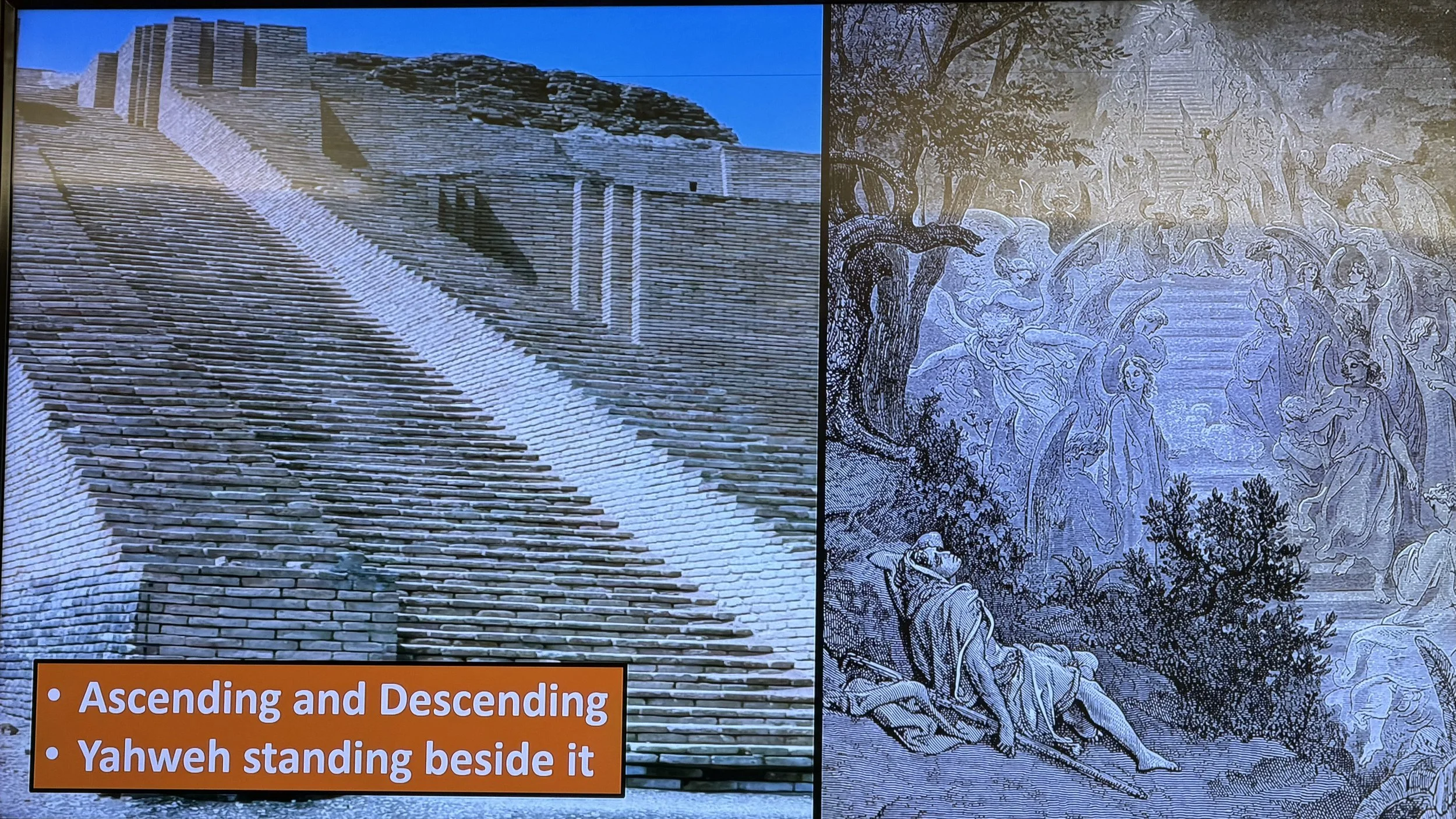
If I say the words "stairway to heaven," some of you already have a Jimmy Page guitar riff in your head. Led Zeppelin wrote one of the most iconic rock songs of the 20th century with that title, but they didn’t invent that image. They borrowed it, whether consciously or not, from Genesis 28. The ancient stairway between heaven and earth was in the Bible nearly two thousand years before Robert Plant belted out the lyrics to the song: "And she's buuuuyyyyyy-ing a staaaaiiiirway to heaven".
But Jacob didn’t have to buy it. God built it and set it right next to where he was sleeping.
Have you seen the Doctor Strange movies or read the comics? You know the scene where he opens a portal between worlds — those spinning rings of orange sparks that tear a doorway in the air between here and somewhere else? That’s probably more similar to what Jacob was seeing. A threshold. A tear in the veil of the physical realm opening into the spiritual. This was a place where two realms connected and movement between them became possible.
Jacob names the place Bet-El (Bethel) meaning the House of God.
Bethel. [Say it with me — Bethel.]
Bethel is the junction between the realm of heaven and the realm of earth. Sacred space. Not because the location was special. Because God showed up there and made it so.
While he was there, in that space, what did God say to Jacob?
“I am with you. I will not leave you.”
This is the same promise he gave Abraham. The same promise echoed to Isaac. Now God spoke it over a man who just narrowly pulled off the scheme of a lifetime and ran from his red, hairy brother after deceiving his blind father.
There is a palpable gravitas to God’s grace here; you can just feel it in your very soul.
Jacob hadn’t cleaned up his act, but God didn’t wait for a better version of Jacob before showing up. He came to him on the road. While he was running. Sunk so low, he slept on a rock.
Now watch what Jacob does next.
Genesis 28:20–22 CSB "Then Jacob made a vow: 'If God will be with me and watch over me during this journey I'm making, if he provides me with food to eat and clothing to wear, and if I return safely to my father's family, then the Lord will be my God. This stone that I have set up as a marker will be a house of God, and I will give to you a tenth of all that you give me.'"
Ummm… Are we reading this correctly?! Jacob presents an “if/then” scenario— to God?
God just made an unconditional promise. And Jacob responds by negotiating the terms.
And ten percent, Jacob?! Are you kidding me?!! You’re offering God ten percent on earnings that God is the source of. Bro! That’s not what we would call a strong opening bid.
And yet, God doesn’t walk. He didn’t retract his stairway as he ascended back up and closed the portal. He doesn’t pull the promise off the table because Jacob tried to scheme Yahweh by turning a grace encounter into a transaction.
Continuing his pattern of faithfulness, God is not distracted by the bargaining Jacob does — and yet still carries his grace through him. God’s grace keeps going. The promise keeps moving. The covenant carries through. Not because Jacob responded well. He obviously didn’t. It’s because God never breaks his word.
GENESIS 29-31: A DOSE OF HIS OWN MEDICINE
After Jacob's Bethel encounter with God, in the next scene, we see him arrive at his uncle Laban's house, immediately fall head over heels in love with Laban’s youngest daughter Rachel, and agrees to work seven years for her.
Remember, Jacob didn't have anything with him besides the clothes on his back because he ran away as fast as he could so Esau wouldn’t kill him. He didn't have a dowry to give as a betrothal gift to Laban for Rachel. Instead, he enslaved himself to Laban for seven years so he could marry her.
The text says those seven years felt like only moments because of his love for her. I think that’s one of the most tender lines in all of Scripture tucked neatly inside a story about a narcissistic schemer.
Seven years pass. The wedding night arrives. And in the morning, Jacob wakes up next to Leah, Laban’s older daughter.
The schemer got schemed!! Must run in the family huh?
Laban switched daughters in the dark of the wedding night. And his explanation was:
Genesis 29:26-27 CSB “It is not the custom in our country to give the younger daughter in marriage before the firstborn. Complete this week of wedding celebration, and we will also give you this younger one in return for working yet another seven years for me.”
Seems that Jacob is getting a dose of his own medicine.
The older before the younger.
Jacob had spent his entire life engineering that exact reversal in his favor within his own family. And now this same strategy and logic has been used against him. He who lived by deception now lived inside it.
The reversal in these chapters is precise to the point of being almost darkly funny. Jacob put on a masquerade to deceive his blind father in the dark; Laban ran a masquerade on Jacob in the dark. Jacob pilfered Esau's double-portion inheritance; Laban kept pilfering Jacob's labor and wages. Jacob sold Esau a bowl of stew; the text tells us Jacob’s own wives use food to negotiate access to his time in their beds. These chapters of Genesis are a long-running dark family soap opera comedy.
Twenty years later. You heard right. Jacob worked twenty years in Laban's house. He finally met someone craftier than himself, and God allowed every bit of it. Not as punishment, but as a life lesson for Jacob’s own development. God was teaching him about character, and it took twenty years of living in the mess he created to begin learning it.
And yet — through all twenty years of this — the Biblical text keeps quietly noting that God was blessing Jacob. His flocks multiplied. His family grew. Twelve sons were born in Laban's house to Jacob— who would become the future twelve tribes of Israel. God was doing something brilliant in the background while Jacob was trying to run every angle in the foreground.
After those twenty years…
Genesis 31:3 CSB "The Lord said to Jacob, 'Return to the land of your fathers and to your family, and I will be with you.'"
Same promise. Same God. Still holding.
In chapter 31 Jacob has yet to learn his lesson because we see him still scheming. He flees from Laban without telling him— taking his whole family and everything he owns. Rachel steals her father's household idols on the way out— which would be a direct jab at Laban’s identity and family culture. She lies about it. Nobody in this family has yet to fully learn to trust God to give what he has already promised. They’re all still gripping for control. Still running.
And God is still there.
Laban makes a covenant with Jacob and said:
Genesis 31:49b-50 CSB “May the Lord watch between you and me when we are out of each other’s sight. If you mistreat my daughters or take other wives, though no one is with us, understand that God will be a witness between you and me.”
This was about each of them not trusting one another, because they were both deceivers and manipulators, and couldn’t do anything to control each other while not being together so an agreement was made to protect one another’s interests.
Even with the obstacles to God’s covenant promise being favoritism, conflict, and character flaws, we see God is not in the short game. He’s in the long game.
Even though the resolution to these obstacles would be coming much later in the story, God provided for his chosen covenant family and preserved them.
Even though he was still scheming and still running, Jacob started moving in the right direction. He headed home.
THE GOD WHO MEETS YOU IN THE RUNNING
The purpose of Genesis chapters 27-31 is not to tell us Jacob’s story. It’s to continue telling us God's story. The narrator isn’t holding these characters up as models to emulate and we ought not refer to the characters as Bible heroes, because that’s not the intended purpose. The narrator is using them as vehicles to show us what God is like. The thread he wants our attention on is not their character. It’s God's.
And what does God's character look like in these chapters?
BIG IDEA: We see God is an obstacle-overcoming God.
He is not impeded by favoritism, conflict, character flaws, lies, bad decisions, broken families, decades of delay, swindlers, or runaway sons and daughters. God doesn’t need perfect people to carry his covenant. He needs people willing to be carried.
Now I want to make one final sweeping Bible connection with you, because the stairway to heaven imagery in Genesis 28 doesn’t end in the Old Testament. It bridges into the New Testament.
John 1:51 CSB Jesus said to his disciple Nathanael, "Truly I tell you, you will see heaven opened and the angels of God ascending and descending on the Son of Man."
Jesus is not pointing to a place. He is pointing to himself. He’s saying: I am Bethel. I am the sullam. I am the place where heaven and earth connect.
The junction between God and humanity is not a location you travel to or have to dream about. It is a person you surrender to and have a real relationship with, today.
Jacob slept on a rock and woke up to find God was already there. All of us in this room are somewhere on a road in the constant cycle of running from something, running toward something, working an angle, carrying something heavy. And the good news of the Gospel is that the God who came down the stairway to meet a scheming man in the wilderness is the same God in this room right now. We don’t have to arrive anywhere or have it resolved. The stairway has already come down.
And the stairway has a name. His name is Jesus.
APPLICATION:
For several weeks now we’ve been weaving in one of the seven basic commands of Jesus, extracted right out of the four Gospels, as our tether between the Biblical text and how we actually live. The seven commands are: repent, be baptized, break bread, love, pray, give, and go. I think the best one for us this week is the first one.
Repent.
The Greek word is metanoia — a change of mind, a turning, a complete reorientation of direction. [Meta-noia. Say it with me.]
It isn’t just feeling guilty. It’s recognizing the way you’re going isn’t the right way, so you turn around, face a different way and walk toward it.
Here’s what I want to say before we practice this together. Often we look at Bible characters like Jacob and try to find ourselves in them, as if the point is to see our reflection and get inspired, but that’s not what the Biblical author is trying to do. He’s not holding Jacob up as a model. He’s showing us what God does with a “Jacob”.
The thread he wants our attention on is this: what is God doing here despite who Jacob is?
God is using these characters to express his covenant plan working through them and into the world.
When we’re honest though — and I want us to be real honest this morning — we do find ourselves in Jacob whether we mean to or not.
Admittedly, I am Jacob. I am that man — a man with deep flaws who has the tendency to live in them more than I should, and who tries to bargain with God.
Does that resonate with you too?
God calls us to repent of that. By faith, let's repent of trying to do this without God and making it all about us. We don't need to bargain with God or compensate for our flaws. God’s grace is greater than all of that.
Here’s what I want you to hear clearly today. God won't come down on you because you’re not perfect or polished and still a mess. We’re all a mess to some degree. We all bargain with God from time to time and he’s not smiting us because of it, is he? God still moves forward with his plans— in my life, in your life, and in the world— because God is a God of grace. Our mess doesn’t scare him away. It’s most definitely not a deal breaker for him.
God uses the human losers. And he’s the winner in the process. That’s the point of all this.
What God actually does— and this is what makes the Gospel of God’s Kingdom so different from every other religion— is that he doesn't accomplish his plans and purposes despite us. He sure could. But he does it in partnership with us. We are the conduits of his covenant. We are his torchbearers.
You don't have to be ready. Jacob wasn't.
You don't have to be clean. Jacob wasn't.
You don't have to be finished. Jacob wasn't — not yet.
You just have to stop running.
We only need to repent and trust God to clean up the mess in us by the grace of the cross and his resurrecting power of his Holy Spirit.
Now I want to create some sacred space for us to practice repentance together. This is not a moment to rush through. This is a moment to actually do something.
I want to invite all of us into a few minutes of silent prayer. Bring before God the place where your grip is tighter than your trust. The bargain you are still holding. The thing you are running from. The version of yourself you are afraid of or ashamed of. Just name it. Silently. Honestly. Release it to God. Time to repent.
Just say this simple prayer to begin: “Lord Jesus Christ, Son of God, have mercy on me, a sinner.”
[SILENT PRAYER — allow 2-3 minutes]
And now I want us to do something that the Church has been doing together for a very long time. This prayer is from the Book of Common Prayer which is one of the oldest and most widely used collections of corporate liturgy in Christian history. Churches across denominations and centuries have stood together and said these words. We now have the opportunity to do the same.
Let’s read and pray it together:
Prayer of Confession
Most merciful God,
we confess that we have sinned against you
in thought, word, and deed,
by what we have done,
and by what we have left undone.
We have not loved you with our whole heart;
we have not loved our neighbors as ourselves.
We are truly sorry and we humbly repent.
For the sake of your Son Jesus Christ,
have mercy on us and forgive us;
that we may delight in your will,
and walk in your ways,
to the glory of your name. Amen.
If you found value in this, here are some additional articles for you.