The Name You’re Building
This sermon was preached at Sherwood Community Friends Church on Sunday, March 22. You can watch the video in full by clicking below.
What we’re going to see in Genesis chapters 10 and 11 today is that the impulse to build a name for ourselves is not modern. It is ancient to the core and woven so deeply into the fabric of the human story that it reaches its clearest, most organized expression in one of the earliest chapters of the Bible. In a single sentence, the Biblical narrator presents it as the honest confession of an entire civilization:
"Let us make a name for ourselves." (Genesis 11:4b)
That sentence is what this whole sermon is about. Not just what those ancient people were doing, but what it reveals about all of us today. And more than that — what God does in response. It’s not judgment, but something far better than any tower we could ever build.
This is the final sermon in our series. We’re going to walk the whole story arc one more time at a 30,000 ft overview, and then we’re going to land somewhere that I believe is going to feel, for some of you, like coming home.
THE STORY SO FAR
We’ve been in a teaching series called GENESIS: The Preface, and that title is intentional. Genesis chapters 1 through 11 are not meant to be read as a science textbook or a strict historical chronicle of human origins in the modern sense. Genesis is ancient Near Eastern theological literature, written to address the deepest questions any human being has ever carried.
Who is God?
Who are we?
What were we created for?
Why does the world feel so broken?
And is there any reason to believe it won't always be this way?
Genesis opens at the beginning. God speaks order into chaos. He forms a cosmos and then a world saturated with his presence. Then he makes humanity, not as his servants or as afterthoughts, but as the pinnacle of his creative work. Image bearers. Partners. Representatives of the One True God, charged with caring for everything he made, ruling it with the same wisdom and love he himself embodies. God’s original design is relationship, presence, and order. God dwelling with humanity on earth. It is, as Genesis 1 says, very good.
Then Genesis 3 happens. Adam and Eve stand before the tree of the knowledge of good and evil, and they make the defining choice of the human story. Rather than trusting God's wisdom, rather than living in reliance on him, they choose to determine for themselves what is good and what is evil. They choose autonomy. Trust was traded for control and the world changed in an instant. They are exiled from the garden, driven out from the sacred space where God walked with them. The vertical relationship between humanity and God fractured.
In chapter 4, that fracture moved horizontal. What broke between humans and God now breaks between people. Cain murders his brother, and the pattern of violence, allegiance to oneself, and pride begins its long, terrible march through human history.
Genesis 5 through 7 show us the corruption had become systemic. The narrator tells us the intentions of human hearts were only evil all the time, and that this deeply grieved God to his core. His created masterpiece had become something he barely recognized. The flood came as an act of re-creation serving as a costly act of pressing reset on a world so saturated with evil disorder that no other path forward remained.
We’re introduced to Noah, one man walking faithfully with God while everything around him unraveled. He’s carried through the chaos waters with his family on a life-saving ark.
Chapters 8 & 9 walked us through what happened when Noah and his family stepped off the ark. The first thing he does is build an altar. He worships God before he plans, before he works, before he does anything else. God responds with the Noahic covenant placing his bow in the clouds, the archer's weapon pointed upward and away from humanity cluing us in that God is for us.
But within the same passage, the darkness in the human heart reasserts itself. Noah gets drunk. His son Ham commits an egregious act of profound betrayal against his own family. The curse of his offspring Canaan follows. The pattern of human evil continues. The flood reset the world, but it didn't reset the human heart.
Which brings us now to Genesis chapters 10 and 11. Two chapters that are easy to skim past. One is a genealogical table full of ancient names. The other is a strange story about a tower. But together they are the capstone of the entire preface. It’s the moment the vertical and horizontal wound reaches its most organized and most revealing expression. And it’s the moment God responds with a counter-move that sets the rest of the Bible in motion.
THE TABLE AND THE TOWER
Genesis 10:1 CSB "These are the family records of Noah’s sons, Shem, Ham, and Japheth. They also had sons after the flood."
What follows across this chapter is what scholars call the Table of Nations. It’s a genealogical account of the descendants of Noah's three sons spreading across the known world. Seventy nations in total.
That number is not random. Remember, in ancient Hebrew thought, seven or a derivative, in this case seventy, was the number of totality and completeness. These seventy nations represent the whole of the Gentile world as the ancient Israelite audience would have understood it.
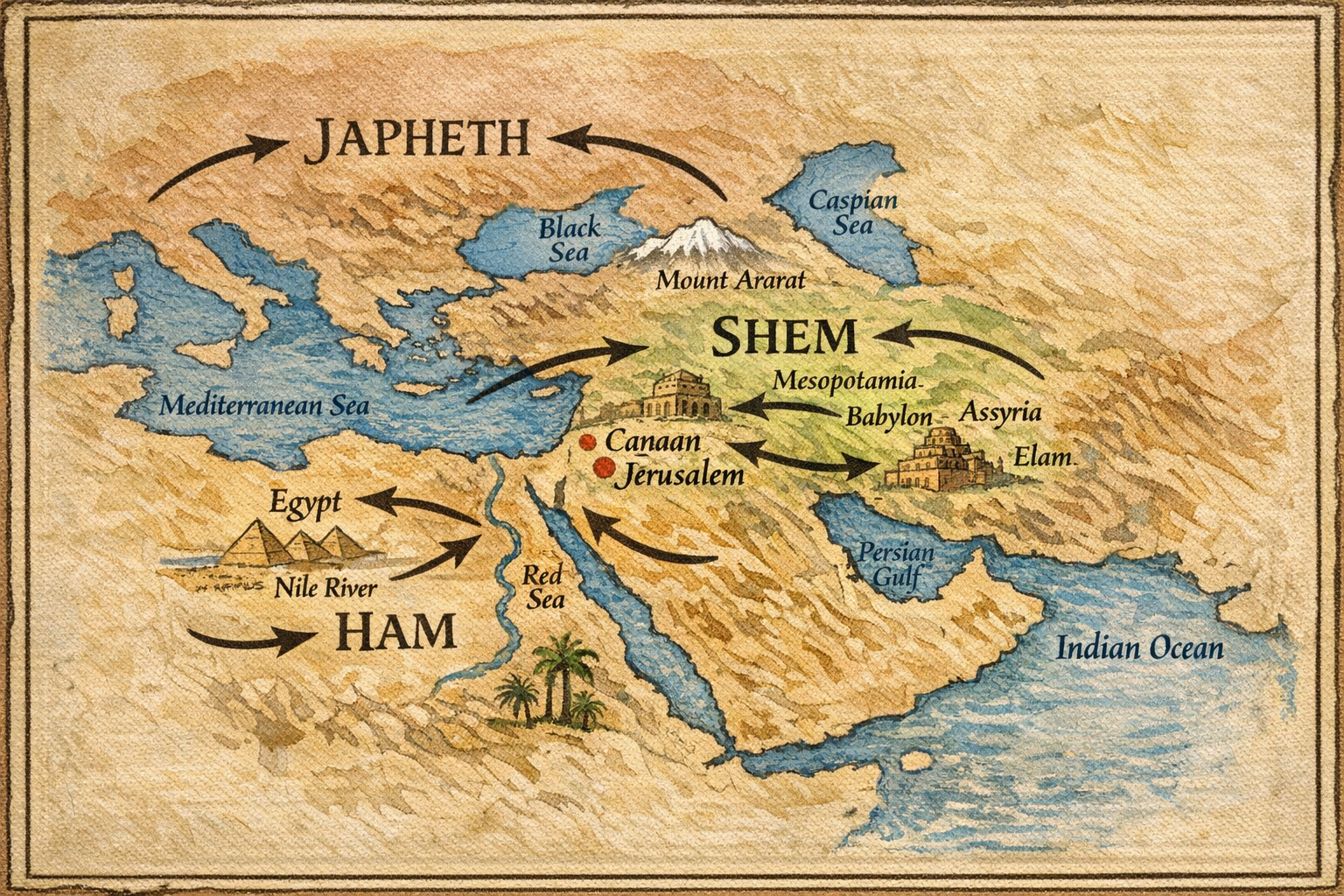
Japheth's descendants spread north and west. Ham's spread south and through Canaan. Shem's line, through which the covenant promise will eventually flow, extends through the Mesopotamian region. The narrator is drawing a map. He is showing us every people group that will inhabit the world. This is every people group that God loves and that God, at this point in the story, is about to let go.
As in prior chapters, one figure stands apart from everyone else. His name is Nimrod.
Genesis 10:8-10 CSB “Cush fathered Nimrod, who began to be powerful in the land. He was a powerful hunter in the sight of the Lord. That is why it is said, “Like Nimrod, a powerful hunter in the sight of the Lord.” His kingdom started with Babylon, Erech, Accad, and Calneh, in the land of Shinar."
Nimrod. The name comes from a Hebrew root meaning "we will rebel." His kingdom begins in Babylon, in the land of Shinar. It’s the very same region where the Tower of Babel will be built in the next chapter. The name Babylon itself, in the ancient Near Eastern world, meant "Gate of the Gods." This is making a theological claim saying: We are the place where heaven and earth connect. We are the access point. We will determine the terms.
Essentially, it’s an attempt at a man-made Eden.
The ancient name for the kind of structure they built, translated literally, was the “Tower of the Foundation of Heaven and Earth." The narrator is speaking in terms his audience understood: Nimrod is pointing the direction, and humanity is about to follow.
Genesis 11:1-4 CSB "The whole earth had the same language and vocabulary. As people migrated from the east, they found a valley in the land of Shinar and settled there. They said to each other, 'Come, let us make oven-fired bricks.' (They used brick for stone and asphalt for mortar.) And they said, 'Come, let us build ourselves a city and a tower with its top in the sky. Let us make a name for ourselves; otherwise, we'll be scattered throughout the earth.'"
Before we examine what they were building, I want you to notice what they were using to build it. Brick for stone. Asphalt for mortar.
This is a pointed detail. In the ancient world, stone was what God provided. It came from the earth, shaped by natural processes, a material from creation itself. Brick was manufactured. Humanity pressed it, fired it, shaped it according to their own specifications. They were constructing their path to God out of his substance, their own materials, by their own methods, and on their own schedule. Even the building materials were a theological statement.
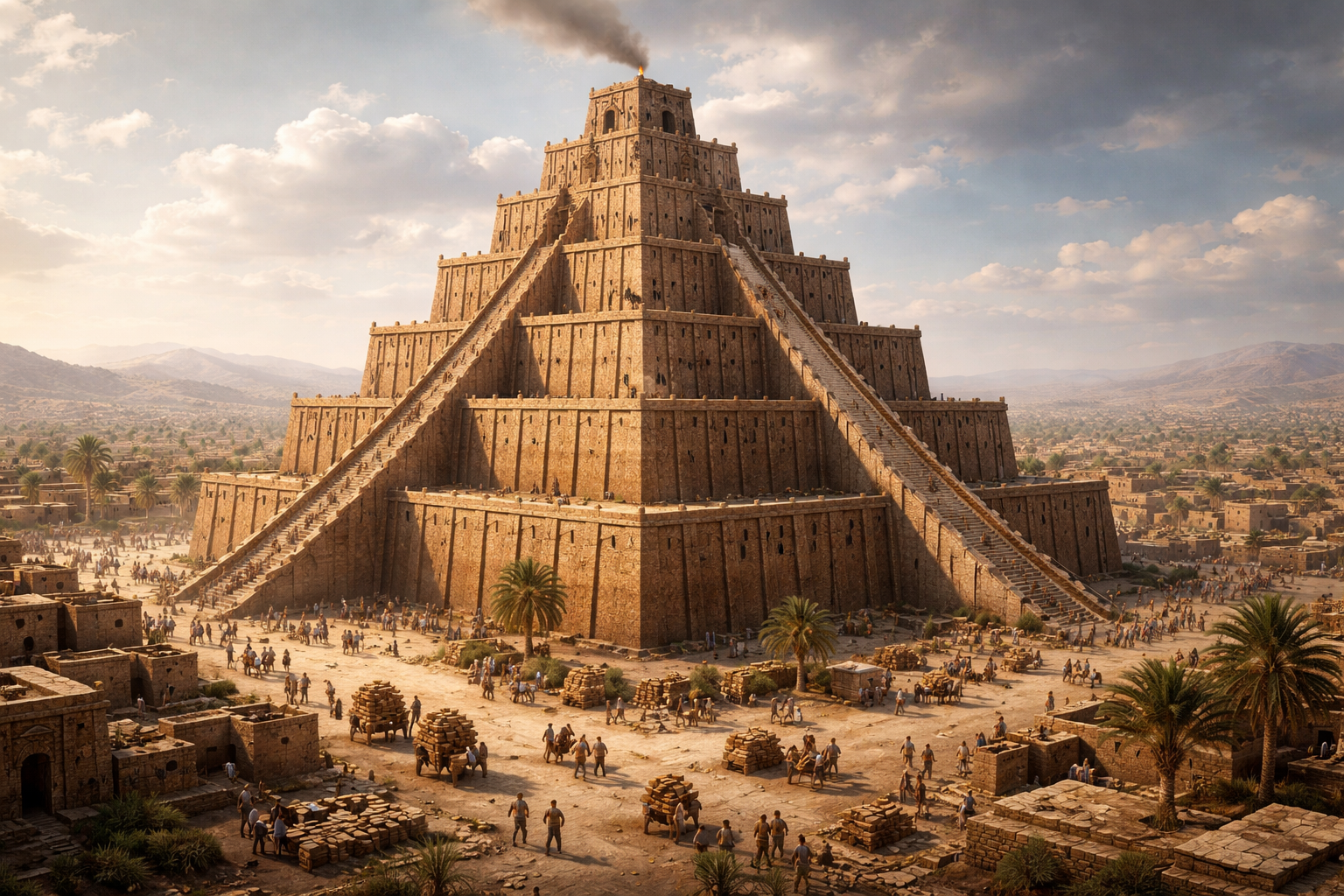
Now, the structure itself. The tower was almost certainly a ziggurat. A massive, stepped temple tower common throughout the ancient Near East. And a ziggurat was not built so that people could climb up to reach God. It was built to invite God to come down to them.
The logic of ancient religion worked like this: you build a home for the deity, provide what the deity requires, perform the right rituals in the right sequence, and the deity is obligated to you. He owes you protection. He owes you provision. You have met his needs, so now he must meet yours. The whole system was a transaction known as the “great symbiosis”.
Dr. John Walton, whose scholarship on Genesis and the ancient Near Eastern world has been a steady guide throughout this series, describes the Babel project like this: "Things were out of order and they were trying to re-establish relationship, presence, and order on their own terms."
Their own terms. That says it all. This is not a story about people trying to storm heaven. It is a story about people trying to manage God — trying to construct a relationship with the divine under conditions they controlled, in exchange for benefits they specified. And Yahweh is not a God who works that way.
He cannot be obligated by what we build. He cannot be leveraged, managed, or kept as a kind of divine insurance policy. He is not a god who has needs we can meet in order to make claims on him.
So how does God respond?
Genesis 11:5-7 CSB"Then the Lord came down to look at the city and the tower that the humans were building. The Lord said, 'If they have begun to do this as one people all having the same language, then nothing they plan to do will be beyond them. Come, let us (the divine counsel) go down there and confuse their language so that they will not understand one another's speech.'"
Notice the irony threaded through this scene. They built the tower so God would come down to them. And he does come down. But not to take up residence in their ziggurat. He comes down to look at it. To assess it. To judge what he sees. And what he sees is a trajectory of allegiance apart from him, not just a minor offense. Pride at this scale, organized and unified and aimed away from him, will take humanity somewhere irreversible. So God acts with surgical precision. He confuses their language. The one thing that made the project possible was shared communication, shared vision, shared vocabulary. God severs that instantly. And the thing they feared most, being scattered, is exactly what happens.
Of course, God wants unity among his people, but not with their initiative being toward their own agenda. He wants unity among his people being together to worship him and fulfill his agenda of them representing him in the earth by stewarding his created world. Amen?!
Genesis 11:8-9 CSB"So from there the Lord scattered them throughout the earth, and they stopped building the city. Therefore it is called Babylon, for there the Lord confused the language of the whole earth, and from there the Lord scattered them throughout the earth."
Babel. Confusion. Scattering.
Now here is the part of this story that most sermons don't get to, and it is the part that will change how you understand everything that follows.
The scattering at Babel was not only a geographic event. It was a spiritual and cosmic one. Dr. Michael Heiser, drawing on the oldest available manuscripts of the Old Testament — including the Dead Sea Scrolls — makes a critical observation about what God does in the moment the nations are divided. We find it in:
Deuteronomy 32:8-9 CSB"When the Most High gave the nations their inheritance and divided the human race, he set the boundaries of the peoples according to the number of the people of Israel. But the Lord’s portion is his people, Jacob (all descendants of Israel), his own inheritance."
When God scattered the seventy nations at Babel, he assigned them. Each nation was placed under the oversight of members of the divine council — supernatural beings aka “the nations” — while Yahweh himself retained one portion chosen as his own. Not a nation yet. One man named Abram, who we’re introduced to later in the story, still living in Ur in Mesopotamia, who hadn't heard God's voice yet. All seventy nations were handed off to a divine counsel entity that later betrayed Yahweh by seeking allegiance to themselves.
As Heiser writes: "These same nations became the enemies of Israel. This event frames the entirety of the rest of the Old Testament. It frames Israel against the nations and Yahweh against the gods [of those nations]."
The spiritual powers that oversaw the scattered nations at Babel are the principalities and powers that Apostle Paul writes about in Ephesians chapter 6. When Paul says we are not fighting against flesh and blood, he is drawing on exactly this framework.
The conflict is supernatural and it is cosmic. It runs underneath everything visible and invisible. And the mission of God from Genesis chapter 12 forward is to undo what happened at Babel — to reclaim every one of those seventy nations, not by force, but by covenant, by love, by the blood of a Lamb.
But to understand why what God does next matters as much as it does, we need to spend a moment on something that does not get enough attention in most sermons on Genesis 11. We need to talk about The Name.
THE THEOLOGY OF THE NAME
"Let us make a name for ourselves." (said the people at Babel)
In our culture, that phrase is metaphorical. We use "name" to mean reputation, legacy, brand, influence. But in the ancient world, and in the Hebrew theological imagination specifically, a name carried far more weight than that.
In Hebrew thought, a name was not simply a label that identified you. A name was your identity, your authority, your character, your essence. To know someone's name was to know something true about who they were at their core.
This is why God renames people in Scripture at key moments in their lives.
Abram becomes Abraham
Jacob becomes Israel
Simon becomes Peter
Saul becomes Paul
The new name marks a real ontological change in who the person is and what they are called to be. And this theological weight around names applies most profoundly to God himself.
In the book of Exodus, when Moses encounters God at the burning bush and asks for his name, God responds:
Exodus 3:14-15 CSB"God replied to Moses, 'I AM WHO I AM. This is what you are to say to the Israelites: I AM has sent me to you.' God also said to Moses, 'Say this to the Israelites: The Lord, the God of your ancestors, the God of Abraham, the God of Isaac, and the God of Jacob, has sent me to you. This is my name forever; this is how I am to be remembered in every generation.'"
I AM WHO I AM. YHWH. God’s divine name is the most sacred grouped four letters in the Hebrew language. It is so sacred that the Israelites would not speak The Name aloud for fear of treating it carelessly. Scribes who copied the Torah would wash their hands before they wrote The Name in it. Some would use a different pen specifically for those four letters. When the text was read publicly, they substituted the word Adonai, meaning "Lord," in its place. Even today, many observant Jewish people write it “G-d’ rather than spell it out. Jews today also refer to God as “Hashem” which is a name for God simply meaning “The Name.”
Why this level of reverence?
Because in the ancient world, how you treated someone's name revealed how you regarded them. To use the name of God flippantly was not just a breach of manners. It was a statement about who you believed God to be. It was misrepresenting him. Treating the Name of God carelessly was treating God himself carelessly.
But there is something even deeper here. Scholar Carmen Joy Imes, in her work on the Third Commandment and the theology of image bearing, makes a crucial observation: bearing the name of God is not simply a privilege. It is a vocation. Israel was specifically chosen and called to carry God's name into the world, the way an ambassador carries the name of their nation. They were to represent him, embody his character, live in such a way that the watching world could see through them who this God actually was.
This is what it means to be made in the image of God. You are not, as an individual human being, intended to image God. We are collectively, all of us together, his name-bearers. We carry something of God's identity into the world, and our life is a testimony to who he is, or, in the case of the fall, a testimony to who we have become when we stop trusting him.
Now let’s go back to Babel.
"Let us make a name for ourselves."
Do you now hear what is actually being said? Humanity was made to bear God's name by carrying his identity, representing his character, and making him visible in the world. At Babel, they decided to construct their own name instead. They turned the God-given vocation of divine name-bearing into an act of self-glorification. They took what was meant to be God's and redirected it entirely toward themselves.
Concluding the Babel incident, at the end of chapter 11, we are intentionally introduced to the man who God chose as his own— to carry his Name forward.
Notice what God does in the opening of chapter 12. Watch the precision of his directive.
Genesis 12:1-3 CSB"The Lord said to Abram, 'Go from your land, your relatives, and your father's house to the land that I will show you. I will make you into a great nation, I will bless you, I will make your name great, and you will be a blessing. I will bless those who bless you, I will curse anyone who treats you with contempt, and all the peoples on earth will be blessed through you.'"
At Babel, they said: we will make a name for ourselves. God says to Abram: I will make your name great.
God does not dismiss the deep human longing for significance, for a legacy that lasts, and for a name that means something. He doesn't say you don't need that. He says I will give you what you have been reaching for. But I will give it on my terms, not yours. And it won’t come through what you build, but by what I do through you.
This is the counter-offer of the Gospel. At every point in human history when we have tried to manufacture our own significance, God comes with an alternative: not condemnation, but a better offer. Stop building your own tower. I will build something through you that no tower could ever accomplish.
This is why the disciples pray the way they do. When Jesus teaches them to pray, the prayer begins: "Our Father in heaven, hallowed be yourname." Not our name. Not the name of our movement, our church, our nation, our political party, our theological tradition. No! Your Name God. Your Name.
When we pray in the name of Jesus, we are not reciting a formula at the end of a wish list. We are invoking his identity, his authority, his character, his core essence, his power as the Almighty God, the Most High, Yahweh. By praying in the Name of Jesus we are declaring: this is not about what I’m trying to build. This is about who he is. Amen?!
At the end of the entire Biblical story, on its final page, it describes what it’s like to live in the restored creation, the New Jerusalem, the world as God always intended it:
Revelation 22:4 CSB"They will see his face, and his name will be on their foreheads."
His name. On their foreheads. This is the completion of the vocation given in Genesis 1. Image bearing fully restored. We were made to carry God's Name. We traded it for our own. The entire Biblical story is the long journey back to that original calling and its completion is not us finally achieving significance, but us finally, fully, bearing his.
PENTECOST: THE REVERSAL OF BABEL
Let’s quickly jump 2200 years ahead in the Biblical story to fifty days after the first Easter Sunday morning. This is where we see God’s full reversal of Babel break open in a specific room, on a specific morning.
Acts 2:1-6 CSB"When the day of Pentecost had arrived, they were all together in one place. Suddenly a sound like that of a violent rushing wind came from heaven, and it filled the whole house where they were staying. They saw tongues like flames of fire that separated and rested on each one of them. Then they were all filled with the Holy Spirit and began to speak in different tongues, as the Spirit enabled them. Now there were Jews living in Jerusalem, devout men from every nation under heaven. When this sound occurred, the crowd came together and was confused because each one heard them speaking in his own language."
John Walton points out something that readers of the Greek text would have caught immediately: the vocabulary, its author Luke, used in Acts 2 intentionally mirrors the vocabulary of Genesis 11 in the Greek translation of the Old Testament with the same specific words for division, confusion, and language. The narrator in Acts is drawing a direct line to Genesis. This is not a coincidence. This is the answer to Babel, written in the language of Babel's story.
And look who is there. The text says devout men from every nation under heaven. Luke then lists the regions representing the known world in the verses that follow. It is, at its core, a version of the Table of Nations from Genesis 10. Every one of the seventy nations scattered at Babel has a representative in Jerusalem on this particular Pentecost morning.
Babel and Pentecost Parallels
At Babel, one unified language was scattered into many, which the people were dispersed and subjected to the rule of fallen spiritual beings. At Pentecost, people of many languages hear one proclamation, each in their own tongue, and begin to be gathered by the Spirit of Yahweh.
At Babel, humanity built a tower so that God would come down into the temple they made for him. At Pentecost, God comes down on his own terms, not into a temple of brick and mortar, but into people. He doesn't enter what humanity built. He enters what he built by his own Holy Spirit.
And the Name — the Name that Babel tried to manufacture for itself — is now proclaimed in every language simultaneously. This is what Peter's sermon in Acts 2 is doing. He preached Christ, crucified and risen, and the name of Jesus goes out in Parthian and Mede and Elamite and several dozen other languages all at once. The name that humanity tried to build at Babel was small and self-serving and it collapsed. The name of Jesus is proclaimed in every language to every people and will never collapse. Amen?!
Acts 2:21 CSB"And everyone who calls on the name of the Lord will be saved."
The supernatural powers that had claimed oversight over the scattered nations at Babel were beginning to lose their hold. The Messianic King had arrived. His mission encompassed every last nation. And the spiritual powers that governed those nations from the unseen realm recognized him — not as a regional religious leader or good teacher, but as the Son of the Most High. The same God who divided the nations at Babel was now, in human flesh, walking into their territory as Yahweh himself taking back what rightfully belongs to him.
Paul writes in 1 Corinthians 2:8 that if the rulers of this age had understood what the cross would accomplish, they never would have let it happen.
They tried to end the mission by ending the Messiah. Instead, the death and resurrection of Jesus shattered their authority over everyone who belongs to him. As Heiser explains, the believer who is in Christ is no longer under the jurisdiction of the powers that claimed ownership over the nations. Satan is, as Heiser puts it, "a prosecutor without a case." He has no claim over anyone who belongs to Jesus the risen King. Amen?!
The Great Commission, Christ’s parting words before he ascended to the throne, is therefore not simply an evangelism strategy. It is cosmic geography. It is The Mission, a mandate, Jesus sends all his followers on to be actively re-gathering of the nations. And this is why missions is so vital to God’s salvation plan today in the world.
Matthew 28:18-20 CSB"Jesus came near and said to them, 'All authority has been given to me in heaven and on earth. Go, therefore, and make disciples of all nations, baptizing them in the name of the Father and of the Son and of the Holy Spirit, teaching them to observe everything I have commanded you. And remember, I am with you always, to the end of the age.'"
All authority in heaven and on earth belongs to Jesus. The authority that was assigned to the sons of God at Babel, over the seventy nations, has been reclaimed by Jesus. And we, as his disciples, are now sent in his Name, under his authority, to every nation on the map of Genesis 10 and beyond.
AT THE STORY’S END
Revelation 7:9-10 CSB"After this I looked, and there was a vast multitude from every nation, tribe, people, and language, which no one could number, standing before the throne and before the Lamb. They were clothed in white robes with palm branches in their hands. And they cried out in a loud voice: 'Salvation belongs to our God, who is seated on the throne, and to the Lamb!'"
Every nation. Every tribe. Every people. Every language.
This is the seventy nations scattered at Babel, gathered again, standing before the throne of God. This is not by a human project or by uniformity of culture or language or political platform, but by the blood of the Lamb.
And what are they all saying? Not "look at what we built" or "look at the name we made." They are proclaiming salvation belongs to God. His Name, not theirs, is the one being declared.
Revelation 21:3 CSB"Then I heard a loud voice from the throne: 'Look, God's dwelling is with humanity, and he will live with them. They will be his peoples, and God himself will be with them and will be their God.'"
God's dwelling is with humanity here on earth.
This is what Babel was trying to build and could not reach. This is what all the towers and temples and ambitious human projects have always been reaching for, in their distorted and misdirected way.
The deepest human longing is not really for a great name. It is for the presence of the One whose Name is great. We were made for this. We lost it in Genesis 3. Every chapter since is a single stone laid on the oldest and most relentless road in history — God moving toward us, refusing to leave the story unfinished, leading us back to the garden and forward to the city.
Revelation 22:4 CSB"They will see his face, and his name will be on their foreheads."
The God who walked with Adam in the cool of the evening now dwells permanently with every nation he has reclaimed. Exile ended. The fracture sealed. The Name finally and fully restored. We are back to what we were always meant to be.
THE NAME YOU'RE BUILDING
I want to close with what I said at the beginning. Because this is where the whole sermon has been heading.
Think about the last time you asked yourself what you wanted to be remembered for.
Every one of us is building something. That is not wrong. We were made to build, to cultivate, to create, to leave something behind that was not there before we arrived. That is the image of God in us, reaching for expression and caring for what our Creator made. The impulse is not the problem.
The question is, for whose name are we building it.
Some of you have been constructing your identity for years around what you have achieved or desire to achieve. The career, the title, the reputation among the people who know your field. And it has taken more energy than you expected to keep the whole thing upright. Because something you built can always be threatened by something someone else builds bigger or better. Something you constructed can always come down.
Some of you have been reaching for significance through your family, through children who carry your family name, through relationships that reflect on you, through being known as someone who has it together. And you know better than most how fragile that project is, because people are not bricks. They don't stay where you put them.
Some of you have been trying to build a relationship with God the Babel way. Performing the right religious behaviors, attending consistently, maintaining the appearance of spiritual health, hoping that if you meet his needs well enough he will be obligated to take care of you. And you are exhausted, because the transaction never quite balances.
All of it is Babel. Different materials. Same tower. Same impulse. Same outcome — eventually, something gets confused, something gets scattered, and you are left wondering how you got here.
And some of you have built your identity around who you believe yourself to be at the very deepest level— your sexuality, your gender, your personality, or some other deeply personal sense of self that you have carried for a long time, perhaps most of your life. You have woven that identity so tightly into the fabric of who you are that the thought of someone challenging it feels more like an attack on your existence. I want to speak to you with as much gentleness as I know how to offer: God is not asking you to disappear. He is not asking you to become nothing. He is asking you to discover that what he says about you goes deeper than any identity you have ever built or been given or chosen for yourself. You are his. Loved. Known. Named. Called. He has something better than the name you have been carrying. He has a name he wants to give you out of his own mouth.
Here is what God says through the whole arc of this story: Stop building your own name. I will make your name great. Not through what you construct, but through whose you are.
We were not made to be remembered. We were made to bear God’s Name into the world, to carry his character and reflect his presence, to be the kind of people through whom other people catch a glimpse of who God actually is. That’s our original vocation. That is what image bearing means. And the only way back to it is not better performance or a more impressive spiritual resume. It is surrender.
The God who came down at Pentecost not to enter a building but to inhabit people— he wants to inhabit you. The Name that is proclaimed in every language across every nation— he wants that Name to be the Name your life announces.
Whose name have you been building?
INVITATION
Stop building for yourself and receive what he built for you. Turn from the tower. Look at the cross.
His name is Jesus. He came for you. He is not done with you. He’s giving you a new name. He's bringing you home.
He’s inviting all of us today: “Come to me. Get away with me and you’ll recover your life.” Matthew 11:28 MSG
“You will be given a new name that the LORD’s mouth will announce.” Isaiah 62:2
“Therefore, if anyone is in Christ, he is a new creation; the old has passed away, and see, the new has come!” 2 Corinthians 5:17 CSB
Will you, today, repent of your ways of building something in your name to accept the name of Jesus Christ as your Lord and Savior and allow him to forgive you, cleanse you, and give you a new name out of the LORD’s own mouth?
If you’re ready to surrender to Christ, let's pause right now and take a silent moment to say that to him.
SOURCES:
Walton, John H. Ancient Near Eastern Thought and the Old Testament. Grand Rapids: Baker Academic, 2018.
Walton, John H. "Tower of Babel: A Close Reading." Christianity Today, February 2023. https://www.christianitytoday.com/2023/02/tower-of-babel-genesis-close-reading-walton/
Walton, John H. and Chris Dolson. Didasko Seminars Scaffolding Document: Genesis 1–11. Portland, OR: July 2025.
Heiser, Michael S. The Unseen Realm: Recovering the Supernatural Worldview of the Bible. Bellingham: Lexham Press, 2015.
Heiser, Michael S. "Why Did Jesus Say: I Saw Satan Fall like Lightning from Heaven?" YouTube. https://www.youtube.com/watch?v=oUE6-Xz3Llk
Imes, Carmen Joy. Bearing God's Name: Why Sinai Still Matters. Downers Grove: IVP Academic, 2019.
If you found value in this, here are some additional articles for you.