What If We’ve Been Reading Revelation Wrong?
This sermon was preached at Sherwood Community Friends Church on Sunday, October 11. You can watch the video of this sermon by clicking below.
Do you remember the moment in The Wizard of Oz when Toto pulls back the curtain?
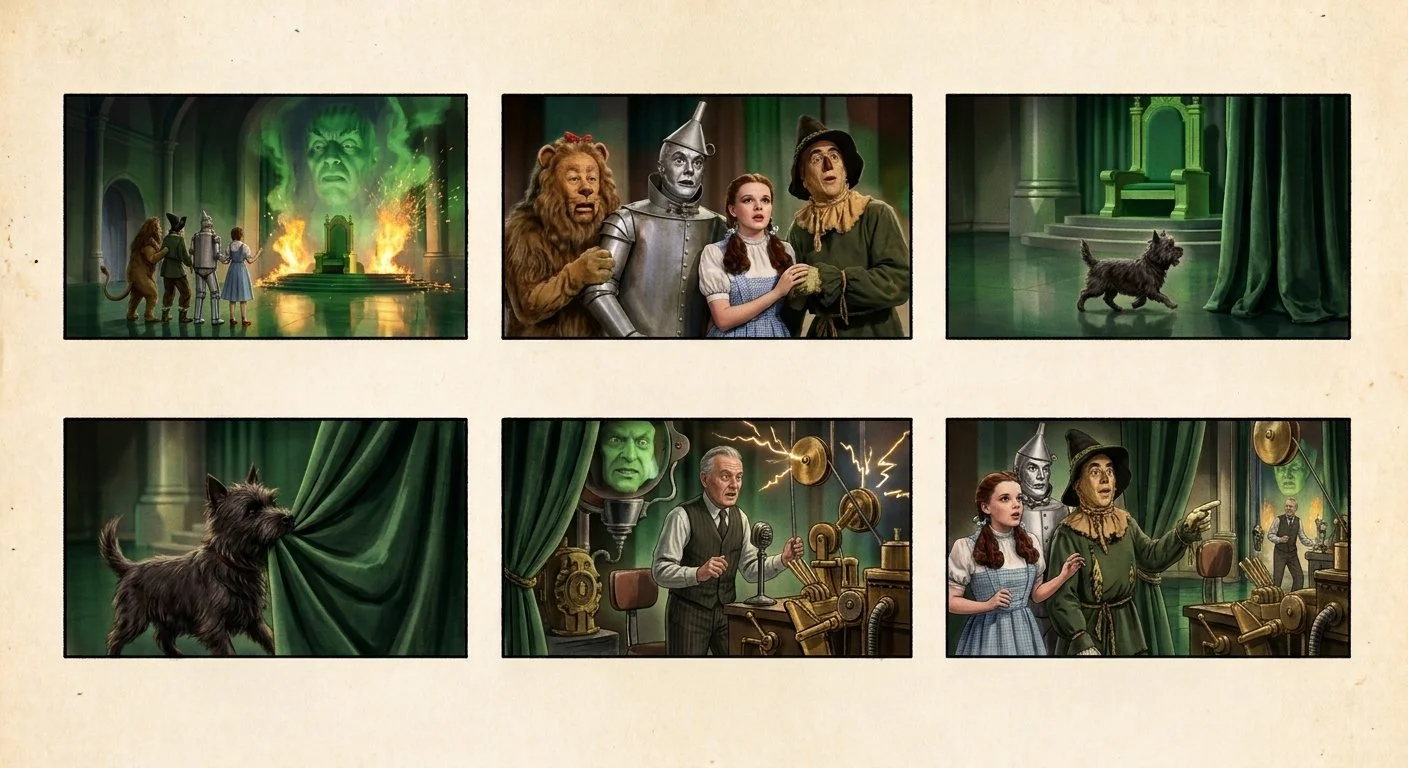
Dorothy and her friends are standing in the great hall. A giant green face floats in the smoke. Fire shoots up from the floor. A booming voice announces that he is the great and powerful Oz, and our heroes are shaking in their shoes.
Then Toto trots over to a curtain in the corner and tugs it open unveiling an ordinary man, pulling levers, popping smoke, and talking into a microphone.
The power was staged and the fear was manufactured.
Hold onto that picture, because the book of Revelation gives us a curtain moment too. When the curtain is pulled back for its author John, the loud powers of this world start looking smaller. Behind them stands a throne. On that throne sits the God who holds everything together. And standing at the center of it all is a Lamb who was slain and now reigns as King.
Amen?!
That's why we’re calling this series Behind the Curtain: A Journey Through Revelation. For the next eleven weeks, we’re going to let Jesus pull back the curtain and show us what's really going on in our world’s unseen realm. And the theme running through every single week is this: Follow the Lamb.
What We Bring to Revelation
Let me ask you this… What comes to mind when you hear the word Revelation?
For some of us, it’s a countdown to the end of the world, a chart, a timeline, or a puzzle to solve. For others, it's the book we avoid because it feels confusing, scary, or flat-out weird. Some of us only heard it used to scare people into faith, but almost every generation of Christians has been tempted to read Revelation like a code to crack.
We play the match game to see which world leaders are the beast. We match current wars to the seals and trumpets. We calculate dates for the end and wonder when will Armageddon begin. This is nothing new. It’s been happening since roughly the second century, and it still happens every time an intense headline breaks.
So-called "End Times experts" make what they call prophecy videos on YouTube. They write books on the end times the way they see it. And preachers try to teach their congregations to decode John’s visions by laying them over our own current modern timeline.
There’s even this pattern across church history. Every generation assumed the beast was their resident tyrant and the mark of the beast was their generation’s new technology or currency. People said it about Nero and Napoleon. People said it about Hitler and Putin. People have said it about barcodes, about microchips, and now about AI.
And what about the antichrist?
Did you know that the word "antichrist" never once appears in the book of Revelation. It shows up only in John’s short, separate letters that precede Revelation in the New Testament, and there he describes the antichrist (all lowercase) as anyone who opposes Christ. Selling people on the antichrist keeps them buying books and watching movies.
There have even been people who have written books and articles predicting specific dates when Jesus would come back.
We never run short of scare tactics and fear-mongering that repeat the pattern. Time and time again, the guessers and speculators were wrong, because predicting a timeline was never the point of the vision John received from Jesus Christ.
So here's the question I want us to wrestle with today: What if we’ve been reading Revelation wrong?
What if we cleared our minds of the programming and the church traditions and the end times based books and movies to let the Biblical text speak for itself?
Does Revelation explain what's happening in our world today? Let’s find out.
What Jesus Said About the End
Before we open Revelation, let’s start with what Jesus said about the end times. And if you were here for the final sermon in our summer’s Unfiltered series, this next part might sound familiar.
In Matthew chapter 24 his disciples ask him about the end of the age, and here's what he tells them:
Matthew 24:4–6 CSB “Watch out that no one deceives you. For many will come in my name, saying, ‘I am the Messiah,’ and they will deceive many. You are going to hear of wars and rumors of wars. See that you are not alarmed, because these things must take place, but the end is not yet.”
Did you catch that? "See that you are not alarmed." Jesus tells us wars and rumors of wars are what ongoing human history looks like. He’s not handing us a signal to watch for, but telling us not to panic every time conflict breaks out and assume it's a countdown clock.
He tells us to expect it. Be aware of it. Realize it's normal and it's going to happen. He’s telling us to go on with our lives, following him first and foremost and help others follow him too. That's what it means to follow Jesus.
Paul summarizes the same thing in Romans 8:22 CSB “For we know that the whole creation has been groaning together with labor pains until now.”
Creation has been groaning since humanity chose its own path in the garden, and it's still groaning today. That groaning is the normal sound of a world pregnantly waiting for its Redeemer to come.
How Not to Read Revelation
So before we read a single verse in the Book of Revelation, let’s name three ways people usually read it.
Some of us read it like a newspaper codebook. We hold the headlines in one hand and Revelation in the other and try to match them up.
Some of us read it like a horror movie. We peek through our fingers, we feel the dread, close the book scared, and push it aside.
And some of us just keep it “locked in a drawer" to never open it at all.
The truth is, none of those lenses help us. Revelation is in the Bible and it’s the inspired Word of God. I think it’s a vital part of understanding how to follow Jesus and we ought to read every word. But first we need to understand how to read it.
There are a few books I will be recommending for our Behind The Curtain series.
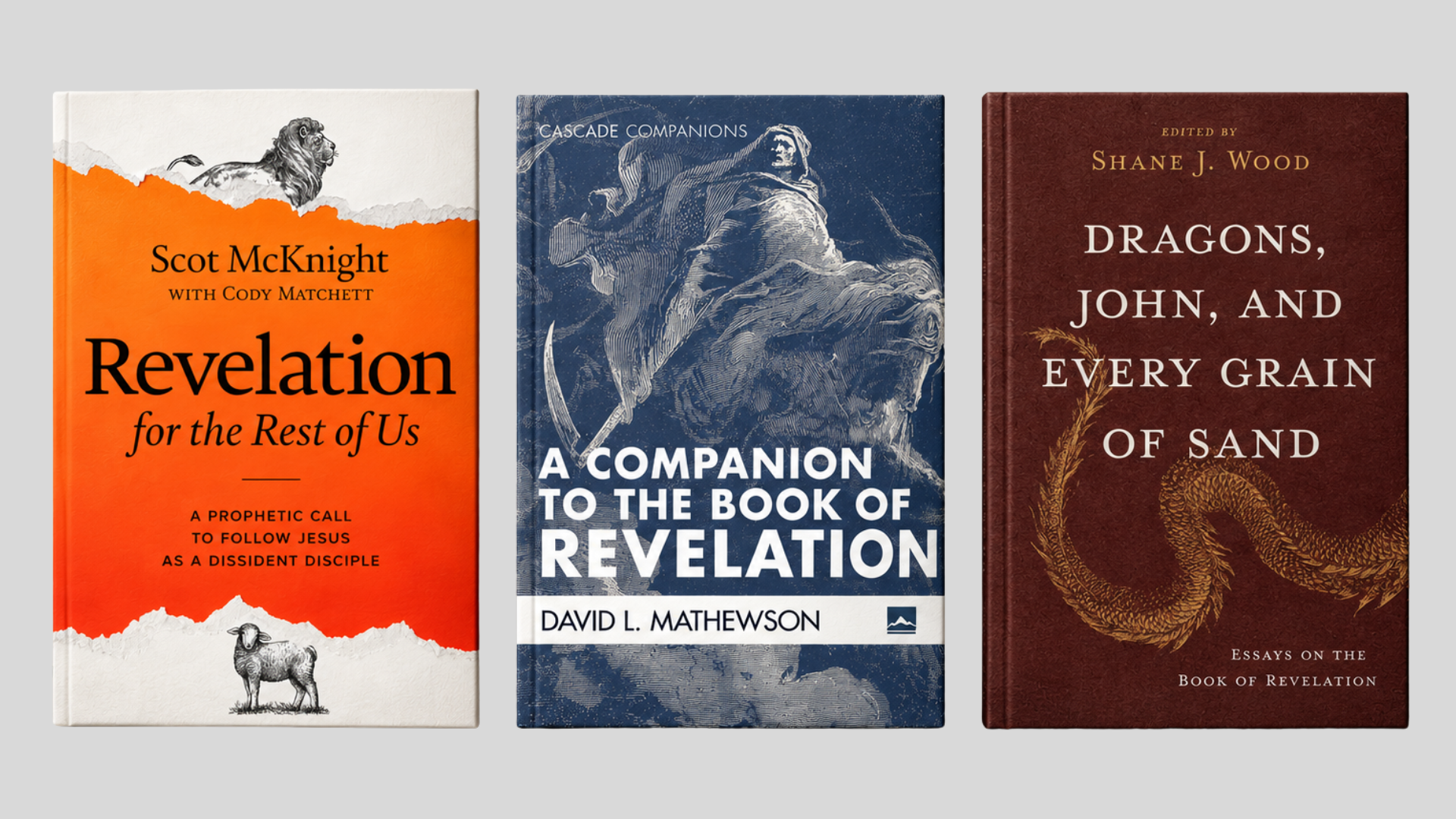
Scot McKnight, a New Testament scholar who wrote a wonderful book called Revelation for the Rest of Us, says: “The very first principle for reading Revelation well is that it's not for speculators.”
If we were meant to crack an encrypted message, God would tell us. Listen to Moses:
Deuteronomy 29:29 CSB “The hidden things belong to the LORD our God, but the revealed things belong to us and our children forever, so that we may follow all the words of this law.”
God has never owed us the full blueprint. He has revealed exactly what we need to trust and obey him by faith. The rest, all those unknown, hidden things, belong to him.
Let the Book Introduce Itself
So let’s allow Revelation to tell us what it is.
Look how it opens:
Revelation 1:1–3 CSB “The revelation of Jesus Christ that God gave him to show his servants what must soon take place. He made it known by sending his angel to his servant John, who testified to the word of God and to the testimony of Jesus Christ, whatever he saw. Blessed is the one who reads aloud the words of this prophecy, and blessed are those who hear the words of this prophecy and keep what is written in it, because the time is near.”
Then verse 4 begins, "John: To the seven churches in Asia."
In four verses, John tells us his book is three things woven together.
First, it’s an apocalypse. That's the cool Greek word in verse 1— an apocalypse or revelation— and it’s not anything scary. It simply means an unveiling. Jesus is pulling back the curtain to show John what’s happening behind the unseen realm. John then describes for his readers what’s actually going on behind the world we cannot see with our physical eyes.
Apocalyptic writing was a literary style people in John’s world knew well. Old Testament writers of Daniel, Ezekiel, and Zechariah wrote this way. It’s a vision story where a heavenly messenger reveals unseen reality to people in crisis, to encourage them and call them to faithfulness. Apocalyptic literature is typically full of symbols, beasts, numbers, and colors. The closest thing we have today might be fantasy literature like J.R.R. Tolkien’s The Lord of the Rings or John Milton’s Paradise Lost.
Scot McKnight puts it this way: “It takes an apocalyptic imagination to write and to read the book of Revelation.” So let’s bring our imagination with us these next eleven weeks to the unveiling of God’s Word.
Revelation is an apocalypse.
Second, Revelation is a prophecy. Verse 3 tells us this. A prophecy is not always, and usually isn’t, predictions. Biblical prophecy is a word directly from God calling his people to covenant faithfulness— and now as witnesses for the Gospel of Jesus Christ.
McKnight reiterates for us that the word "prophetic" does not have to mean prediction. Open the books in the Old Testament known as the prophets of Israel: Isaiah, Jeremiah, Ezekiel, Obadiah, Amos, and the others each spoke to people in their own day first, about their own idols and their own injustices. Their words still reach beyond their day, and so do John’s, but most of it has to do with what was happening in their day.
There’s a detail at the end of the book of Daniel— which is the closest book in the whole Bible to Revelation, because Daniel is apocalyptic, prophetic, and in a way a letter— but… Daniel is told to seal up his book (Daniel 12:4). At the end of Revelation, John is told the opposite. He’s told, don’t seal it, because the time is near (Revelation 22:10). John’s book was meant to be opened and lived right away. That’s prophetic.
Revelation is an apocalypse and a prophecy.
Third, Revelation is a letter. Verse 4 says, “John: To the seven churches in Asia." It’s a pastoral letter written to real recipients in ancient, real churches, with a real purpose they could understand.
Revelation is an apocalypse, a prophecy, and a letter.
Written to Them
Last year I went to a week long seminar on Revelation where scholar Dr. David Mathewson gave us a principle that has stuck with me ever since. He said— and I’m paraphrasing him here— if a reading of Revelation would have made no sense to the seven churches John was writing to, that reading probably isn’t correct.
Let’s keep that in mind. Revelation was a real letter, written to seven real churches, in seven real cities, dealing with real pressure from Rome to compromise their worship.
Picture these churches. They lived in cities filled with temples to Caesar. Their jobs often ran through trade guilds that held feasts in honor of pagan gods. Saying “Jesus is Lord” meant saying Caesar is not, and that could cost you your business, your friends, your freedom, or your life. Persecution came and went.
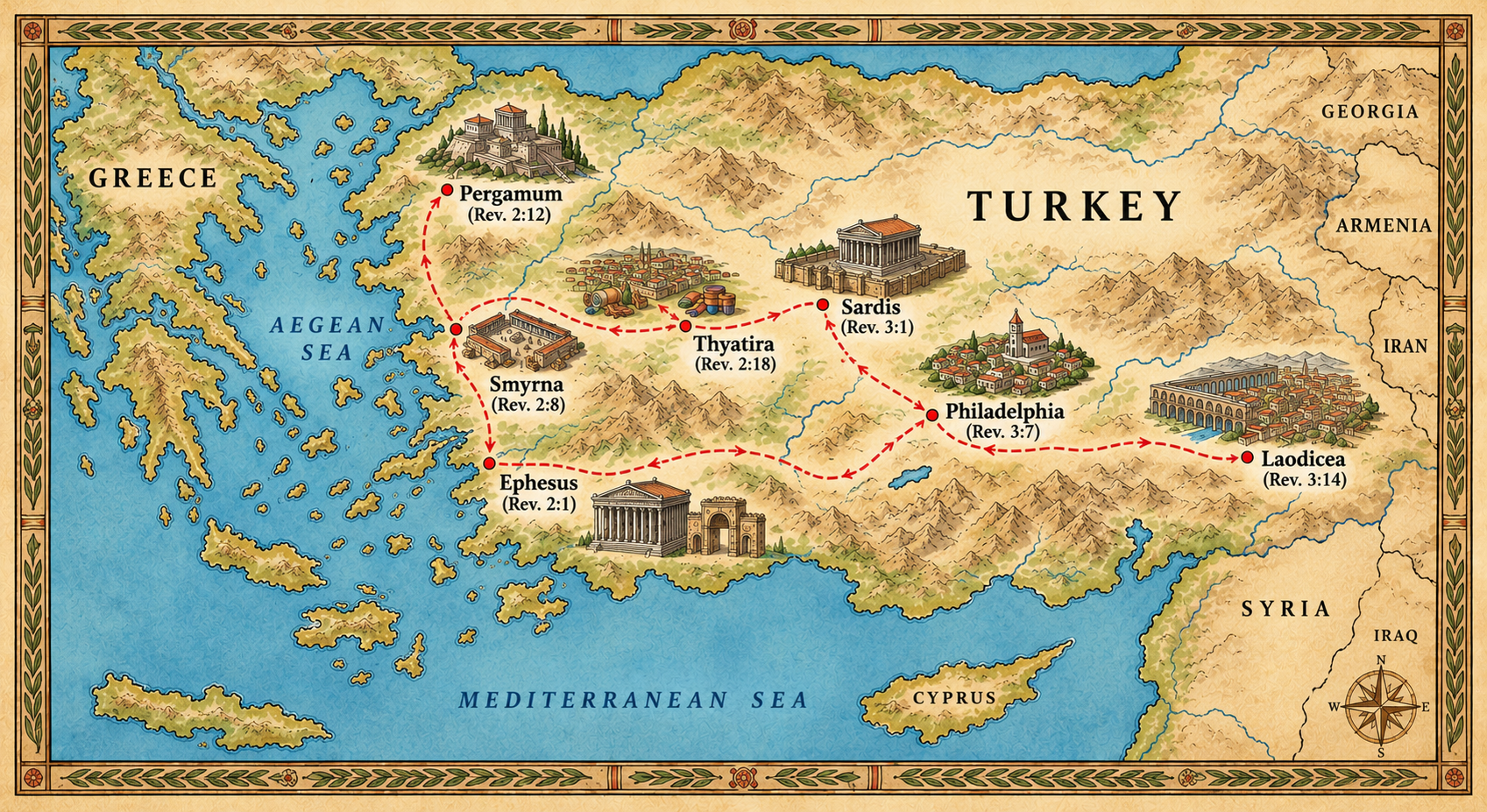
One believer, Antipas, is named as having been killed for his faith in Revelation chapter 2 verse 13. For most of them, though, the bigger danger was compromise. It was so easy to go along to get along.
The Roman Imperial cult propaganda told the story that Rome was chosen by the gods. Rome was eternal. Rome brought peace to the world. John’s letter was a direct polemic against the Roman cult telling the true story that Jesus is Lord, the Lamb is on the throne, and every Babylon— yes indeed even Rome— falls.
Vocalizing this testimony landed John in exile on the island of Patmos where he penned his apocalypse.
You see, John wasn’t leaving a coded message for readers two thousand or more years in the future. He was sending pastoral, prophetic mail on behalf of Jesus Christ, to congregations under real persecution and to some who were growing lackadaisical in their witness for Jesus. Every image in his letters would have meant something specific and relevant to these congregations first.
And that testimony landed him in prison.
So does Revelation still speak to us today? Absolutely! It speaks to us the same way the rest of Scripture does. A responsible reading means we should first learn what it meant to its author and its first readers. We see what it reveals about God. And then we let that meaning shape how we live now.
Here's what I’d like us to hold onto throughout our series:
BIG IDEA 1: Revelation is written to an original audience, it’s true for us, and it’s all about Jesus.
How can a letter written to them be true for us? Because the same Jesus is speaking.
Hebrews 13:8 CSB “Jesus Christ is the same yesterday, today, and forever.”
So as we read along, really anywhere in the Bible, let's ask these two questions, always in this order:
What was the author’s intended message for his original audience?
And what does it mean for us?
HANDOUT REFERENCE
We won’t unpack all of this today because there’s too much. I will share an addendum to today’s message. You’ll find a page called “How We Read Revelation” with a few more principles that will help you. As you read it, do so along with Revelation chapter 1 this week.
The Revelation of Jesus Christ
Let’s go back to the very first words of the book.
“The revelation of Jesus Christ.”
That little phrase works double duty in proclaiming this revelation comes from Jesus. He’s the one pulling back the curtain. And this revelation is about Jesus. He’s the one we see when the curtain opens.
Watch the chain of delivery in verse 1. God gives this to Jesus. Jesus sends his angel (his messenger). The angel brings it to John. John writes it to the churches. And today it lands with us.
Then comes a blessing in verse 3. Revelation is the only book in the Bible that opens with a promise of blessing for the one who reads it aloud and for those who hear it and keep it. To keep it means to obey it. The blessing then goes only to people who live it.
Are you ready for this blessing? Do you want to be blessed?
Listen to Revelation and then go live it out.
Look at how John describes Jesus in verse 5:
Revelation 1:5 CSB “and from Jesus Christ, the faithful witness, the firstborn from the dead and the ruler of the kings of the earth.”
The faithful witness. Hold onto those words. Jesus told the truth about God all the way to the cross, powerfully raised from the dead, and he kept on going. Everything we’ll read in the rest of the book flows from there. We’re called to be faithful witnesses because Jesus was the Faithful Witness first.
And listen to how John introduces himself in verse 9:
Revelation 1:9 CSB “I, John, your brother and partner in the affliction, kingdom, and endurance that are in Jesus, was on the island called Patmos because of the word of God and the testimony of Jesus.”
John was on a prison island because of his witness for Jesus— because of talking about the things he eventually wrote down in Revelation. He calls himself our brother and our partner. Partner in what? Affliction, kingdom, and endurance. That's the life of a follower of Jesus in a world run by Babylon. We suffer. We belong to a kingdom that's already here. And we endure.
We have a little bit more to go today in our introduction, but here's another big idea I want you to remember about Revelation.
BIG IDEA 2: Revelation is not about predicting the future. It’s about revealing Jesus and forming us into his faithful witnesses in the present.
Let’s Meet the Cast
The Book of Revelation reads like a drama, and every good drama has a cast.
Here’s a playbill to download and use to enhance your read-through of Revelation. It was created by Blackhawk Church in Madison, Wisconsin, and they gave us permission to share it with you.
It’s based on Scot McKnight’s book, Revelation For The Rest of Us, where he describes the characters of Revelation as two teams.
[These are on the playbill.]
On one side is Team Lamb. Hoooraaaayyyy!!!
God on the throne. Jesus, the Lamb who was slain— now stands. The angels who carries God’s message out on mission. The woman who gives birth to the Messiah. The faithful witnesses who follow the Lamb wherever he goes. And the new Jerusalem, the bride, the Church.
On the other side is Team Dragon. Boooooooo!!!
The dragon himself, who is Satan, the accuser of humanity. Two wild beasts, one from the sea and one from the earth, that do the dragon’s dirty work through political power and religious propaganda. And Babylon, the great city that seduces the whole world with wealth and power. In John’s day, Babylon was Rome. But Rome was not the first or the last Babylon.
Here's the thing about these two teams… Team Lamb and Team Dragon are not locked in the first century. Every generation lives with the same battle going on behind the curtain, all the way until Jesus returns and makes all things new. That's why this book still speaks to us today.
McKnight says the whole story of Revelation is John’s challenge to his readers, and to us, to “turn from Team Dragon and live out the story of Team Lamb.”
Which team are you living for?
The full cast is on the playbill, along with a list of what we’re calling “curtain moments.” Those are places in the story where John stops the action and pulls the curtain back a little bit more to show the church how to stand and live. We’ll come back to these curtain moments again and again.
Behind the Curtain
For just a moment, let’s go back to Patmos. John hears a voice behind him like a trumpet, and he turns around to see who’s speaking.
Revelation 1:12–16 CSB “Then I turned to see whose voice it was that spoke to me. When I turned I saw seven golden lampstands, and among the lampstands was one like the Son of Man, dressed in a robe and with a golden sash wrapped around his chest. The hair of his head was white as wool—white as snow—and his eyes like a fiery flame. His feet were like fine bronze as it's fired in a furnace, and his voice like the sound of cascading waters. He had seven stars in his right hand; a sharp double-edged sword came from his mouth, and his face was shining like the sun at full strength.”
There are many people who want to read the book of Revelation literally, or so they think, but in those handful of verses, does it make sense to read anything literal from that? I'm not saying it's not going to happen. I'm talking about something literal like a literal double-edged sword probably won’t be coming out of Jesus's literal mouth. Right?!
Church tradition tells us the same John who leaned up against Jesus at the Last Supper is the guy who’s writing now how he’s seeing him unveiled in all his might and glory. And notice where Jesus is standing. Among the lampstands. Chapter 1 verse 20 tells us the lampstands are the churches. Jesus is right there, walking among his people.
John does what any of us would do in a jaw dropping moment like this. He falls flat on his face.
Revelation 1:17–18 CSB “When I saw him, I fell at his feet like a dead man. He laid his right hand on me and said, ‘Don’t be afraid. I am the First and the Last, and the Living One. I was dead, but look—I am alive forever and ever, and I hold the keys of death and Hades.’”
The first words out of Jesus’ mouth as he emerged from behind the curtain are “Don’t be afraid.”
How’s that for a sword out of his mouth huh?!!
Chasing certainty about a future timeline will never satisfy what we’re actually hungry for or truly seeking underneath all our questions. What we want isn’t an end-times itinerary. We want to know we’re safe. We want to know we’re not alone. We want to know everything is moving toward something good and that all the evil and injustices in the world will be dealt with.
Revelation answers exactly that. It starts answering it by revealing Jesus and his Church. The one who holds the keys of death and Hades has his hand on your shoulder.
Close
Remember Toto and the curtain? In Oz, the curtain came back and the great and powerful wizard turned out to be a small fraud of a man pulling levers.
When the curtain gets pulled back in Revelation, we see the ones pulling levers in our world, every empire and every Babylon, turn out to be the small ones. And behind the curtain stands the First and the Last, the Living One with real power, real glory, and his first words are, “Don’t be afraid.”
How many of us need to hear that today?
How many of us need his right hand on our shoulder today?
“Don’t be afraid.”
Jesus is standing among us here and saying “I am alive forever and ever, and I hold the keys of death and Hades.’”
“Don’t be afraid.”
So here's the invitation for us today, and this will be our theme verse for the whole series:
Revelation 14:4 CSB “These are the ones who follow the Lamb wherever he goes.”
IF YOU REMEMBER ONE THING ABOUT THIS BOOK: Revelation reveals Jesus and forms us into his faithful witnesses in the present.
When we follow the Lamb by being faithful witnesses to Christ and enduring until the end, we have no reason to fear anything.
Are you following the Lamb?
Are you on his team?
Have you surrendered to Jesus as Lord and are you following him in every way— with your whole self?
Or is there some part behind your own curtain that you have yet to release for him to hold?
Citations
Scot McKnight and Cody Matchett, Revelation for the Rest of Us (Grand Rapids: Zondervan, 2023), 94. The five principles for reading Revelation, including “not for speculators.”
McKnight and Matchett, Revelation for the Rest of Us, 95. Quoted: the word “prophetic” does not have to mean “prediction.” The prophets speak to their own day as much as to the future.
McKnight and Matchett, Revelation for the Rest of Us, 104. Quoted: John’s challenge to “turn from Team Dragon and live out the story of Team Lamb.”
McKnight and Matchett, Revelation for the Rest of Us, Appendix 2, “Wthat's an Apocalypse?” Quoted: “It takes an apocalyptic imagination to write and to read the book of Revelation.” The description of apocalyptic literature is paraphrased from John J. Collins’ definition as presented there.
McKnight and Matchett, Revelation for the Rest of Us, Appendix 3, “The Antichrist.” Paraphrased: the term does not appear in Revelation and appears only in John’s letters.
David Mathewson, The Book of Revelation, Didasko Seminar, May 2025. Principle paraphrased in the pastor’s own words: an interpretation John’s first-century readers could not have grasped is probably not correct.
Blackhawk Church, Madison, WI, Revelation Playbill, from the series Once Upon a Future (2025). Used by permission. Cast descriptions summarized from the playbill and McKnight.
John J. Collins, The Apocalyptic Imagination, 3rd ed. (Grand Rapids: Eerdmans, 2016).
Scripture quotations are from the Christian Standard Bible (CSB), copyright 2017 by Holman Bible Publishers.
If you found value in this, here are some additional articles for you.