This sermon was preached at Sherwood Community Friends Church on Sunday, September 6. You can watch the video of this sermon by clicking below.
A few weeks ago I asked an AI model to tell me what was coming. I didn't want to know about the weather or a game score. I wanted to know what was ahead for the future of mankind, and it gave me a specific response that sounded pretty confident.
It told me: superintelligence and automation of advanced AI systems, human biotechnology and augmentation, energy transition, re-engineered cities with climate-resilient adaptation, circular resource economics, shifting demographics, the redefinition of labor and purpose, and multi-planetary space expansion.
Wow!!
This was an interesting prediction and it did unpack much of that into certain details, but in my followup inquiry there was a glitch and then a completely made up answer. Turns out that's currently a known problem with these AI systems. The people who build them have a word for it: hallucination. That’s software engineer-speak for when the machine sounds certain about something it invented out of nothing.
Here's what surprised me even more. Ask the engineers who build these models how the model actually arrives at an answer like that, and most of them will tell you they don't fully know. They can see the code. They can see the math— which is what AI really is— just a bunch of code and math, nothing truly alive. But somewhere inside all those billions of calculations, an answer comes out the other side, and nobody, not even the people who built it, can walk you through every step of how it got there. We built something we use every day, and we still can't fully explain it.
That’s crazy! They want to open it up, decode it, run it back to the beginning and account for every piece because humans don't like mystery. If the machine doesn't make sense to us, we assume something's broken, or someone's hiding something from us. We try to figure it out and spend a lot of time doing that.
I think we do the same thing with God.
This is our fifth and final week in our Unfiltered series where we address your real questions with honest, Biblically based answers, no filter, and if you've been with us since the beginning, you know we built this whole series around questions you submitted back in May and June.
This week we're covering some ground that might feel like the miscellaneous pile, the questions that didn't fit neatly into the other four weeks. And that’s probably true, but still, they’re really good questions.
Questions like:
—What happened during the four hundred years of silence between the Old and New Testaments?
—What is the book of Revelation actually saying, and does it explain what's happening in our world today?
—What does it mean that we're called Quakers or Friends, which is it, and how do we know when the Spirit is really speaking and what’s with the inner light?
These questions all seem like different subjects entirely, but I believe they come from the same place, the same itch I felt with that AI model. We want to open God up, decode him, and walk away holding an answer in our hands. And every time, God gives us something better than an answer. He gives us himself. Let’s find out more about God today, shall we, by talking about those questions.
The Silence Between the Testaments
—What happened during the four hundred years of silence between the Old and New Testaments?
The book of Malachi closes out the Protestant canon of the Old Testament with a promise: God will send a messenger to prepare the way before he comes. Then he gives a warning to follow the instructions of the LORD to be safe from his judgement or else there will be a curse.
Then the curtain falls. Four hundred years pass without a single word. When the curtain rises again in the Gospels of Matthew and Luke, the world looks completely different. Angels appear to a priest named Zechariah. A locust eating preacher living in the wilderness named John shows up quoting the prophet Isaiah and baptizing crowds in a dirty river.
Suddenly there are Pharisees, Sadducees, synagogues on every corner, and Roman soldiers patrolling the streets of a Jewish homeland ruled by a puppet king named Herod. Where did all of that come from?
Those four hundred years are usually called the intertestamental period, though some traditions refer to it as "the silent years." If you want to go deeper on your own, the BEMA Podcast spent the first part of season 3 walking through this era in detail. It's some of the best free material out there for understanding what filled the gap.
Here's the short version… and if you like history… you’re going to LOVE this! If not, I think you’ll learn something too.
In 722 BC Assyria conquered and scattered the northern kingdom of Israel for good, while Babylon conquered and exiled the southern kingdom of Judah in stages, starting in 605 BC, and destroyed the temple in Jerusalem in 586 BC, and that destruction, not just the deportations, was the real exile, since it meant God’s presence and Israel’s identity as his people seemed gone. Persia then defeated Babylon and, under King Cyrus, let the exiles return home about 70 years later, fulfilling what Jeremiah had promised about the temple, and God’s presence with it, returning to be rebuilt.
During the time when the Persian empire had allowed Judah to return home from exile and rebuild, all that eventually fell to Alexander the Great, who conquered most of the known world in roughly a decade. Alexander doesn't only bring armies, he brings the Greek language and culture everywhere he goes. That’s called Hellenization and it’s a significant detail because within a couple of generations, Greek became the common trade language of the entire Mediterranean world, which is a large part of why the New Testament could later be written in Greek and read by nearly everyone from Rome to Jerusalem.
After Alexander dies young in 323 BC, his empire splits among his generals, and Israel becomes a small nation caught between two rival Greek dynasties fighting over the land. Eventually a Seleucid king named Antiochus IV desecrates the temple in Jerusalem, outlaws Jewish worship, and sacrifices a pig on the altar.
That act of non-Kosher contempt sparks the Maccabean Revolt, led by a family of Jewish priests who fight back and win a brief window of independence. This is where the story behind Hanukkah comes from. Judah Maccabee and his brothers retook the temple from the Greek Seleucids and rededicated it. Then they celebrated with an eight-day festival. Tradition says they found only enough consecrated oil to keep the menorah burning for one day, but it burned for eight (Shabbat 21b, Talmud).
How you all doing so far?
During this time is also where several groups we meet in the Gospels begin to take shape: Pharisees who committed to obeying all literal aspects of Torah in daily life, Sadducees who aligned with overseeing the temple and priestly power, Essenes who withdrew into the desert (they're the community behind the Dead Sea Scrolls in Qumran) to deeply study the scriptures by “knowing the path to walk the path” (Marty Solomon from Bema Podcast rooted from Jeremiah 6:16), the Zealots who want to overthrow Rome by force, and the Herodians who cooperate with the ruling family for political comfort and advantage. The reality of this background noise in the Gospels is the world Jesus walked into.
Before we get there, we see that Rome eventually swallowed the whole region when they conquered the Greeks, bringing Roman occupation, a network of roads, and a stretch of relative peace historians call the Pax Romana. That peace, ironically built by an empire hostile to God's people, becomes part of how God providentially caused the gospel to travel so efficiently across the ancient world once Jesus rises from the dead.
During the intertestamental period is when we see synagogues take root. Without a temple during the exile, scattered communities needed a local place to gather, read Scripture, and pray together.
You see, before exile, the temple was the one and only center of Jewish worship. No other buildings and no other structures were permitted by God. Once the temple was destroyed and the people were scattered, that centerpiece was gone. So exiled Jews, meeting informally in homes (“house synagogues,” not designated buildings yet), start asking why this exile happened to them.
The answer they came up with was that they didn’t obey God’s law because they didn’t actually know it. So they made a decision to never again be a people who don’t know Torah. And that's why the Pharisees were so legalistic about it. They feared going back to exile.
That decision is the actual foundation for the formation of the synagogue. It became a total reorientation of Jewish identity around knowing and studying the Biblical text itself, since it’s the one thing Babylon couldn’t take from them or destroy the way it destroyed the temple.
That’s why, when synagogues later become physical buildings, everything about the architecture (the bema in the center of the room, the Torah closet, the Moses seat) is built not to keep a priest or a stage or even an altar for sacrifice, at the center of communal life, but Torah.
By the time Jesus begins his ministry, synagogues exist in nearly every town he visits, which is exactly why he has a pulpit wherever he goes.
So the four hundred years were never empty, inactive, certainly were not silent, and God was not absent. Think of him as rearranging the furniture to prepare a common language for the gospel to travel in, a network of roads for it to travel on, and a system of synagogues ready to receive it. Even the religious tension that would eventually crucify Jesus was quietly being set into place during what looked, from the outside, like total silence.
Dr. Michael Heiser says, “when Scripture goes quiet on the human side, that doesn't mean nothing is happening in the unseen realm”.
Let’s remember, God's plan doesn't pause because we stop hearing new prophecy. Malachi doesn't end the story. It ends a chapter, but the next chapter had already begun long before Matthew ever picked up his pen.
Habakkuk 2:3 CSB “For the vision is yet for the appointed time; it testifies about the end and does not lie. Though it delays, wait for it, since it will certainly come and not be late.”
We call it silence because we didn't hear a new word from a prophet, but I think some of God's most important work happens in the moments or years we don’t hear him say anything new at all.
Now, I'm not gonna spend any time on it, but there are intertestamental writings that are considered canon in the Catholic Church and the Ethiopian Orthodox denomination. These are called the Apocrypha or the Deuterocanonical books. You can look into that, or I can talk to you more about that another time.
You all doing okay so far? We’re about to begin the Revelation question. Ready?
Reading Revelation Without Losing the Plot
—What is the book of Revelation actually saying, and does it explain what's happening in our world today?
Almost every generation of Christians has been tempted to read the book of Revelation like a puzzle to crack, matching world leaders to the beast, matching current wars to the seals and trumpets, calculating dates for the end, and wondering when Armageddon will begin. This isn't new. It's been happening since roughly the second century, and it's still happening every time an intense headline breaks.
So called “End Times experts” have what they call prophetic videos about this on YouTube, they write books on the end times according to the way they see it, and church preachers try to teach their congregations to decode and transpose John’s apocalyptic visions onto our own current human timeline. What if we cleared our minds of our programming and church tradition to let the Biblical text speak for itself?
So let's address this question directly: does Revelation explain what's happening in our world today?
Before we open Revelation, let’s begin with what Jesus had to say about the end times. In Matthew chapter 24, his disciples ask him about the end of the age, and here's what he says:
Matthew 24:4-8 CSB “Watch out that no one deceives you. For many will come in my name, saying, ‘I am the Messiah,’ and they will deceive many. You are going to hear of wars and rumors of wars. See that you are not alarmed, because these things must take place, but the end is not yet. For nation will rise up against nation, and kingdom against kingdom. There will be famines, and earthquakes in various places. All these events are the beginning of labor pains.”
Jesus tells us wars and rumors of wars are simply what ongoing human history looks like. He's not handing us a signal to watch for. He's telling us not to panic every time we see conflict and assume it's a countdown clock.
This aligns with what Paul wrote in Romans 8:22 CSB “For we know that the whole creation has been groaning together with labor pains until now.”
So what are we really looking at here?
Revelation scholar Dr. David Mathewson, says, “if a reading of Revelation would have made no sense to the seven churches John was actually writing to in the first century, that reading probably isn't correct.”
Keep in mind, Revelation was a real letter, written to 7 real churches, in real cities, who were dealing with real pressure from Rome to compromise their worship.
John wasn't leaving a coded message for readers two thousand years or more in the future. He was communicating a direct message from Jesus Christ.
Revelation 1:1-2 CSB “The revelation of Jesus Christ that God gave him to show his servants what must soon take place. He made it known by sending his angel to his servant John, who testified to the word of God and to the testimony of Jesus Christ, whatever he saw.”
John was sending pastoral, prophetic mail, on behalf of Jesus Christ, to congregations under real persecution and some who were being lackadaisical in their witness of Jesus. Every image in that letter would have meant something specific and relevant to them first.
Sure, Revelation still speaks to us today. It speaks to us the same way the rest of Scripture does. In order to understand it, we must unlock the Biblical text’s full authority by learning what it meant to its first readers, its intended audience, comprehend what it’s communicating about God— first, and then we let that meaning shape how we live now.
Revelation is really three things woven together.
First: It's an apocalypse, meaning an unveiling of something Jesus was sharing with John from behind the unseen realm. John gets the curtain pulled back and describes for his readers what's actually going on behind the world we can’t see with our eyes.
Second: Revelation is a prophecy, a word from God calling his people to covenant faithfulness as witnesses for the Gospel of Jesus Christ. It is not a script for predicting geopolitics.
Third: Revelation is an epistle, a pastoral letter written for real recipients in ancient churches to understand an intended purpose.
If we look at the pattern across church history, you'll notice something. Every generation has assumed the beast was their resident tyrant, and the mark of the beast was their generation's new technology or currency system. People said it about Nero. People said it about Napoleon. People said it about Hitler. People have said it about barcodes, about microchips, and now about AI.
We are never at a shortage for scare tactics and fear mongering. Every single time, the pattern repeats. They were wrong, because predicting a timeline was never the point of the vision John received from Jesus Christ.
Matthew 24:4-6 CSB “Watch out that no one deceives you. For many will come in my name, saying, ‘I am the Messiah,’ and they will deceive many. You are going to hear of wars and rumors of wars. See that you are not alarmed, because these things must take place, but the end is not yet.
“See that you are alarmed.” He's telling us to expect this, to be aware of it, and realize it's normal and it's going to happen. We must go on with our lives and follow him first and foremost. Next, we help others follow him. That's what it means to follow Jesus.
If we were intended to know something that was encrypted, God would share it with us.
Deuteronomy 29:29 CSB “The hidden things belong to the LORD our God, but the revealed things belong to us and our children forever, so that we may follow all the words of this law.”
God has never owed us the full blueprint. He's revealed exactly what we need to trust and obey him by faith, and the rest, all those unknown, encrypted things belong to him.
So if Revelation isn't a code, what is it? Here's the big idea I want you to remember this morning about Revelation:
Revelation is not about predicting the future, it's about revealing Jesus and forming us into his faithful witnesses in the present.
Watch how the whole book is built. Chapter 1 opens by revealing the risen Christ in overwhelming glory. Chapters 2 and 3 are letters to seven real churches, calling out compromise, complacency, and persecution by name. Chapters 4 and 5 pull back the curtain on heaven's throne room, worship, and a slain Lamb worthy to open a sealed scroll no one else can open. Chapters 6 through 20 show God peeling back every human empire that has ever set itself against him, an unveiling of what it actually costs to choose Babylon, any human system built on chaos, control, and counterfeit worship, over Shalom, the peace and order and trust God has always offered his people.
Then comes chapters 21 and 22, the goal the whole book has been building toward. A new heaven and a new earth. The marriage of heaven and earth. God coming to dwell with his people permanently, no longer needing a temple building because his presence fills everything. Every nation, tribe, and tongue gathered together as one people, one bride, worshiping side by side. This isn't a vague picture of floating on clouds somewhere far away. It's a renewed creation, and God's people get to rule and cultivate it alongside Jesus, the calling Adam and Eve carried in the garden from the very beginning.
The last thing I’ll say about it is that God isn't playing hide the ball with us. If he wanted us to know something, he'd tell us, and what he has told us is enough. Jesus is enough.
Chasing certainty about a future timeline or transposing ours onto an obscure Biblical timeline will never satisfy what we're actually hungry for underneath all the questions. What we want isn't an end times itinerary. We want to know we're safe, we're not alone, and everything is moving toward something good. Revelation answers exactly that. It answers it by revealing Jesus, and his Church, not by handing us a calendar.
Now we’re not going to unpack the book of Revelation right now because that would take a long, long time. However, if you’re interested, we are starting a sermon series dedicated to the book of Revelation on Sunday, October 11. Come back for that and bring a friend with you who’s also curious about it.
What It Means to Be Friends
For our final group of questions, we’re going to get at the heart of our own church tradition: What does it mean that we're called Quakers or Friends, which is it, and how do we know when the Spirit is really speaking and what’s with the inner light?
Some of you have been part of a Friends church for decades. Some of you are experiencing a Friends church for the first time. Many of you are still wondering and trying to figure out what makes us different from the last church you attended or any other evangelical church. Either way, this is worth understanding, because it shapes how we're formed as a church community who follows Jesus and does life together.
The Friends tradition traces back to a man named George Fox in seventeenth-century England. Fox grew up in the throes of the English Civil Wars (1642-1651) and in a religious culture heavy on ritual, hierarchy, and formality, one that had, in his experience, lost touch with the living presence of God.
One day he had an encounter with God, and from then on, preached that every person could encounter God through Jesus Christ directly without needing a priest or elaborate ritual to mediate that relationship.
Early members called themselves “Friends,” drawing on Jesus’ own words in John 15:14, “You are my friends if you do what I command you,” since they saw themselves bound together not by clergy or ceremony but by shared obedience to Christ.
The nickname “Quaker” started as an insult, reportedly coined when Fox told a judge to “tremble at the word of the Lord” during a court appearance, and that judge and other observers mockingly called Fox and his followers “Quakers” for the trembling that sometimes accompanied their intense, Spirit-led worship. They leaned into it and the name stuck. What began as ridicule became the common name history remembers them by, even though “Friends” remains our preferred, formal identity because it links us to Jesus.
Fox and the early Friends held a conviction that every person carries something of God's Light within them, a divine capacity to recognize truth and be transformed by the Holy Spirit. That's where the phrase “Inner Light” comes from and it’s rooted in the Gospel of John chapter 1.
I think it’s important to note this isn't a claim that human beings carry a private divine spark of their own, independent of Jesus. Some sects of Friends do believe that, but they are not evangelical or adhere to the authority and orthodoxy of God’s Word. Early Friends grounded the whole idea of the light within us as reflecting that which is from Christ.
John 1:1-9 CSB “In the beginning was the Word, and the Word was with God, and the Word was God. He was with God in the beginning. All things were created through him, and apart from him not one thing was created that has been created. In him was life, and that life was the light of men. That light shines in the darkness, and yet the darkness did not overcome it. There was a man sent from God whose name was John. He came as a witness to testify about the light, so that all might believe through him. He was not the light, but he came to testify about the light. The true light that gives light to everyone was coming into the world.”
We know that scripture is about Jesus.
The Inner Light is Christ's own Spirit, present and active in a person, not a human quality Quakers invented to sidestep Scripture. George Fox and the early Friends were deeply Bible-soaked people. Their letters and journals are full of Scripture, verse after verse, quoted from memory.
So how does personal leading from within one’s own conscience get weighed against the authority of God's Word? Authentic leading from the Spirit will never contradict what God has already spoken.
1 John 4:1-3 CSB “Dear friends, do not believe every spirit, but test the spirits to see if they are from God, because many false prophets have gone out into the world. This is how you know the Spirit of God: Every spirit that confesses that Jesus Christ has come in the flesh is from God, but every spirit that does not confess Jesus is not from God. This is the spirit of the antichrist, which you have heard is coming; even now it is already in the world.”
Scripture functions as our plumb line. When someone says “the Spirit told me” something, we’re to run it against what God's Word already says, because that's how you know the source.
Or maybe they don’t say anything about the Spirit and just believe what they sense is their truth. All truth must be filtered through God’s objective truth Biblically to understand where it truly stands.
In Acts chapter 17 Luke describes the believers in Berea as people who received the message eagerly and then examined the Scriptures every day to see whether what they'd heard was true. That's the model we ought to follow too. Be eager, and discerning using Scripture, at the same time.
One more important layer here…. How you all doing?
Friends have historically practiced discernment together. A leading or sense wasn't tested by one’s own feeling alone. It’s tested by bringing it to the church elders, pastors, and to a gathered meeting (as we do in our church business meetings a few times a year), which is to receive the wisdom of the wider community and hear together how God’s Spirit is leading us.
Discernment was never “I feel it, so it must be true.” It was always: “I feel led, let's test this together against Scripture, humility is practiced, and the wisdom of people who know and love me is expressed.”
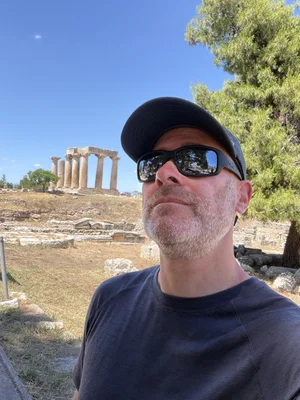
This is the exact process Lisa and I have been following as we are discerning being sent to Greece as missionaries. We are still on that path of discernment and we’ll share more about this soon.
Friends have always practiced discerning together as part of a bigger family. Sherwood Community Friends Church belongs to Northwest Yearly Meeting, a network of Friends churches in the Northwest belonging to Evangelical Friends Church North America carrying this same conviction forward across our region and nation. A few weeks ago, Jim LeShana was here sharing specifically about the organization of Friends, so if you missed that, I recommend going to our church’s YouTube channel and watching that message. He did a phenomenal job.
The point is, being Friends means being part of something bigger than what happens in this room on a Sunday morning.
Being Friends means we don't only meet with God through a stage or a sermon. Each of us carries the capacity, through the Holy Spirit, to hear from God directly.
And you were never meant to carry that alone. You test it, you hold it loosely, and you bring it to the body of Christ to discern together and to filter it through the truth and authority of God's Word.
CONCLUSION
As we bring this to a conclusion, let me just reframe some of the things we talked about.
We keep trying to open God up like some black mystery box hoping if we study the code long enough, or calculate the right formula, we'll finally have him figured out.
God was never asking us to solve him. He was asking us to trust him and walk with him in relationship.
He filled those four hundred quiet years with careful, intentional work we couldn't see. He gave John a vision to strengthen and awaken worn-out, persecuted or lackadaisical churches, not a cipher for future generations to decode.
He put his own Spirit inside ordinary people like us, not so we'd chase private certainty, but so we'd walk with him and with each other together.
The pathway through God’s Word, from Genesis to Revelation is about revealing Jesus Christ and forming us into his faithful witnesses in the present. The theme and heartbeat of Scripture is about knowing Jesus, and becoming the kind of people who follow him faithfully, together, until he returns and makes all things new.
That's actually where this whole Unfiltered series was pointed. We had many different questions, but the answers kept circling back to the same center: Jesus, and a life following him, not alone, but in community.
Which is exactly why I'm so glad about what's coming next.
Starting next Sunday, we're beginning a new four-week series built around The Community Practice, part of the Practicing the Way material developed by John Mark Comer and his team. A couple years ago we went through the Sabbath Practice, last year was the Prayer Practice, and we started this year in January with the Generosity Practice.
The Community Practice focuses on how even with more ways to connect than any generation in history, we're more isolated and lonely than ever.
Jesus never intended his followers to gather around a stage and go home strangers. He built his church around a table, real relationships, real vulnerability, real belonging. Over these four weeks, we'll dig into Scripture to unpack what it actually looks like to build rhythms of real connection, create places where you can be known, bring your brokenness into the light instead of carrying it alone, and grow through authentic relationships that can hold real love over the long haul.
If community has ever felt hard for you, awkward, thin, or missing altogether— yes even for those of us who are introverts— this series is built for you.
And just a real quick plug that our men's and women's Bible studies begin again Monday, September 14 at 6 PM right here at the church. It is a tremendous place to learn from God's Word and be in community together.
Then on October 11th, we begin a brand new series walking through the book of Revelation, verse by verse, chapter by chapter, without skimming the surface the way we did this morning. If today raised more questions than it answered, that's exactly where I want us to start when we open this exciting book together this fall.
I just want to say it all one more time as we close our Unfiltered series today. Jesus is worth following. He's building something bigger than any of us alone. And he isn't finished with us yet. Keep showing up faithfully and let’s walk this journey together.
Pray with me.
If you found value in this, here are some additional articles for you.