The Moment Everything Breaks Open
This sermon was preached at Sherwood Community Friends Church on Sunday, June 8. You can watch the video in full by clicking below.
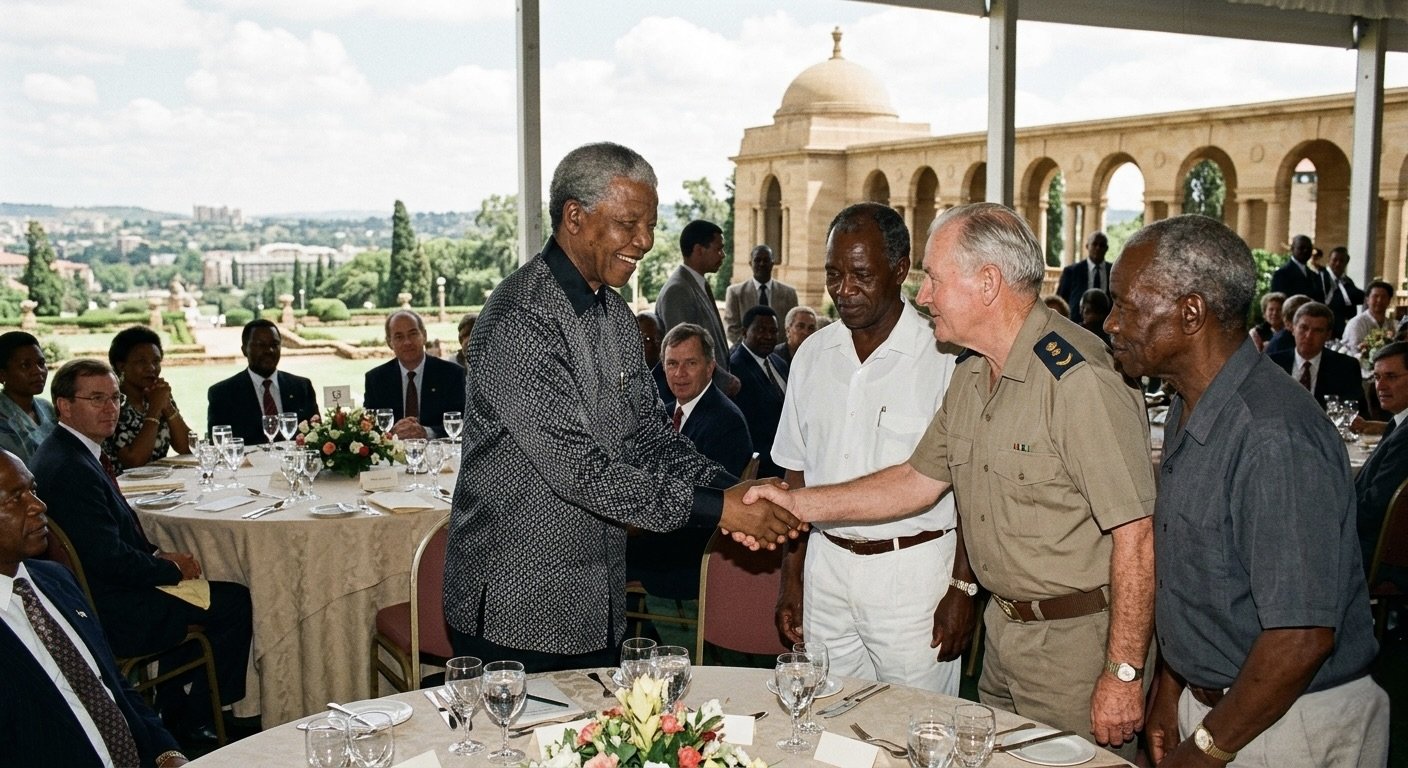
On May 10, 1994 in Pretoria, South Africa, Nelson Mandela stood before the world and was sworn in as the first democratically elected president in the history of his nation.
He had been sentenced to life imprisonment in 1964, spent 27 years breaking rocks in a quarry and watching the world behind bars, all for daring to publicly believe that every human being in South Africa deserved to be free. He had every justification, on the day he walked out of Victor Verster Prison in 1990, to spend the rest of his life organizing vengeance.
He didn’t.
At his inauguration that day, Mandela made a point of inviting three of his former prison warders to attend as his personal guests. He stood before dignitaries at a VIP lunch afterward and praised the men who had guarded his cell, saying that the people who could look beyond race were the very reason he believed South Africa would become something great. Against the advice of his critics, he helped establish the Truth and Reconciliation Commission to name what happened and decide to move forward together— which may have been the only thing that saved the country from a civil war.
There’s another man who also spent time in a pit he didn’t deserve, years in a prison on a false accusation, rose to one of the most powerful positions in the ancient world, and one day he found himself face to face with his oppressors who came to him desperate, unknowing, and completely at his mercy. We’re going to talk about that today— as his story was one recorded on the pages in the book of Genesis.
Before we do, pray with me.
THE STORY SO FAR
For those of you who are here today for the first time, we are so glad you’re with us. Let’s take a few moments to do a fly over what we’ve been doing together since April.
We are 8 sermons into a 9-sermon series called GENESIS: The Promise walking through the first book of the Bible, Genesis, and specifically looking at chapters 12 to 50.
The story opens as God calls one man out of obscurity — Abraham — to leave all that was familiar and comfortable, and makes a three-part covenant promise with him: I'll give you land, family, and blessing. God promised that through Abraham's offspring, all the nations of the earth will be blessed.
Then God blessed Abraham with a child he thought he would never be able to have, because his wife, Sarah, couldn’t conceive, and then his loyalty was put to the test. God asked Abraham to take his son to a mountain called Moriah and offer him as sacrifice there. I mean, can you just imagine?!!
And yet, Abraham went.
Bible Study Sidebar: The Hebrew word for “test” here is “nissah” and this sort of test is designed to draw out what’s inside Abraham, to develop him into who he needed to become.
At the top of that mountain, as Abraham raised the knife, God called out to stop him and Abraham spoke the name that echoes through the whole Bible: Yahweh-Yireh. The Lord provides. The Lord sees to it. Because on that mountain, provision was seen. Mount Moriah shows up once more in the Old Testament (2 Chronicles 3:1) as the exact site where Solomon builds the temple. And again, centuries later, at a hill just outside Jerusalem called Golgotha, where God did not stop the knife. What Abraham experienced on Mount Moriah was a preview of what God always intended to do himself on the cross.
The next section of the story occurs when Abraham is 140 years old and we’re introduced to one of the most beautiful words in the Hebrew language— hesed. [Say that with me. Hesed.] This is God’s never-ending, always-prevailing, covenant-faithful love. Its first appearance in all of Genesis comes in chapter 24, when Abraham sends his servant to find a wife for his son Isaac.
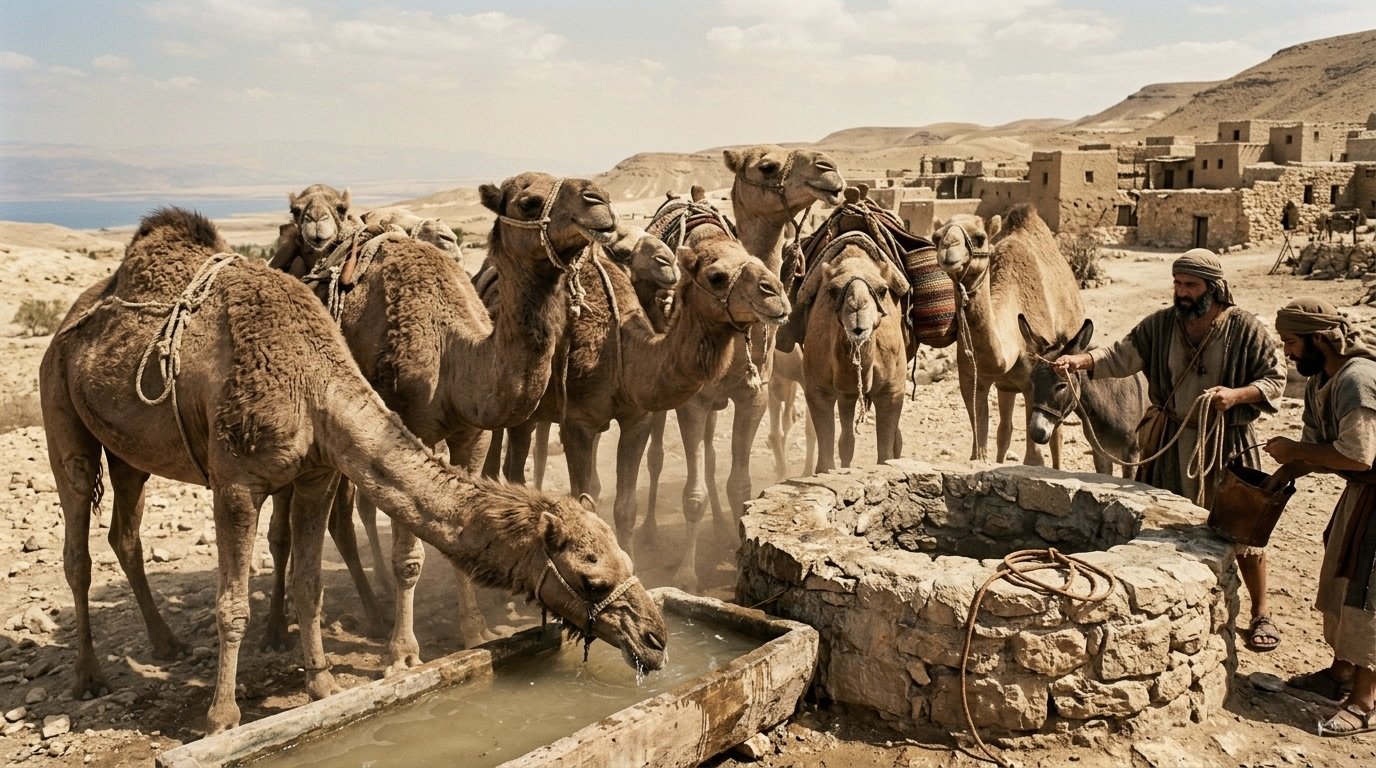
Now, he doesn't just walk up and choose a random and willing girl. He pauses before he goes into the village and asks God to have the woman he's supposed to bring back for his master’s son be a woman of sacrificial hospitality. He asks God to have her offer him a drink of water from the well, but not only that, offer to water his 10 camels also. He finds just the girl. Enter Rebekah.
I don't know about you, but I've never watered a camel. Anyone? Did you know this…? A typical camel, after a long journey, can drink up to 20 gallons of water. With the ten camels there and the size of a typical water jug, this would have been over 100 trips to the well. Several hours of work. Rebekah was a beast! She was jacked!
This is exactly what God was looking for. Well maybe not the jacked part being on her prematrimonial resume, but her heart posture. In today's terms, she was the kind of woman who ran toward the need, not away from it. Sacrificial hospitality was a core value of Abraham’s family that he personally modeled. And sacrificial hospitality is a core value of God’s family that Jesus modeled for us, the Church, to model in our lives for the world to see. Amen?!
Rebekah agrees to go marry Isaac and they begin having a family. They have twin boys, Esau and Jacob.
And it got messy. You see, Jacob was a spicy schemer who manipulated and stole his father’s patriarchal blessing from his older brother which gave him full authority over Isaac’s entire family and estate.
Then he ran for his life because, naturally, Esau wanted to kill him over it. I mean, not saying it’s right, but can you blame him?
In the midst of his running, one night, he stopped to sleep with a rock for a pillow. While he slept, Jacob had a dream, long before Led Zeppelin ever wrote a song about a stairway to heaven with angels going up and down which was a gateway connecting heaven and earth. And God showed up in that open field, stood next to him, and renewed the covenant promise over him: land, family, blessing.

Jacob then spent the next twenty years estranged from his family working at his Uncle Laban's ranch where he married two women, Leah and Rachel who bore him 12 sons (who later became the 12 tribes of Israel), and Jacob watched God bless him through all his schemes and struggles to carry the covenant forward.
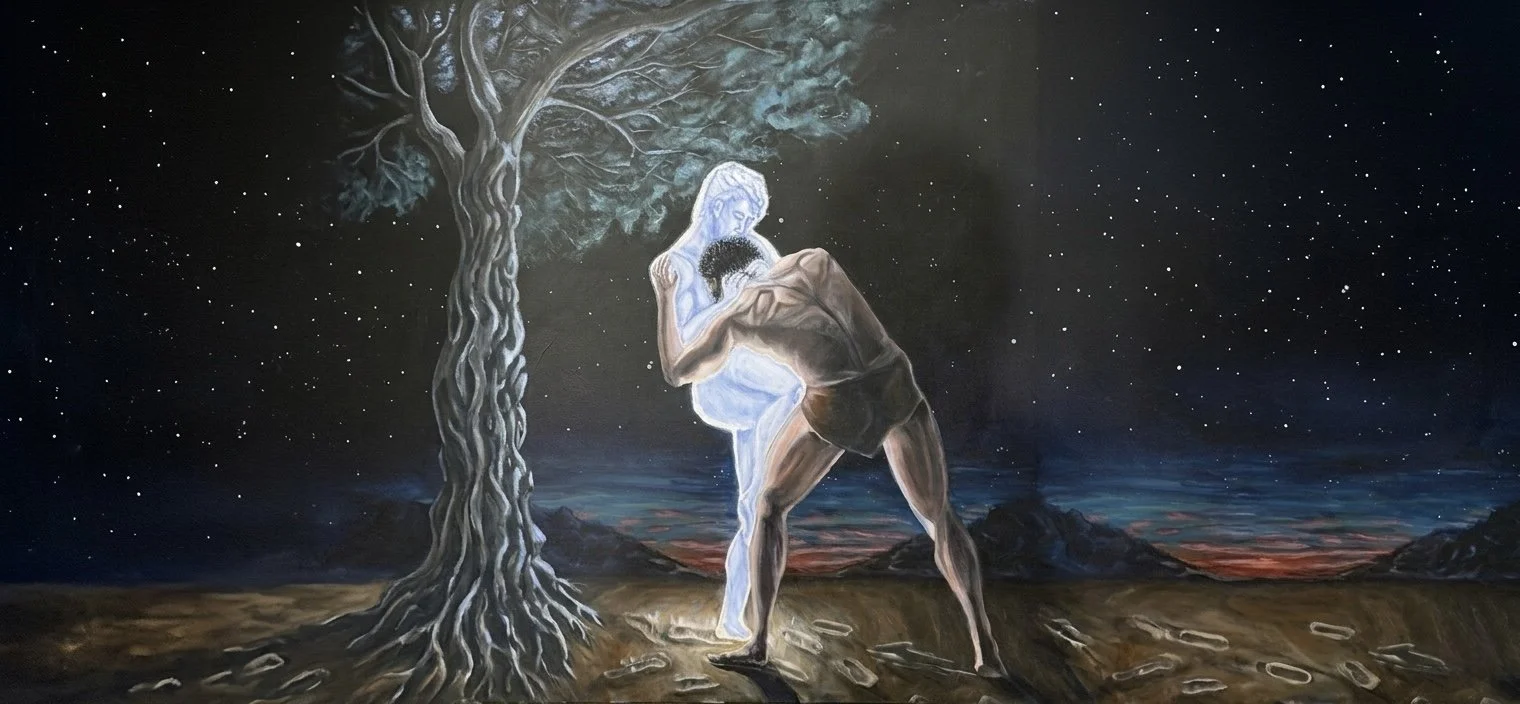
One day God spoke again to Jacob telling him to go home. On Jacob’s way back he knew he had to face his brother Esau. As his entourage approached, they camped for the evening across the Jabbok River, with Jacob on the other side where he found himself all alone when a mysterious figure wrestled with him through the night. This divine figure wasn’t trying to beat Jacob in a physical match. Think of him acting more like a bouncer, keeping Jacob out of divine space until Jacob relinquished his will and surrendered. Because with Jacob, it had always been a conflict of wills and God was using that experience to develop him into the man he needed to be. Jacob walked away from his encounter with a new name given by God— Israel— and a limp for the rest of his life which served as a permanent, every-step reminder of the night he finally stopped fighting and surrendered to God.
Last week we met Jacob’s son, Joseph. Seventeen years old, a dreamer, his father’s unapologetic favorite, given an ornate long sleeved robe of status, thrown into a pit by his own jealous brothers who hated him because of all that, and sold to slave traders headed for Egypt. He ended up in the house of a guy named Potiphar, who was Pharaoh’s captain of the guard. He recognized Joseph was wise beyond his years and placed him as his household manager. Shortly after, Joseph’s circumstances took a quick nose dive when Potiphar's wife accused him of propositioning her for sex. It was a false accusation, but Potiphar believed his wife, and that was the end of it. It was prison for Joseph. Two years forgotten by anyone who had the power to help him. And through every chapter of that suffering, the Biblical text quietly whispers this one phrase like an anchor in a storm: “the Lord was with Joseph”. God was there with him in his suffering.
After those two years in prison, Joseph is pulled out because Pharaoh had two dreams that needed interpreting. God gifts Joseph with the ability to interpret the dreams and as reward, Pharaoh elevates Joseph to one of the second highest positions in all of Egypt.
We also spent time last week looking at Joseph’s messed up, jerk of a brother Judah. He’s the one who (Genesis 37) looked at his brother crying from the pit and said: “What do we gain if we kill him? Let’s sell him to those slave traders.” That same Judah had what I would honestly describe as a train wreck of a personal life. Two out of his three sons died under the judgment of God because they were so wicked. He treated his daughter-in-law Tamar with contempt. Confused her as a cult prostitute and slept with her, which resulted in her getting pregnant with twin boys. Then he tried to execute her by burning, but was exposed, humiliated, and had to say out loud: “She is more righteous than I.” That was step one of Judah’s transformation, but God wasn’t finished with him. This week, we get to see the evidence of it.
Hold all of that in mind because it converges in the next four chapters for the rest of today’s talk.
GENESIS 42–44: THE TESTS
Joseph was 17 when he landed in Egypt a slave and is now 39. There had been seven years of agricultural abundance followed by a severe famine that covered the whole ancient Near East.
Jacob—now Israel—who thought his son Joseph was dead all this time, hears there’s grain in Egypt and sends his ten oldest sons to go buy food. Benjamin, his youngest and Joseph’s only full bio brother, stays home. Benjamin is Jacob’s last living connection to Rachel, his beloved wife who was now deceased. He’s already lost Joseph. He will not risk losing Benjamin.
What none of them know is the man running the grain supply of Egypt is Joseph. Their brother. The one they threw in the pit and sold over twenty years prior.
Bible Study Sidebar: In a moment, you’ll hear the text say Joseph was "in charge of the country" and "second in command" to Pharaoh. We tend to picture him as Egypt's one singular number two kind of like a lone vice president over an entire nation.
But scholars who study ancient Egyptian administration suggest it was more nuanced than that. Pharaoh likely had several departmental leaders— think multiple vice presidents, each overseeing a specific sector of the kingdom.
Joseph's domain was almost certainly the granaries: the agricultural storehouses, grain distribution, food supply management, and the international trade relationships that came with it. He was Egypt's chief food security officer. And in a famine swallowing the entire ancient Near East, that role made him the most consequential man in the region outside of Pharaoh himself. Every nation that needed grain had to come through Joseph. Which is exactly why his brothers ended up bowing in front of him.
Genesis 42:6-8 CSB “Joseph was in charge of the country; he sold grain to all its people. His brothers came and bowed down before him with their faces to the ground. When Joseph saw his brothers, he recognized them, but he treated them like strangers and spoke harshly to them. “Where do you come from?” he asked. “From the land of Canaan to buy food,” they replied. Although Joseph recognized his brothers, they did not recognize him.”
The original audience would have caught something in this moment immediately that might take us a minute to connect. Joseph’s original dream from chapter 37 where his brothers’ sheaves of grain bowed down to his sheaf is literally happening right here. This was the same dream, at age 17, that caused them to hate him enough to rough him up and sell him off to Egypt. The text says Joseph “remembered his dreams.” He knew exactly what he was watching.
But he doesn’t reveal himself. Not yet. He has a question that twenty years couldn’t answer for him at that moment: have they changed? So he tests them. He accuses them of being spies. He holds his brother Simeon as ransom. He sends them back to Canaan to their father with a demand to return with Benjamin. He plants their own silver payment back in their sacks and throws all the punches at them— all to see what sort of men they had become.
I do wonder if there was some part of Joseph, not necessarily in a vengeful way—more playful really—that he wanted to mess with his brothers for doing what they did to him so long ago. I mean how easy it was for him to do this and unnerve them before Joseph’s authority to really drive the lesson home for them.
As the tests unfold, something starts surfacing in the brothers. When they’re caught with the silver in their bags, they don’t deflect. They say to each other:
Genesis 42:21 CSB “Obviously, we are being punished for what we did to our brother. We saw his deep distress when he pleaded with us, but we would not listen. That is why this trouble has come to us.”
Hmm… It seems they’ve been carrying the weight of this with them all these years.
Joseph wastes no time and flexes his power to convince his brothers to go back home and bring their brother Benjamin to him. This was a test of their loyalty and honesty.
When they were home, they contemplated— over weeks, maybe months— what to do and begrudgingly convinced their father Jacob to allow them to return to Egypt with Benjamin.
After they bring Benny to Egypt, Joseph frames him by planting his own silver cup in Benjamin’s sack. Caught red handed with the sentence being Benjamin would stay in Egypt as a slave, but the rest go home free. Joseph has them right where he wants them because this recreates the original crisis exactly: will they abandon another one of Jacob’s favored sons to save themselves? Will they do to Benjamin what they did to Joseph? If they did, they knew it would surely cause their father to die of grief— and Joseph would know the undeniable truth.
But then, in an unexpected turn of events, Judah stood up and gave one of the most significant speeches in the entire book of Genesis. He laid out the whole situation— their aging father, Benjamin as the last surviving son of Rachel (who was deceased), the weight of what another loss would do to Jacob— and then he said this:
Genesis 44:33-34 CSB “Now please let your servant remain here as my lord’s slave, in place of the boy. Let him go back with his brothers. For how can I go back to my father without the boy? I could not bear to see the grief that would overwhelm my father.”
That is Judah. The man who once devised the plan to sell his brother to slave traders. The man who lived his life in such a way two of his own sons died because they were so wicked. The man who withheld his youngest son from marrying his daughter-in-law to control outcomes. The man who sexually exploited Tamar and was going to execute her by fire. This man was now standing in the gap for his brother. Offering himself. Thinking of his father’s grief. Surrendering his own life.
This is what God was building in him across all those years. Judah became the kind of man who steps in without thinking about it because that’s who he had become.
There it was— plain and simple. Joseph had his answer. His conniving brothers had changed.
GENESIS 45: “I AM JOSEPH”
Genesis 45:1-3 CSB “Joseph could no longer control himself in front of all his attendants, so he called out, “Send everyone away from me!” No one was with Joseph when he revealed himself to his brothers. But he wept so loudly that the Egyptians heard it, and Pharaoh’s household heard it. Then Joseph said to his brothers, “I am Joseph! Is my father still living?” But his brothers were unable to answer him because they were terrified in his presence.”
Three words. “I am Joseph.”
Can you imagine being in the tectonic emotion of that room?! The most powerful man in Egypt—second only to Pharaoh—just told you he’s your brother. The one you sold. The one you’ve spent twenty-some years not talking about. And he’s been looking at you the whole time— through all the tests and all the speeches.
They were paralyzed. They were terrified. They thought it was over. The ground beneath them was shifting. And then Joseph said…
Genesis 45:4-8 CSB “Please come closer to me,” he said to them. So they came closer. “I am Joseph, your brother,” he said, “the one you sold into Egypt. And now don’t be grieved or angry with yourselves for selling me here, because God sent me ahead of you to preserve life. For the famine has been in the land these two years, and there will be five more years without plowing or harvesting. God sent me ahead of you to establish you as a remnant within the land and to keep you alive by a great deliverance. Therefore it was not you who sent me here, but God.”
“Don’t be grieved or angry with yourselves.”
Wow!! I mean, really Joseph?! After all these years and everything they've done to you?! Just like that?!
Notice, he didn’t minimize what they did. He recontextualized it. He’s doing what only someone who has deeply and prayerfully processed their suffering can do. He held the whole story in view at once. Essentially he was saying, “Guys you were actors in a story God was writing that was bigger than any of us could see. The pit wasn’t the end. The prison wasn’t the end. Even the forgetting wasn’t the end. ‘God sent me ahead of you.’”
Three times in this passage Joseph says that. Three times. Are you getting it guys? God had a redemption plan and was writing his story, through all the turmoil and suffering, with Jacob and his 12 sons that was bigger than any of them— bigger than all of us! Amen?!
GENESIS 46: “MY SON JOSEPH IS STILL ALIVE”
To capstone this for today, the text says the brothers ride back to Canaan with the good news. Here’s how Jacob receives it…
Genesis 45:26-28 CSB “They told him, “Joseph is still alive, and he is ruler over all the land of Egypt.” Jacob was stunned; he did not believe them. But when they told him all that Joseph had said to them, and when he saw the wagons that Joseph had sent to transport him, the spirit of their father Jacob revived. “My son Joseph is still alive,” Israel said. “I’ll go and see him before I die.””
“The spirit of their father Jacob revived.”
For over twenty years, Jacob had gone to bed every night grieving a son he believed was dead. He had refused to be comforted. He told his children he would carry this grief to his grave. And now from the same mouths that lied to him all those years ago are bringing him back to life.
In chapter 46, Jacob packs up his entire household and heads toward Egypt. At Beer-sheba— the holy place where God had appeared to Jacob’s father Isaac— God speaks to him one more time.
Genesis 46:3-4 CSB “God said, “I am God, the God of your father. Do not be afraid to go down to Egypt, for I will make you into a great nation there. I will go down with you to Egypt, and I will also bring you back. Joseph will close your eyes when you die.”
Even the move to Egypt was in God’s hands. The covenant was still intact and the promise was still moving forward.
And then comes the reunion we’ve been waiting for.
Genesis 46:29-30 CSB “Joseph hitched his chariot and went up to meet his father Israel in Goshen. When he appeared before him, he threw his arms around his father and wept for a long time. Israel said to Joseph, “Now I am ready to die, since I have seen your face and you are still alive.””
A father and son, across twenty-plus years of grief and separation, finally holding one another. And the old man saying: this is enough. I’ve seen your face. I can go now. Wow!
While there was so much happening in Joseph's life as he took on all the responsibilities given to him by Pharaoh, he was in a season of waiting. He wasn't quite sure what he was waiting for, but he knew God had him where he intended him to be for a specific purpose.
Sometimes— and I want to be careful here, because I don't mean all the time, and I don't even mean most of the time— God calls us to wait. Sometimes we are to wait for him to act, but he's not asking us to wait in a passive sense of waiting by doing nothing. He wants our prayer relationship with him. He wants us in his Word every day. He wants us with his people here at church. He wants us to teach others to obey everything Jesus has taught us and make disciples who make disciples that bring his hope and life into the world. He wants our presence so he could give us his.
Oftentimes, God asks us to wait because he needs us to stop doing something, whatever it is — even our normal routines in life — by our own strength and in our own way. He wants to slow us down so he has space to form us.
In spiritual formation, we are called to be something first, and as we become through the trials, then we do something out of what we become. Who I am becoming has to precede what I am doing. If I don't like what I'm doing or who I've become, I need to humbly and prayerfully reassess this to have God make the necessary changes. This takes time, and in those waiting seasons God is forming us, refining us, developing us to become who he wants us to be— as long as we surrender to allow him space. When we do, God will lead us in his life-giving way.
Jesus is the way of life and the way to life.
APPLICATION
Here’s where we land today.
Like Mandela, Joseph had every reason to use what he had been given against the people who gave him nothing but pain. He had power. He had proximity. He had opportunity. And yet he looked at his brothers and said: come closer.
That’s love. Not as a feeling— as a choice. Real love expressed through forgiveness.
We’ve been walking through the seven basic commands of Christ throughout this series: repent, be baptized, break bread, love, pray, give, and go.
I think the one that fits best for us today is love.
John 13:34 CSB Jesus said, “I give you a new command: love one another. Just as I have loved you, you are also to love one another.”
Just as I have loved you. Jesus didn’t say: love the people who deserve it or only those you like. He said it straight: love the way I love you.
Love the people who don’t deserve it. Love the people it’s hard to love. Love the ones who have betrayed us and those who hurt us deeply.
Loving people doesn’t excuse their bad behavior or even suggest we need to like them.
Love is a choice. Love is costly. Love is unearned. Love asks something real from the one giving it.
Honestly, who in your life are you waiting to love until they’ve changed “enough”?
Who is the person, maybe in your family, your neighborhood, your workplace, somewhere in your past, that you’ve put conditions on or said you would never forgive them?
Who have you told yourself: when they apologize, when they finally get it, when they’ve earned it, shown evidence of change, or only when I feel like loving them then I’ll move toward them?
The truth is, Jesus didn’t wait for us to do any of that. He forgave us and said, “Father forgive them for they know not what they do” (Luke 23:34). We are to love because he first loved us (1 John 4:19).
Love. Choosing love. Genuine love comes only when we follow Jesus’s sacrificial example of love.
Will you love like that?
Let’s silently sit with that and prayerfully bring our hearts before the Lord together.
Prayer
“Most merciful God, we confess that we have sinned against you in thought, word, and deed, by what we have done and by what we have left undone. We have not loved you with our whole heart; we have not loved our neighbors as ourselves. We are truly sorry and we humbly repent. For the sake of your Son Jesus Christ, have mercy on us and forgive us; that we may delight in your will, and walk in your ways, to the glory of your name. Amen.” (Book of Common Prayer General Confession)
If you found value in this, here are some additional articles for you.