GENESIS: God’s Story From The Beginning
This sermon was preached at Sherwood Community Friends Church on Sunday, June 28. You can watch the video in full by clicking below.
Over the past six months we have been in the book of Genesis, the first book of the Bible. We looked at it in two phases. The first was called Genesis: The Preface where we unpacked chapters 1 through 11. The next phase was Genesis: The Promise where we unpacked chapters 12 through 50. We took a few breaks along the way for Holy Week, Mother's Day, and Father's Day, but we stayed in it.
To help us remember where we were, I’m going to give you a capstoning 30,000 ft overview of the whole book: God’s Story From The Beginning.
We’re going to briefly zoom all the way out and see the whole story at once— all fifty chapters. One story. Because when we hold the whole book together in our hands something becomes clear that we can miss when you're sitting inside the individual stories.
The first important thing I want all of us to keep in mind for perspective sake is: Genesis is not about us.
The fourth word in the English translations of the book— which is the fourth word in the entire Bible— is God. In the beginning... God. Not: in the beginning, Abraham figured it out. Not: in the beginning, humans did this or did that. This story is about God. He’s the main character from page one, and every story that follows is a story about him— and we ought to read his book from his vantage point.
Sure there are other characters in the story, however, the characters in the story are not delivering the message; therefore, they do not carry its authority. The narrator delivers the message and he’s the one who has authority. We ought not spend our time evaluating the Bible characters too extensively, but spend time evaluating or understanding what the narrator is communicating because it is the narrator who is the vessel of God’s authority.
As we listen to the Genesis story, here’s the big idea I want us to carry out of this room today:
God is the God of overcoming obstacles.
[say that with me]
Every story in Genesis— every family, every failure, every impossible situation— is a story about something or someone standing in the way of God's purposes. And every single time, without exception, God overcomes it.
Let me show you what I mean.
Genesis 1-2: The obstacle of chaos.
The book of Genesis opens in darkness. The earth is formless and empty. Tohu vavohu are the Hebrew words it uses. Chaos. Void. Nothing. These are the first obstacles. But the Spirit is hovering there.
And then God speaks. Light appears. Land rises from the sea. Stars are hung in place. Animals fill the earth. And into all of it, God forms a human being from the dust and breathes his own breath into them. He places them in a garden where he would hand craft his dwelling place, his sacred space on earth and gives the humans a vocation: bear my image and make more imagers, rule my creation well, and fill this world with my presence.
Obstacle one cleared. God made a world and called it very good.
Genesis 3: The obstacle of betrayal.
But then something breaks.
The humans, surrounded by everything good, choose to reach for the one thing God asked them not to touch. They trade trust for autonomy. They decide they'd rather be their own god than live in relationship with the real One. And the consequence is devastating. They are separated from the presence of God. Exiled from the sacred space of the garden.
The obstacle is no longer just chaos. Now it's fracture. Spiritual death. Separation from sacred space. And the rest of the Bible— from this moment forward— is the story of God working to close that distance and bring us back into his sacred space.
But before God removes his fallen humans from the garden, he makes a promise. He looks at the serpent and says:
Genesis 3:15 CSB “I will put hostility between you and the woman, and between your offspring and her offspring. He will strike your head, and you will strike his heel.”
Obstacle two is the fracture, but met with promise one.
Umm wait, but I thought God created us in his image and he loves us and wants to be with us? Why didn't he stop the fracture from happening? It's because of how much he loves us. He loves us so much that he didn't program us to love him. He didn't force us to love him. He gives us the choice and the agency to decide whether we love him or not. He loves us so much that he is willing to let us not love him and go our own way.
He did and we did. And God says: that’s not the end of the story.
Genesis 4-11: The obstacle of sin multiplying.
The fracture doesn't stay contained. Adam and Eve’s son, Cain, kills his brother Abel. The human story grows darker. Violence fills the earth. By chapter six, God looks at what the world has become and grieves. The obstacle is no longer one bad choice, but the whole human species in freefall.
So God does something radical. He finds one man, Noah, and preserves the world through him. Here’s where we see spiritual beings corrupting mankind even more, resulting in the flood, the ark, and the first covenant sealed by branding a colorful bow in the sky.
Even after this hard reset, it doesn't take long. By chapter eleven, humanity has gathered in one place to build the tower of Babel to make a name for themselves. This is the same impulse as Genesis 3 with the same reach for autonomy to be one’s own god. But it was far worse than that.
Their goal was to unite together to get God to come down to them on their own terms so they could control him by tending to whatever needs they thought he had, and therefore he would owe them something. Bad move. So God scatters them and confuses them by changing their united language into many.
You'd think the story was game over. That God would walk away.
He doesn't. He’s not done yet. Because he’s about to set his master plan in motion.
Genesis 12: The obstacle of a dead-end family.
Chapter 12 opens as God calls one man out of obscurity—Abraham—to leave all that was familiar and comfortable, and makes a three-part covenant promise with him: I'll give you land, family, and blessing. God promised that through Abraham's offspring, all the scattered nations of the earth will be blessed.
Genesis 12:1-3 CSB "Go from your land, your relatives, and your father's house to the land that I will show you. I will make you into a great nation, I will bless you, I will make your name great, and you will be a blessing. I will bless those who bless you, I will curse anyone who treats you with contempt, and all the peoples on earth will be blessed through you."
This passage is THE CENTRAL message of Genesis. The narrator comes back to this message (promise) over and over again. He doesn't come back to chapter 1 or 3, 6 or 11 or anything else, but this promise is returned to again and again.
God's answer to a fractured, scattered world is not an army or to smite every human like he did during the flood reset. Instead, his plan focused on one family. One covenant. One promise.
The only problem? Abraham’s wife, Sarah, is barren. They have no children and she couldn’t bear any. And to top that off they're old— like really old— in their 90’s old. The very promise that Abraham’s offspring will bless the world has one enormous obstacle standing in front of it. There is no offspring.
Genesis 15-21: The obstacle of barrenness.
Decades pass after the promise is made. Abraham and Sarah wait. They doubt. They try to help God out by finding a surrogate to the plan and Abraham’s son Ishmael is born, but their plan doesn't go well.
[Pro Tip: I don't recommend taking the reins and trying to help God out. He doesn’t need help. He knows what he’s doing. We only need to trust him and follow his plan.]
But nonetheless, they tried to push the plan forward in their own way and God stayed with them. He shows up and says: this time next year, Sarah will hold a son in her arms and Abraham, you will be the father.
To that, Sarah literally laughs out loud!
But true to his promise, Isaac is born.
Obstacle cleared. God overcame barrenness.
Genesis 22: The obstacle of sacrifice.
Next up, the story takes an interesting twist when God tells Abraham to take Isaac— the son of the promise, the miracle child, the only way forward for everything God promised he would do— and offer him on a mountain as a sacrifice. To take him up and kill him there.
That must have been one hard day.
Yet Abraham goes. He ties his son to the altar. He raises the knife.
And in the sweeping moment where Abraham was swiping down the blade, God stopped him by calling out his name.
God then provides a ram caught in the nearby thicket as the sacrifice and Abraham names the place “Yahweh-Yireh”, meaning the Lord provides. In this test of his true faithfulness— which Abraham passed without compromise— and in the provision, God reaffirms the covenant.
Centuries later, on that same mountain, Mount Moriah, the same hill where King Solomon would build the sacred space of the Temple, the adjacent ridge is where Jesus would be crucified— only then, God did not stop the knife. He let it fall. On his own Son— who willingly offered his life on the cross for many.
Obstacle cleared. God overcame death. [And he would do it again.]
Genesis 24-26: The obstacle of continuity.
Isaac grows up, marries a jacked woman named Rebekah who was a person of sacrificial hospitality, and discovers she too was barren [because of course she is, right?! Why not toss another obstacle into the mix!]
But God opens her womb. Twin boys are born: Jacob and Esau. The covenant continues.
Genesis 27-36: The obstacle of a fractured family.
Jacob, whose very name means deceiver, earns the reputation of his name. He schemes to steal his brother's patriarchal blessing, runs for his life because of it, dreams of a stairway to heaven, gets deceived by his own father-in-law, and spends twenty years far from home estranged from his family. And yet, at his lowest moment, God meets him one night for a wrestling match of wills on the Jabbok riverbank where Jacob finally surrendered. Jacob walked away from that encounter with a limp and a new name, Israel, meaning the one who struggled with God and prevailed.
For the rest of his life, every step Israel would take carried a reminder as proof he surrendered to God, God broke him, and he would never again be the same man who walked alone. His limp meant identity and transformation. His limp was proof.
And God’s promise continued through him.
Genesis 37-50: The obstacle of a pit.
Next we’re introduced to one of Jacob’s twelve sons, Joseph.
Seventeen years old. Father’s favorite. Also a dreamer. Adorned with an ornate robe and sent out to be his father’s tattle telling eyes and ears. His own brothers hate him because of it so they throw him in a pit and sell him into slavery. He ends up in Egypt as a servant, then after being falsely accused, forgotten in a prison cell. Every step forward seems to take him further from any kind of future.
But the Biblical text quietly whispers three different times: “The Lord was with Joseph” (Genesis 39:2,21,23).
God was with him in the pit. God was with him in the prison. And Joseph— through faithfulness in seasons of feeling invisible, through gifts only God could give— rises to second in command of the most powerful nation on earth.
When famine devastates the land and his brothers show up in Egypt, hungry and desperate, the very man they threw in a pit is controlling the food supply. And when they finally recognize him and fall before him in terror, Joseph doesn't take revenge. He weeps. He realized, in that instance, what his boyhood dreams had always meant and how God had prepared ahead of them for this very moment.
And then he says something that is, honestly, the theological summary of the entire storyline:
Genesis 50:20 CSB “You planned evil against me; God planned it for good to bring about the present result — the survival of many people.”
That's the whole book, guys. That’s all of Genesis.
And yet Genesis ends with something unresolved. Joseph dies in Egypt. But before he does, he makes one request. He asks his family to carry his mummified bones out of Egypt when God brings them home. God’s covenant people were still in a foreign land. The promise wasn’t finished yet.
The first book of the Bible sets God’s master plan in motion because what we see is Genesis doesn’t close the story. It hands it forward.
Eight centuries later, the One Genesis points to, Jesus walked out of a tomb. With the ultimate God-mode power move the world had ever seen on full display, the scattered exile ends. The fracture closes. The promise is fulfilled. Real hope returns.
To receive this we only need to surrender to Jesus as Lord, declare God raised him from the dead, put our full trust in him, and follow wherever he leads.
The book of Genesis traces the idea of God’s Covenant. In the process, the book establishes a case for the mastery of God. God has shown his mastery in creation, in the promise of the covenant, and throughout history. This is what the narrator is doing by establishing the covenant with God’s mastery.
In doing so, God advances his covenant plans and purposes by transforming the identity of his people.
Remember this about Genesis: God is the God of overcoming obstacles.Amen?!
Every single time. And he’s not finished yet. His story is still being written. Will you choose to surrender today, tomorrow, each morning, and walk with him?
Concluding Prayer
Father God- As we read Genesis, as we read any book of the Bible for that matter, help our perspective not be on what the people are doing in the story, but what you, God, are doing in your story. When we do that, we journey down the road to unlock its full authority and have it forever change our lives. Father, have the power of your Word forever change our lives by being the dominating source of hope and truth we crave and give our attention to above all else. Help us be people of your book and changed by your book as we follow Jesus out of its pages and into real life with Christ. In Your Holy Name we pray. Amen!
Question & Response
Alright, I want to invite Lisa to join me up here, and we're going to open it up to your questions. We're staying in Genesis— so we invite you to ask any question about this book that has come to your mind or that you’ve wrestled with or have always been curious about.
There are no stupid questions, and if you think the question you ask is stupid, there might be another person or two thinking the exact same thing. It’s important to bring that question. No one’s going to judge you for your question.
Close: Next Week
I realize next week is a holiday weekend, but if you're able to come, please do. We invite you back and bring somebody with you to be part of our church family.
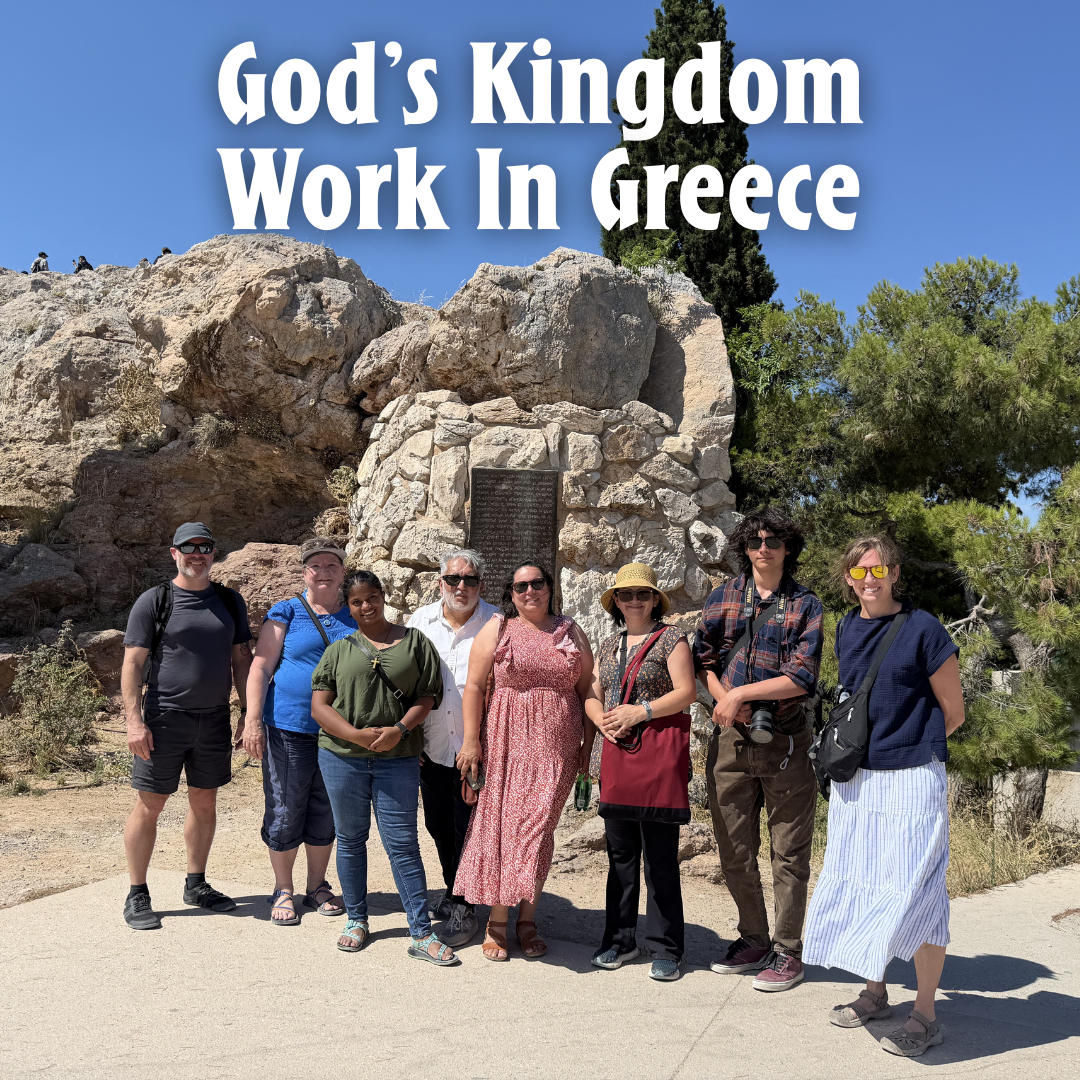
Next Sunday, I'll be sharing about my experience in Greece and what I saw God doing there in the lives of so many people.
Pray with me.
If you found value in this, here are some additional articles for you.