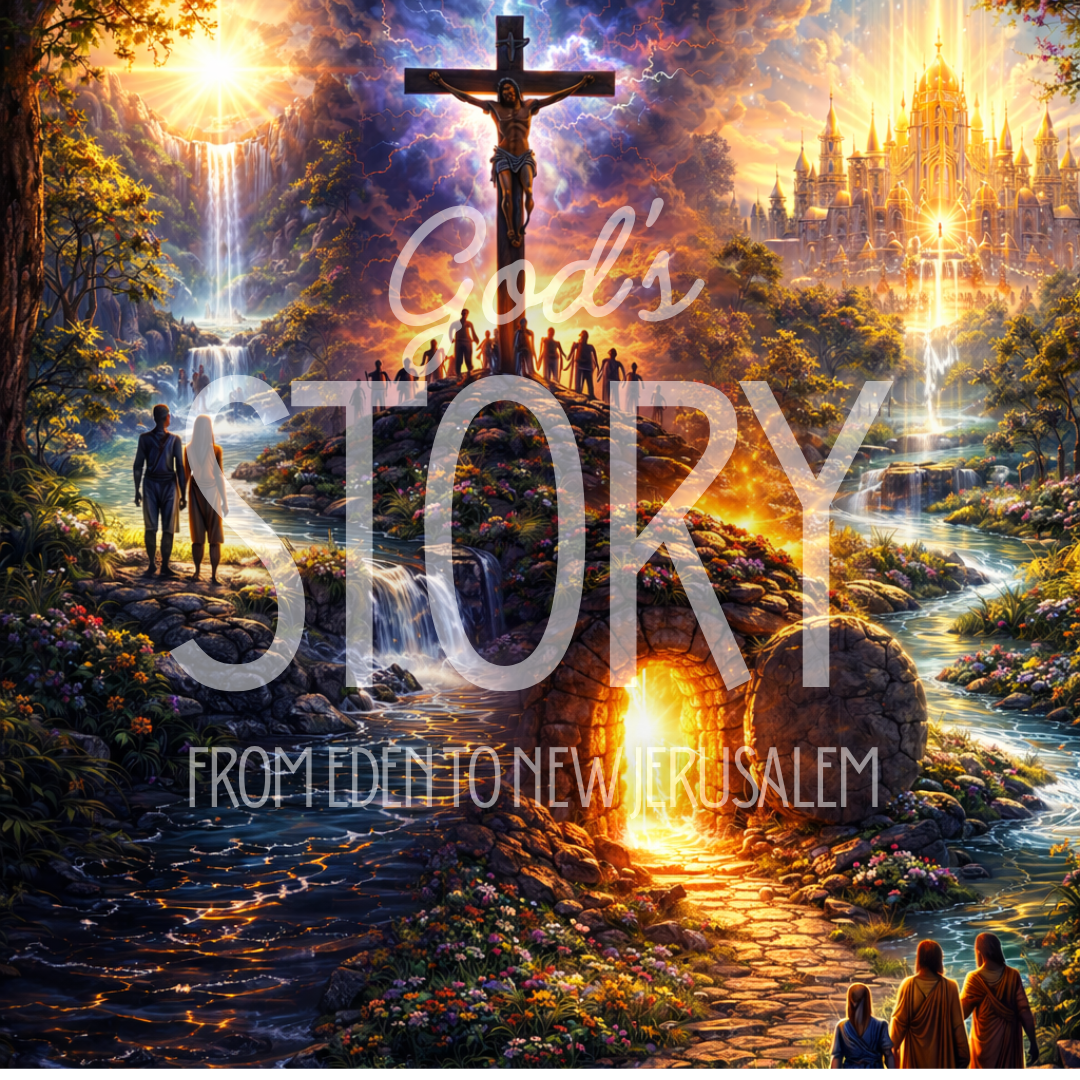
God’s Story: from Eden to New Jerusalem
In 2005, Brian Nichols escaped from a courthouse in Atlanta after killing several people. Later that night, he broke into an apartment and took a woman named Ashley Smith hostage. They did a movie on this encounter in 2015 called Captive.
Everything in that room said: this is how it ends.
Fear in the air.
Time running out.
No control.
And in the middle of that chaos… Ashley Smith asked for a Bible.
Not to wave it around like a religious symbol.
Not to quote something cute.
But to read it—out loud.
So she did.
Page after page. Psalm after psalm. Gospel words. The kind of words you don’t read when life is easy… the kind you cling to when everything is shaking.
And here’s the part that gets me:
Something shifted.
Not because Ashley suddenly became powerful.
Not because the room suddenly became safe.
But because God’s Word has a weight to it when it’s spoken into the dark.
As Scripture was read out loud—along with reminders of God’s mercy and the possibility of forgiveness—Nichols began to unravel. His anger started to crack. The panic started to collapse. The human underneath the violence started to surface.
And eventually… Brian Nichols surrendered peacefully.
Now listen—don’t romanticize that. That story is soaked in tragedy and trauma. But it also carries a truth I don’t want us to miss:
When everything is stripped away—when you don’t have a plan, and you can’t control outcomes—God’s Word still does what God’s Word does.
It doesn’t just inform.
It exposes.
It comforts.
It confronts.
It heals.
It leads people back to reality.
And that’s why we’re talking about the Bible today—not as a churchy habit, not as a religious accessory, but as something God uses to speak life in places we can’t fix or control and illuminate his light into the darkness within every one of us.
Biblical Intro
Before we go any further, I want to mention I’m drawing some of this framing from BibleProject’s “How to Read the Bible” series which is super helpful. Keep in mind BibleProject DOES NOT replace Scripture, but they do immensely help us see what God is already doing in Scripture.
If you’ve ever felt overwhelmed by the Bible—confused by the order, unsure how the pieces fit together, or tempted to read it like a grab-bag of verses—you should know there are excellent tools available. BibleProject offers clear, thoughtful succinct overviews of every book of the Bible, along with videos, articles, and themes that trace key words, ideas, and storylines across Scripture. Their website, YouTube channel, and app are designed to help everyday people see the big picture—how this whole thing actually holds together—and to read the Bible with more confidence and clarity as one unified story.¹ And it’s all completely free!
Now—with that said—let’s talk about what the Bible actually is.
When we say “the Bible,” we’re not talking about a magic book that floated down from the clouds and landed on somebody’s desk. The Bible is a collection—a whole shelf of writings bound into one story—that took shape over a long stretch of real human history, inside mainly one particular people group, as God was actively at work with them. And that’s the tension: it is God-breathed, and still unmistakably carried by human hands and voices—not because God bypassed people, but because God chose to speak through people, time, process, and even complexity as partners of his communication.
And that history matters.
This collection of writings didn’t come together overnight. It was written over more than a millennium—roughly fifteen hundred years—by around forty human authors inspired by the Holy Spirit (2 Timothy 3:16-17), across multiple continents, in three primary languages: Hebrew, Aramaic, and Greek. It holds together 66 books total—39 in the Old Testament and 27 in the New Testament. And somehow—miraculously—it still tells one unified story.
That alone should make us slow down and pay attention.
Biblical scholar John Walton puts it this way: “The Bible was written for us, but not to us.” That line is gold.
What he means is this: Scripture is absolutely meant to shape us, guide us, correct us, and lead us into life with God—but it was first spoken into ancient cultures, with assumptions, questions, and worldviews very different from our own. Knowing the original audience matters.
The Old Testament emerges from a Hebrew world—a people shaped by covenant, land, temple, sacrifice, family identity, and eventually exile. Exile wasn’t just a historical event where the Jewish people were removed from their home country; it reshaped everything. When Israel lost their land, their king, their identity, and their temple, they were forced to ask deeper questions: Is God still faithful? Is he still with us? What does obedience look like now? Much of the Old Testament is forged in that tension—faith being relearned in loss.
Then the New Testament writers step into a different pressure cooker altogether. They are still Jewish—but now they’re living in a world shaped by Hellenization, where Greek language, philosophy, and empire influence how people think about power, identity, truth, and even the gods. And into that world, these writers make a bold claim: Jesus is Lord—not Caesar. That would cost many of them their very lives. The gospel moves forward in Greek, but it carries a deeply Jewish story, insisting that the long-awaited Kingdom of God has arrived in Jesus.
So when we read the Bible, we’re not reading modern Western thought with religious language sprinkled on top. We’re listening in on ancient conversations—Hebrew and Jewish conversations—about God, reality, faithfulness, suffering, hope, and redemption. Our task isn’t to drag the Bible into our world too quickly and it would be quite irresponsible to do so. It’s to step into their world first… and then let the Spirit bring it forward into ours.
When we let Scripture speak on its own terms, it opens up in powerful ways.
And this is where everything starts to come together.
The Bible is carefully crafted literature—divine literary art. It has design. It has seams. It has echoes. It has hyperlinks. The biblical authors—and later the faithful editors and compilers—didn’t treat these writings like a random pile of religious thoughts. They were shaped into a unified story that can actually be followed. That unity isn’t mainly “all the verses agree with each other.” It’s that the whole thing is intentionally woven together around a single forward-moving message: God’s purposes unfolding through the story of Israel for the sake of the world in Jesus.
And that story is designed to lead somewhere.
Jesus himself says the Hebrew Scriptures—the Law of Moses, the Prophets, and the Psalms—were always pointing to him (Luke 24:27). By the time you reach the gospels, you’re not meeting a new idea; you’re meeting the long-promised resolution. The Messiah the Scriptures have been training us to look for is not primarily a conqueror who wins through force, but a King who serves, suffers, dies, rises from the dead—and who brings God’s kingdom in a way no one expected until Jesus opened the Scriptures and helped his followers see the story they had been standing inside all along.
In a moment we’re going to thematically take the Bible, cover to cover, and talk about God’s story—from Eden to the new Jerusalem. I’m not giving you a Bible highlight reel. We’re stepping into a carefully designed, communal, multi-genre masterpiece that has been carrying one relentless heartbeat from the beginning: God creating a world meant to be a garden-temple; humanity unraveling that calling; God choosing Israel as the vehicle for restoration; Israel struggling, breaking covenant, and going into exile; the prophets insisting exile won’t be the end; and Jesus arriving as the faithful Israelite, the true human, the promised Son of David—launching God’s kingdom through his life, death, and resurrection—until the story finally resolves with heaven and earth renewed, reunited, and God dwelling with his people forever— as he always intended— here on earth from the ground which we were created, not up somewhere in the skies.
The Bible is the doorway.
And once you walk through it, the Bible stops feeling like a confusing stack of ancient religious documents—and starts reading like one sweeping, relentless story of God refusing to give up on his world.
Footnote
¹ Resources referenced are from BibleProject — including their How to Read the Bible podcast series, book overview videos, theme studies, articles, YouTube channel, and mobile app.
Ok… let’s just pause here and pray.
God’s Story: From Eden to New Jerusalem
Come close for a minute. Not because this story is tame… but because it’s true.
If you stand at the doorway of the Bible and look down the long hallway of its pages, you realize quickly: this isn’t a religious rulebook. It’s not a disconnected anthology of moral lessons. And it’s not primarily about how to get to heaven when you die— because it never says that.
It’s a story. A long, honest, sometimes uncomfortable story about God’s relentless desire to live in relationship with humanity—and humanity’s ongoing struggle to trust him.
God’s story begins where every good story begins: with a world that is good.
ACT 1: Creation
“In the beginning God created the heavens and the earth (Genesis 1:1).”
At the beginning, there is no hurry in how God ordered his world.
He was not a distant architect who winds it up and walks away. God creates as a present Father—speaking, shaping, blessing, dwelling. He forms light and land and sea. He fills the world with life. And when he looks at what he has made, he calls it good (tov). And when he makes humanity, he calls it very good (tov me’od).
God builds his world to share with his humans.
God creates a space where heaven and earth overlap—where his presence is near. And then he places humanity in the small garden of a larger place called Eden as his image-bearers: not as pets, not as slaves, but as partners. Humans are given a calling: represent God, steward his creation, cultivate what’s good. (Genesis 1:26–28)
God gives freedom. God gives boundaries. God asks for trust.
And for a moment, everything is as it should be.
But then the story breaks—right where every one of our stories breaks.
ACT 2: The Fall
The fracture isn’t first about appetite. It’s about distrust.
The slimy serpent doesn’t deny God’s existence. He attacks God’s character.
He inquired of the humans, “Did God really say…?” (Genesis 3:1)
The temptation isn’t simply to disobey—it’s to believe a new narrative: God is holding out on you. God cannot be trusted. You have to take control.
And the moment humanity believes the wrong story, everything starts unraveling.
Shame enters. Hiding begins. Blame spreads. Trust collapses.
Sin doesn’t stay in the heart. It spills into relationships and families and society—like a dye that won’t stop bleeding.
Cain kills Abel (Genesis 4). Violence fills the earth (Genesis 6:5). Human pride builds the Tower of Babel (Genesis 11:8–9).
By the time we get just 11 chapters in (Genesis 11), the world is fragmented: scattered languages, scattered people, scattered hearts. And underneath it all is the same question: Can God be trusted?
Now here’s what’s wild.
God does not respond with a full reset.
He responds with a promise— because he still desires partnership.
ACT 3: Abraham and the Promise
Genesis chapter 12 is a major turning point in the entire Bible. God chooses one man—Abram—and makes a promise that becomes the backbone of everything that follows:
He said, “I will make you into a great nation… I will bless you… and all the peoples on earth will be blessed through you.” (Genesis 12:1–3)
In other words: I’m going to heal this broken world through a family. Through relationship. Through covenant. Through partnership.
God is not just saving individuals. God is building a people.
And if we don’t understand that—if we don’t understand God’s covenant purpose through Israel—we’ll misunderstand everything else.
Because the Bible is not God abandoning humanity after the fall. It’s God pursuing humanity through covenant love and doubling down on partnership.
Torah
The first five books of the Bible are known as the Torah and they are the foundation— the entire Bible’s bedrock.
Torah is not just “law.” Torah is instruction. A story that teaches a people being formed how to remember.
And Torah says, “Here’s how this story got broken… and here’s how God begins making it right.”
It tells of Abraham’s family becoming a people. He fathered his son Isaac. Isaac fathers Jacob. And Jacob fathers 12 sons who become the 12 tribes of Israel.
Torah tells us about how all the Israelites get stuck in slavery in Egypt. It tells of God hearing their cries, seeing their suffering, and moving toward his people with power and compassion.
Then comes the Exodus—the rescue plan.
God said, “I have observed the misery of my people in Egypt… and I have come down to rescue them.” (Exodus 3:7–8)
That’s God. That’s what he’s like.
He delivers Israel through the Red Sea on dry ground by a miracle partnered with their leader, Moses. God feeds them in the wilderness. He leads them by his Spirit’s cloud by day and fire by night. He teaches them to live as a free people.
And then Mount Sinai is where the marriage ceremony occurs.
This is also where many people get lost, because they think the commandments are just God being strict. But Torah is a gift.
The Law through Moses isn’t God saying, “Obey so I will love you.” It’s God saying, “I rescued you because I love you and I loved you first. Now learn to live free without becoming slaves in Egypt again.”
At Sinai, God binds himself to them:
He said, “I will be your God, and you will be my people.” (Exodus 6:7) Marriage. Partnership.
The commandments become guardrails for relationship. Worship God alone. Don’t exploit your neighbor. Don’t turn humans into objects. Don’t build a society on lies and manipulation. Keep Sabbath every week so you remember you’re not a slave anymore and as an act of resistance to human empire.
God instructed them to build a Tabernacle, a sophisticated large tent compound, so he could move in among his people.
Torah is the foundation of the Bible because it answers the question: What does life with God actually look like in our broken world?
But the story doesn’t stop at Sinai. God is leading them somewhere.
ACT 4: Land and the Test
After Moses passes the torch to his successor Joshua, Israel enters the promised land, and the question becomes: Can a people shaped by trust live differently than the nations around them?
Next scene, the book of Judges, is brutally honest. It says several times, “Everyone did what was right in their own eyes.” (Judges 21:25)
Not because they lacked information—because they lacked trust.
I would describe the judges not as moral heroes in a “sin cycle,” but as recurring instruments in a redemption cycle, revealing God’s relentless patience, compassion, and commitment to rescue his people as they slowly learn how to walk with him.
But as the story goes, they drift. They compromise. They forget. They cry out. God rescues. And the cycle repeats.
Eventually, Israel demands a king—not because God asked for one, but because they want security, power, sameness.
They want to be like everyone else.
God warns them. They insist. God allows it.
He gives them a donkey herder as their first king and then after he fails, a shepherd boy by which all other kings would be compared— well because almost all their other kings were wickedly terrible.
And here’s what the story reveals: the problem isn’t simply kings.
The problem is what humans always do with power.
Some kings listen. Many don’t. Even the best ones crack under the weight of desire and ego and fear.
Wisdom Literature
And right in the middle of that national chaos, God gives another kind of gift: wisdom literature.
The wisdom books are God’s formation for everyday life. They’re for the kitchen table. The marketplace. The marriage. The inner world. The chariot ride to work.
The Book of Proverbs teaches that the fear of the Lord is the beginning of wisdom (Proverbs 9:10)—that reality works best when you live in alignment with God’s ways by trusting him.
150 Psalms give Israel a prayerbook—worship for joy, lament for grief, confession for sin, hope for the waiting.
Ecclesiastes wrestles with the meaninglessness of life “under the sun” and refuses shallow answers.
The book of Job is described as an inspired drama that reframes suffering around perspective— because only God can “mine” true wisdom from what we can’t see, and the book’s point isn’t an explanation for pain and suffering in the world, but an invitation to trust God’s bigger view when answers never come.
Wisdom literature is how God forms a people to stay human in a dehumanizing world. It’s how they learn to trust God with their hearts, not just their headlines.
ACT 5: The Prophets
Then come the prophets. They are NOT fortune tellers, but covenant prosecutors, identity reminders, and hope-bearers.
They stand in the middle of God’s story and say, “You have forgotten who you are.”
They call out idolatry, injustice, immorality exploitation, empty religion. They say, You can’t sing worship songs and neglect the poor. You can’t claim God and live like Babylonians (ancient Las Vegas meets New York).
And yet, for all their fire, the prophets are not mainly doom. They are mercy with a megaphone.
They warn: judgment is real. God will not allow evil to go unchecked forever.
But they also promise: exile will not be the end.
They speak of a day when God will write his instruction on hearts. A day when God will give a new Spirit. A day when a Davidic king will come—not to dominate, but to Shepherd in a Kingdom that will not end. A day when the nations will stream toward God’s light.
The prophets build hope like a bridge over the dark waters of exile.
ACT 6: Exile
Then the collapse comes. Because of Israel’s idolatry, injustice, and immorality…
The land is lost. The temple is destroyed. The king is dethroned.
And it feels like the story has failed.
But exile reveals what was true all along: Israel’s hope was never meant to be in land, temple, or monarchy as ends in themselves. Those were signs pointing to something deeply needed—God’s presence with his people.
In exile, Israel rediscovers Scripture. Prayer. Identity. Faithfulness without geography.
And they begin to wait. Not for a system to return—but for God to return and restore.
ACT 7: Jesus
Then, in the fullness of time, the story doesn’t take a random turn. It comes into focus.
Jesus enters the scene not arriving as a plot twist, but as fulfillment to what was being said all along.
“The Word became flesh and dwelt among us.” (John 1:14)
That word “dwelt” is the language of tabernacle. God pitching his tent again among humans as he did in the Sinai wilderness and the Temple in Jerusalem.
Jesus embodies everything Israel was called to be—and couldn’t sustain. He announces the kingdom of God is here. He heals the sick. He forgives sins. He welcomes outsiders. He confronts hypocrisy. He refuses the empire’s games of violence and dominance. He restored God’s order to the world. He came to make it good again.
And then he goes to the cross.
The cross was not Plan B.
It is the clearest revelation of God’s character.
Instead of responding to violence with violence, God absorbs it. Instead of crushing enemies, God loves them.
“This is love: not that we loved God, but that he loved us and sent his Son to be the atoning sacrifice for our sins.” (1 John 4:10)
Resurrection
And then the stone rolls away on Easter morning.
Jesus’s resurrection is not only proof. It is an announcement of God’s Good News.
Death does not win.
Exile is over.
New creation has begun.
“If anyone is in Christ, they are a new creation.” (2 Corinthians 5:17)
Through Christ, God calls us to come home.
Jesus is the firstfruits—the beginning of the restoration humanity was meant to steward from the start.
ACT 8: Acts and the Early Church
Then Jesus passes the baton to his apprentices. The Book of Acts opens, and the story keeps moving.
God pours out his Spirit (Acts 2:17). Not on a building like a Tabernacle or Temple. Not on a priestly class of elite specialized religious people. He poured out his Spirit on all the people.
And suddenly, the blessing promised to Abraham begins spilling outward: Jews and Gentiles, slaves and free, men and women, all nations and every tongue.
The early church is not an escape pod. It’s a witnessing community inside empire.
They learn to love enemies, share resources, resist idols, reject the seduction of power, and live as a preview of God’s kingdom.
And then come the letters— known as the epistles, written directly by close apprentices of Jesus.
They aren’t random theology essays. They are Spirit-breathed coaching for communities of Jesus followers trying to live God’s way in a world that pressures them to bow and become slaves.
The epistles teach the church what it means to be the body of Christ. How to walk together in the Spirit. How to endure suffering together. How to live holy without becoming self-righteous. How to stay faithful when faithfulness costs you something.
The letters don’t flatten the story—they apply it.
ACT 9: The Apocalypse
And then the Revelation of Jesus Christ closes the canon as an apocalyptic letter of hope.
Apocalyptic literature uses images and symbols to bring hope to its audience’s present day.
It pulls back the curtain and unveils what’s really going on behind the spiritual scene: the Lamb reigns. “Babylon” will fall. Being a faithful witness of Jesus Christ matters most.
Revelation is not about predicting the end—it’s about forming a people who can endure the middle.
And then the Bible ends as it began—but better.
A city-garden here on earth populated by a people who have God present with them.
The Apostle John wrote, “Look, God’s dwelling is with humanity, and he will live with them. They will be his peoples, and God himself will be with them and will be their God.” (Revelation 21:3–5)
That’s Eden language from the beginning—expanded to the cosmos.
No more curse. No more death. No more tears.
Creation healed—not abandoned.
Heaven and earth reunited, restored, and re-ordered.
God’s original intent—fulfilled forever.
The Story Continues…
If we step back and listen closely, the Bible keeps asking the same question:
Will you trust God enough to live his way in the world?
God never stops choosing relationship.
Wanting partnership.
Humanity never stops struggling to trust him.
And God never stops inviting us back into the story.
That’s the Bible.
From Eden to new Jerusalem.
From God walking with humanity… to God dwelling with humanity again— forever.
One unified story pointing in one direction of One faithful God.
I’ll tell you this personally: I read the Bible at least once a year—every year—and often certain sections multiple times. And I can say honestly, without exaggeration, that every time I read it, God shows me something new.
Not because the Text changes.
But because I do.
That’s the work of the Holy Spirit—meeting us where we are and drawing us deeper into God’s story.
So today, as we come to the end of one season and stand at the beginning of another, I simply want to invite you—again—back into the story.
Because every time we come back to this story, the Spirit meets us in it.
The words don’t change—but we do.
God has a way of opening our eyes to something we’ve never seen, right when we need it most.
So as we close this year, we celebrate what God has done in us through his Word over the past 2 years. And as we begin a new 2 year plan, we’re not just starting another Bible reading plan.
We’re stepping back into God’s story—together.
You’ve already heard about the next two-year reading plan. You know where to find it. You know how it’s structured.
This isn’t about information.
It’s about formation by trusting God’s story.
It’s about choosing—together—to keep opening God’s Word every day with expectancy.
To keep listening.
To keep asking.
To keep trusting.
And I want to encourage you: don’t do this alone if you don’t have to.
Read alongside someone.
Talk about it in your Friends Group.
Join a group if you’re not yet in one.
Ask questions. Wrestle honestly. Share what you’re seeing. Together.
And if you hit moments of confusion—or tension—or wonder—reach out.
Lisa and I are here.
Our elders are here.
We want those conversations.
Because engaging God’s Word together is how a church grows—not just bigger, but deeper.
This isn’t about finishing another plan.
It’s about continuing to let God shape us as a people who live inside his story over the next two years and hopefully over our lifetime.
Closing
And now, before we rush off—before we talk or move or sing—I want us to sit inside the story one last time.
Let’s allow Scripture to have the final word.
As I read a few passages, listen— try not to analyze, not to fix anything—just listen. Let God’s words wash over us. Let the Holy Spirit surface whatever he wants to surface in us.
After I finish reading, we’ll take a few moments of silence together.
Scripture Reading
John 1:14 CSB
“The Word became flesh and dwelt among us. We observed his glory, the glory as the one and only Son from the Father, full of grace and truth.”
Revelation 21:3–5 NLT
“I heard a loud shout from the throne, saying, “Look, God’s home is now among his people! He will live with them, and they will be his people. God himself will be with them. He will wipe every tear from their eyes, and there will be no more death or sorrow or crying or pain. All these things are gone forever.” And the one sitting on the throne said, “Look, I am making everything new!” And then he said to me, “Write this down, for what I tell you is trustworthy and true.” And he also said, “It is finished! I am the Alpha and the Omega—the Beginning and the End. To all who are thirsty I will give freely from the springs of the water of life. All who are victorious will inherit all these blessings, and I will be their God, and they will be my children.”
Revelation 22:17 CSB
“Both the Spirit and the bride say, “Come! ” Let anyone who hears, say, “Come! ” Let the one who is thirsty come. Let the one who desires take the water of life freely. ”
Revelation 22:20 CSB
“He who testifies about these things says, “Yes, I am coming soon.” Amen! Come, Lord Jesus!”
Now… let’s be still.
As we sit in silence, consider this one question—not to answer out loud, just to hold before God:
How is God inviting me to trust him and step more fully into his story in this next season?
—
Please share this with someone who you think will benefit from reading it too.
If you found value in this, here are some additional articles for you.