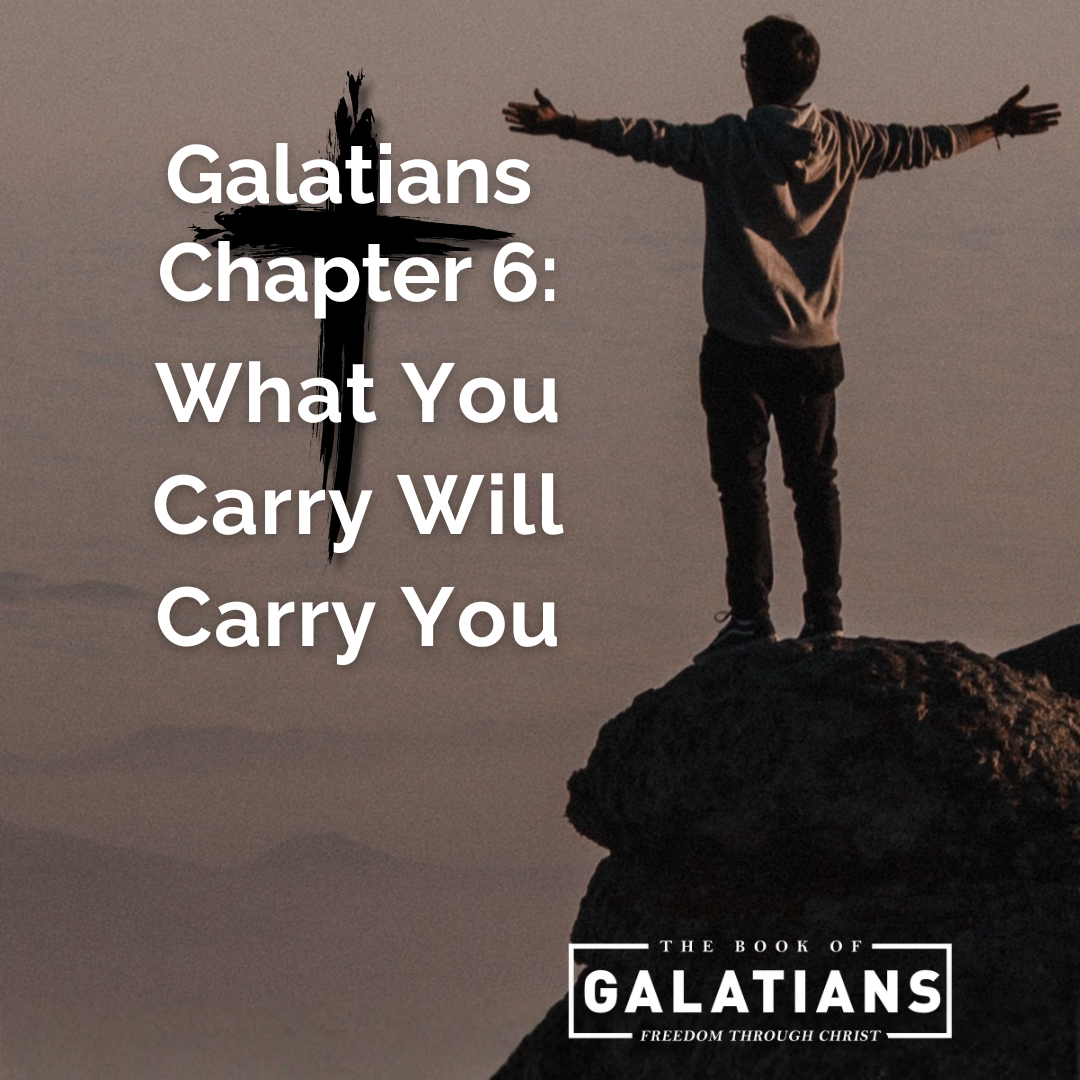
What You Carry Will Carry You
You know how practically every superhero movie has that one moment — known as the pivot — where the hero has to choose between saving themselves or laying down their life for someone in distress? And the moment they choose sacrifice over self-preservation, the whole story shifts. Everything meaningful in the film, and in the character’s development, hinges right there.
Our culture celebrates that scene without realizing it’s pointing to something far more ancient and far more real — a life shaped by self-giving, cross-shaped love. A life that moves against the grain of “protect yourself, promote yourself, prove yourself.”
That’s the life Apostle Paul is calling us into in Galatians chapter 6.
And maybe that’s why the story hits us so hard—because our world trains us to live in the exact opposite direction. Everything around us runs on self-promotion and performance: prove yourself, produce more, keep up, don’t fall behind, rest when you’re dead.
Even in the church, grace can slowly turn into spiritual score-keeping before we realize it. We hustle because we’re afraid to slow down, compare because we forget who we are, and perform because we think belonging or finding approval has to be earned.
That’s the very drift Paul confronts in Galatians—a people who started with grace but slipped back into striving. So when he gets to his last page in chapter 6, he brings it all to a point: true freedom doesn’t look like self-expression; it looks like self-giving. A life shaped and patterned after the cross– living how Jesus lived. A life that carries, sows, and loves in the way of Jesus. Cruciformity.
That’s where we’re headed today, but before we go any further, pray with me.
Recap: The Journey So Far (Galatians 1–5)
Before we dive into chapter 6, let’s remember where we’ve been.
In chapter 1, Paul lights a flare in the dark:
“The gospel is Jesus plus nothing.”
No add-ons. No fine print. No spiritual subscription plan. Just Jesus — crucified and risen — the only One who can save us.
In chapter 2, he gets personal:
Galatians 2:20 is the verse in which Paul’s whole letter is hinged: “I have been crucified with Christ, and I no longer live, but Christ lives in me.”
That’s not a slogan — it’s Paul’s identity and what he says our identity ought to be as Christ followers.
He’s saying the gospel isn’t about trying harder; it’s about surrendering deeper. The Christian life is not self-powered — it’s cross-powered.
Then in chapter 3, Paul turns into a theological surgeon. He cuts right through the confusion asking:
“Did you receive the [Holy] Spirit by works of the law, or by believing what you heard?”
The answer is faith — always has been. Remember, Abraham was justified by faith long before the Law ever existed.
In chapter 4, he talks about adoption.
We’re no longer slaves to performance, fear, or sin.
We’re sons and daughters who cry out, “Abba, Father.” We belong in God’s family because of our relationship with Christ, not rule-keeping.
In chapter 5, Paul contrasts life in the flesh and life in the Spirit. He says, “You were called to be free, brothers and sisters; only don’t use this freedom as an opportunity for the flesh, but serve one another through love (Gal 5:13).”
Freedom isn’t a license to sin — it’s the power to love others in a Spirit led way. And that’s where the Fruit of the Spirit comes in as we mature in Christ. We sprout these Christlike Holy Spirit grown characteristics: love, joy, peace, patience, kindness, goodness, faithfulness, gentleness, and self-control (Gal 5:22-23).
All of it leads to this culminating pivotal moment in Galatians 6, where Paul takes rich, head-level theology and turns it into a way of life we can actually live.
His entire letter to the Galatian church, and our BIG takeaway is this:
What you carry will carry you.
This is the whole letter distilled:
If you carry the flesh, it drags you back into slavery.
If you carry the Spirit, you walk in freedom.
If you carry the cross, the cross shapes you and carries you into God’s new creation.
It’s Galatians 2:20, 5:16, and 6:14–16 all braided together.
Galatians 2:20 “I have been crucified with Christ, and I no longer live, but Christ lives in me. The life I now live in the body, I live by faith in the Son of God, who loved me and gave himself for me.”
Galatians 5:16 “I say, then, walk by the Spirit and you will certainly not carry out the desire of the flesh.”
Galatians 6:14-16 “But as for me, I will never boast about anything except the cross of our Lord Jesus Christ. The world has been crucified to me through the cross, and I to the world. For both circumcision and uncircumcision mean nothing; what matters instead is a new creation. May peace come to all those who follow this standard, and mercy even to the Israel of God!”
What you carry will carry you.
Pay attention to that theme as we read Paul’s final chapter in Galatians.
Galatians 6 CSB
“Brothers and sisters, if someone is overtaken in any wrongdoing, you who are spiritual, restore such a person with a gentle spirit, watching out for yourselves so that you also won’t be tempted. Carry one another’s burdens; in this way you will fulfill the law of Christ. For if anyone considers himself to be something when he is nothing, he deceives himself. Let each person examine his own work, and then he can take pride in himself alone, and not compare himself with someone else. For each person will have to carry his own load.
Let the one who is taught the word share all his good things with the teacher. Don’t be deceived: God is not mocked. For whatever a person sows he will also reap, because the one who sows to his flesh will reap destruction from the flesh, but the one who sows to the Spirit will reap eternal life from the Spirit. Let us not get tired of doing good, for we will reap at the proper time if we don’t give up. Therefore, as we have opportunity, let us work for the good of all, especially for those who belong to the household of faith.
Look at what large letters I use as I write to you in my own handwriting. Those who want to make a good impression in the flesh are the ones who would compel you to be circumcised—but only to avoid being persecuted for the cross of Christ. For even the circumcised don’t keep the law themselves, and yet they want you to be circumcised in order to boast about your flesh. But as for me, I will never boast about anything except the cross of our Lord Jesus Christ. The world has been crucified to me through the cross, and I to the world. For both circumcision and uncircumcision mean nothing; what matters instead is a new creation. May peace come to all those who follow this standard, and mercy even to the Israel of God!
From now on, let no one cause me trouble, because I bear on my body the marks of Jesus. Brothers and sisters, the grace of our Lord Jesus Christ be with your spirit. Amen.”
Point 1: Freedom That Serves Is Freedom That Carries.
Paul opens this final chapter with a picture of what freedom looks like when it’s lived out.
He says, “Carry one another’s burdens; in this way you will fulfill the law of Christ.”
Think about that — the “law of Christ.”
He just spent five chapters telling us the Law can’t save us.
Now he says, “There’s one law you do keep — the law of Christ. This is the law of sacrificial love expressed by serving.
Paul said something here even I struggle with every day unless I’m intentionally thinking and praying about God’s Spirit leading me to do this.
Galatians 6:2 CSB “Carry one another’s burdens; in this way you will fulfill the law of Christ.”
Paul doesn’t say “notice” burdens or “like” posts about burdens or give a “thumbs up” to someone’s prayer request that we know we could do something about. He says carry them. That’s intentional! We have to be intentional about putting something on us to carry something for someone.
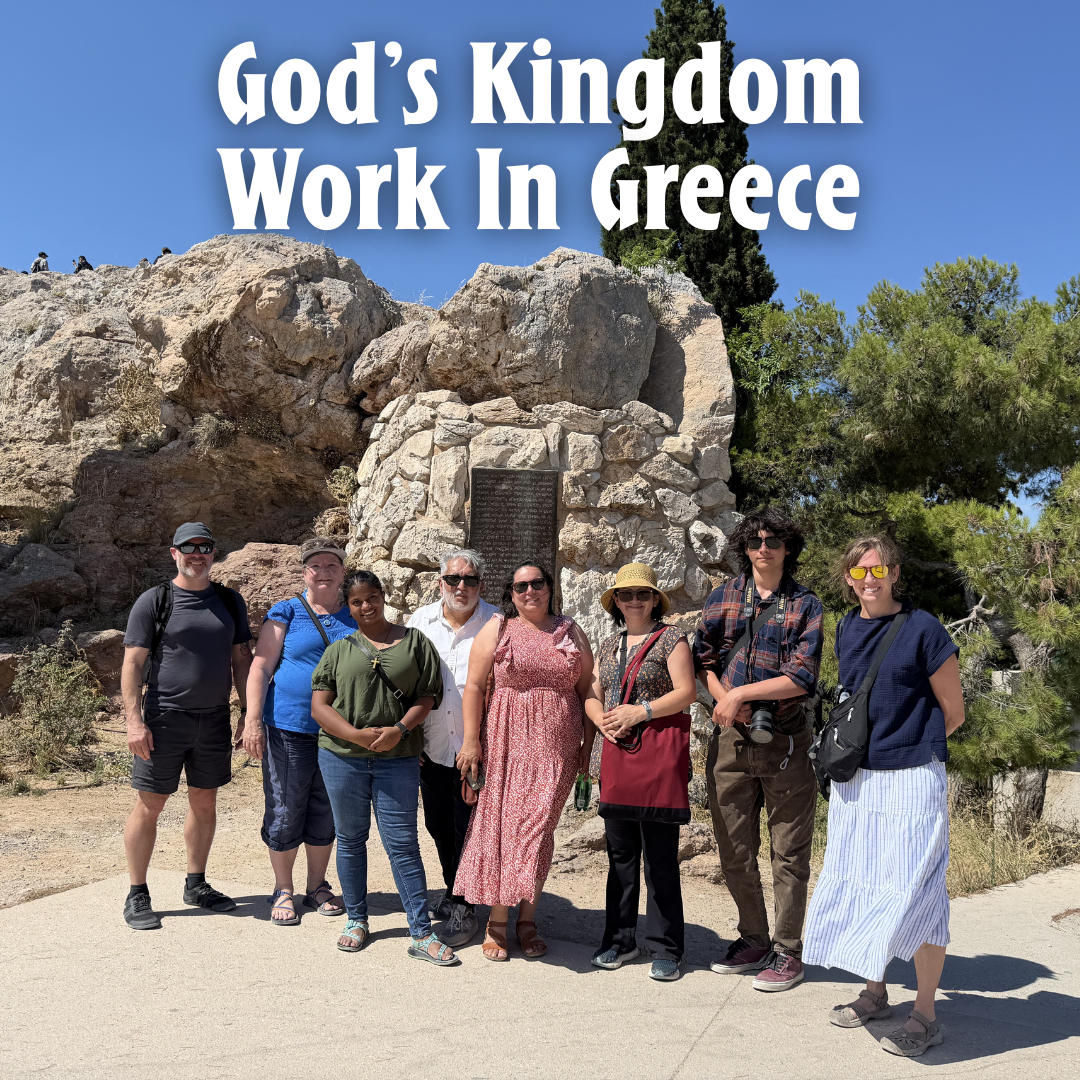
When I was in Greece, one of our older team mates had an artificial hip and struggled going up and down stairs. He had a rather large suitcase. The Airbnb we were staying in was 5 floors with lots of stairs in a winding staircase. So I carried his bag down to his room when we arrived and out into the van when we departed. I not only noticed his burden, but had to be intentional to carry it.
Okay I am in no way tooting my horn here by telling you this. Not bragging because I totally dropped the ball when I was at the airport. There was an older lady, a stranger to me, who appeared to be struggling with her small carry-on as we walked up the stairs to our plane. This was at the Frankfurt airport. At the gate, we had to walk down several flights of stairs, outside to a bus that I think drove us all the way to the Berlin airport on the other side of the country, and then we walked up a steep staircase from the tarmac to enter the plane. I was so consumed in my own head to get to my seat, my mind or heart weren’t intentional to assist others. Another guy jumped in and carried that lady’s bag. He carried her burden. I failed in Frankfurt, but I also learned a valuable lesson from the Holy Spirit about growing the fruit of kindness in me for others—even perfect strangers in Germany.
Galatians 6:2 CSB “Carry one another’s burdens; in this way you will fulfill the law of Christ.”
Most of the time, carrying one another’s burdens doesn't look like luggage at airports. It looks much different.
The Law of Christ—the Way of Jesus— Paul’s talking about Christlike sacrificial love with a backbone. This is the rugged kind of love that kneels in the dirt with the hurting and says, “You’re not alone.”
Two words matter here: burden and load. A load is what you are meant to carry—your backpack. A burden is what crushes a person—too heavy for one set of shoulders. Their backpack and yours.
Galatians 6:5 CSB “For each person will have to carry his own load.”
Both are discipleship. You carry your load with responsibility; we carry your burden with compassion.
Will you be humble enough to allow others to carry your load if you need it? Sometimes people are filled with too much pride to allow someone to do that for them— to enter their life and see their vulnerability and weakness. They don’t want to admit that. And yet, this is what we as disciples of Jesus are called to do. On his way to be crucified, even Jesus allowed someone else to carry his cross for him much of the way.
When we carry someone’s burden, we are walking in the same footprints Jesus left behind. And this is the test of real spiritual maturity: not how much you know, but how much you show love by doing it.
That’s freedom that carries.
Because grace isn’t passive.
It’s active.
It moves.
Freedom doesn’t isolate; it integrates.
Its goal is to weave people back into the fabric of God’s family.
Church, imagine if that’s what we were known for in Sherwood — not how slick our programs are or what clever saying our sign says down by the street, but how deeply we carry people. That’s what Paul’s talking about.
Freedom that serves is freedom that carries.
Point 2: Faith That’s Sown Works Better.
Paul moves from serving to sowing — from what we do for others to what we cultivate in ourselves.
He writes, “Don’t be deceived: God is not mocked. For whatever a person sows he will also reap, because the one who sows to his flesh will reap destruction from the flesh, but the one who sows to the Spirit will reap eternal life from the Spirit.”
That’s Galatians 6:7–8 — and it’s one of the most sobering, hope-filled truths in the entire Bible.
That goes back to what Paul talked about in Galatians chapter 5. She brought up the shadow side of humanity, mentioning the fruits of the flesh versus the Fruit of the Spirit.
It's so easy to get swept away by the shadow side of humanity and the evidence is there.
Fruits of the Flesh
Paul wrote, “the works of the flesh are obvious: sexual immorality, moral impurity, promiscuity, idolatry, sorcery, hatreds, strife, jealousy, outbursts of anger, selfish ambitions, dissensions, factions, envy, drunkenness, carousing, and anything similar. …those who practice such things will not inherit the kingdom of God.” (Gal 5:19-21)
And that’s where the Fruit of the Spirit comes in to bring light and life: love, joy, peace, patience, kindness, goodness, faithfulness, gentleness, and self-control (Gal 5:22-23).
Paul’s saying: You can’t fake your formation.
You reap what you sow. Always.
If you sow to things of the flesh, you'll get those things, but if you sow to the things of God’s Spirit, you'll get those things. It also works if you don't sow anything, you don't reap anything. Paul’s saying choose where and what you sow.
You sow hours into your phone — you reap distraction, depression, and anxiety.
You sow bitterness — you reap isolation, blame, and broken relationships.
You sow secrecy in sexual sin — you reap shame, disconnection, and a heart that can’t see people as God’s imagers anymore.
You sow gossip — you reap shallow friendships built on suspicion instead of trust.
You sow comparison — you reap insecurity and a life that never feels like enough.
You sow control and self-reliance — you reap exhaustion, distanced relationships with others, and a soul that never rests.
You sow prayer — you reap peace and intimacy with God.
You sow generosity — you reap joy and change someone’s life.
You sow to the Spirit — you reap life with God and are a light among God’s people.
Sowing and reaping…
It’s not a punishment or reward system, but simply how reality works in the Kingdom of God.
Jesus teaches the same principle, but in different language. Here are the closest teachings from Jesus about this:
Luke 6:38 “For with the measure you use, it will be measured back to you.”
Matthew 7:17–18 Good trees bear good fruit, bad trees bear bad fruit.
Matthew 13 In the Parable of the Sower he said, the condition of the soil (the heart) determines the harvest.
Faith isn’t just something you believe in your head. It’s something you plant with your life.
It’s the daily, ordinary actions (what you sow) that prove what you actually believe and who you truly trust.
If we believe that Jesus is Lord, then that faith should look like obedience to how he said we ought to live — not to earn His love, but obedience because we already have His love.
Every day, you and I are investing in one of two worlds — the one that’s fading or the one that’s eternal. And we must choose wisely.
That’s what makes this next verse so powerful.
He says, “Let us not get tired of doing good, for we will reap at the proper time if we don’t give up.” Galatians 6:9
Don’t grow weary in doing good.
That’s Paul’s way of saying, “Faith that works keeps working — even when it’s hard, even when it’s thankless, even when it feels unseen, even when we’re tired or physically unwell.”
You might be tired right now. You’ve been praying for someone for years and haven’t seen change. You’ve been serving faithfully but feel like no one notices. You’ve been doing good — and you’re weary.
Paul says: Keep sowing. The harvest is coming if we don’t give up.
Because faith is never wasted. Every seed counts.
Anthony Murray, a pastor on the Youversion Bible app devotional we recently did together with our Saturday morning Men’s Ascent group… he said this, “If I have it, that’s my harvest. If I release it, that’s my seed.”
Faith That’s Sown Works Better.
And notice how Paul ends that section. He said, “Therefore, as we have opportunity, let us work for the good of all, especially for those who belong to the household of faith.” Galatians 6:10
He’s reminding us: Faith that works is communal.
It’s not just about me and Jesus — it’s us and Jesus. You and me walking together with Jesus leading us.
Our faith finds its expression in how we love our true family — the people sitting beside us right now. Faith that works is communal.
So let’s ask ourselves: What kind of seeds are we sowing?
Are we sowing anxiety or peace? Cynicism or hope? Gossip and division or unity? Flesh or Spirit?
Because the harvest always tells the truth.
You can’t fake the fruit.
That’s what Paul’s showing us — faith that works best is faith that keeps sowing good even when it’s slow. Don’t give up!
Freedom That Serves Is Freedom That Carries.
Faith That’s Sown Works Better.
Point 3: Love That Lasts Is Cruciformity
Finally Paul brings it all home with the line that defines his life.
He writes, “But as for me, I will never boast about anything except the cross of our Lord Jesus Christ. The world has been crucified to me through the cross, and I to the world.” Galatians 6:14
See how that verse hinges directly on what he said in Galatians chapter 2 verse 20?
If you were to summarize the entire letter of Galatians in one verse — one of those would be it.
All our boasting, all our proving, all our performance dies at the foot of the cross. Because when we really see what Jesus did there — there’s no room left for ego or anything else.
Paul had every reason to boast — his résumé was flawless. He had the pedigree, the education, the discipline, the spiritual credentials. But when he met Jesus, all of it burned away instantly like a flash grenade bursting in the night.
He says, “The cross is my only boast.”
Why?
Because everything else fades — achievement, reputation, applause — but love endures.
He said in 1 Corinthians 13:13 “Now these three remain: faith, hope, and love—but the greatest of these is love.”
And the love that endures isn’t sentimental. It’s cruciform. It’s shaped like a cross.
Marianne Meye Thompson puts it plainly: “the cross determines the church’s mission because we are Christ’s body—and his body was given in death.”
The night before his death, in Gethsemane Jesus prayed, “Not my will, but yours Father.”
Paul wrote in Philippians 2:5–8 CSB “Adopt the same attitude as that of Christ Jesus… he humbled himself by becoming obedient to the point of death—even to death on a cross.”
The cross is the great reversal — where shame becomes glory, weakness becomes power, and death becomes life. It’s the place where God’s love proves stronger than our sin and our shame.
And Paul’s saying, “That’s what defines me now.”
I’m crucified to the world — I’m dead to my old ways of striving, comparing, and performing. I’m dead to all those fruits of the flesh. And the world is crucified to me — I’m not looking for its approval anymore.
That’s the kind of love the church is called to embody — a cruciform love.
That’s love that lasts.
Love that carries burdens instead of keeping score.
Love that forgives when it’s inconvenient.
Love that looks foolish in a world obsessed with winning, honor, and pride.
Love that endures even when it's rejected.
Now, of course, I'm not talking about being a stalker. That's bad and not a good way to love, but I think you get what I'm saying here.
Jesus took the curse of our sin, the shame of our failure, and turned it into the promise of what Paul said is the only thing that matters — God’s new creation (Gal 6:15).
The cross didn’t just change Paul’s theology — it changed the world. It inaugurated a brand-new reality where love reigns because Jesus is King and he showed us how to love so it lasts. Amen?!
Freedom That Serves Is Freedom That Carries.
Faith That’s Sown Works Better.
Love That Lasts Is Cruciformity
Conclusion: The Family of Cruciformity
So if we were to sum up Galatians — all six chapters — into one idea, it wouldn’t just be freedom or grace or belonging. It’s cruciformity.
Being people of cruciformity encapsulates all three of those.
Belonging to one family — God’s family — where the grace of the cross becomes our common story, our shared identity, and our way of life that we carry together.
Because Galatians isn’t Paul shouting about personal liberty; it’s Paul pleading for the church’s cruciform unity. He’s saying: the cross has made us one. Jew and Gentile. Male and female. Slave and free. All of us — one family, one faith, one Father.
That’s why he keeps coming back to the cross — and being crucified with Christ on it.
The cross isn’t just the isolated event that saves us. It’s the shape that forms us.
That’s cruciformity.
Cruciformity is the pattern of our lives.
Cruciformity is the rhythm of our relationships.
Cruciformity is the mark of true maturity.
Cruciformity is the goal of every apprentice, disciple, follower of Jesus, Christian— whatever you want to label it.
Cruciformity is what our focus ought to be every day.
We are called to be a family of cruciformity — people who live together in the posture and way of Jesus. Humble. Dependent. Self-giving. Loving. Carrying. Crucifying.
People who serve, forgive, and carry one another’s burdens because that’s what family does.
The gospel doesn’t produce isolated saints; it produces a crucified community.
That’s the church!
A family where grace levels up the proud and lifts the broken.
Where true freedom looks like serving.
Where active faith looks like sowing.
And where cruciformed love looks like laying down your life (your preferences, desires, expectations, opinions, feelings) for others— just like Jesus did.
Do you make your life about you… Or about loving and living like Jesus?
So as Paul closes his letter, he gives us an invitation:
To live as one family of faith.
To bear the marks of Jesus in our own lives — not the scars of performance, but the signs of surrender.
To let the cross do its full work in us, until we look more like Jesus together than we ever could apart.
How can you live a cruciformed life more today?
Here Are Three Specific Action Steps For Us This Week:
1. Step into someone’s story and lift something real.
Before the day ends, reach out to one person God brings to mind — someone carrying emotional, spiritual, or practical weight — and ask them this question: “What can I carry with you this week?”
Then actually do it.
A meal. A ride. A listening ear. A financial need. A prayer over the phone. This is cruciform love in real time.
2. Replace one flesh-pattern with one Spirit-practice — at the exact moment of temptation.
Identify the one pattern that drags you toward the flesh this week — scrolling, comparison, gossip, pornography, anger, overeating, control — and pre-decide your replacement.
For example:
When you want to scroll → open to Psalm 23 and read it slowly.
When comparison or resentment hits → bless and pray for that person out loud by name.
When gossip starts → speak just one sentence of encouragement instead of anything else that might come to mind.
When sexual temptation rises → step outside for a three-minute prayer walk or prayer walk around your living room or office for three minutes. Also call a trusted friend to pray with you if at all possible.
This is sowing to the Spirit at the moment it matters.
3. Practice one cruciform decision that costs you something — on purpose.
Choose one moment this week to take the lower place deliberately and practice obscurity:
Apologize first.
Serve someone who can’t repay you.
Let someone else have the win.
Give anonymously.
Make the choice to forgive someone who doesn’t deserve it even if you don’t feel like it yet.
Do one act of self-giving love that mirrors the cross and reshapes your heart toward Jesus. That’s cruciformity!
Freedom That Serves Is Freedom That Carries.
Faith That’s Sown Works Better.
Love That Lasts Is Cruciformity.
That’s what it means to belong to the family of God.
That’s what it means to live cruciform.
—
If you resonate with any of this and like it, please share this with someone who you think will benefit from reading it too.
If you found value in this, here are some additional articles for you.